
Looking for the best dog food brands in Europe? This guide compares eight options: Farmina N&D, Royal Canin, ORIJEN, Bozita, ACANA, Hill’s Science Plan, Prins, and Yarrah, with a quick comparison table, brand-specific strengths, and important limitations.
Start with the comparison below to build your shortlist. If you are still deciding between feeding formats, our wet vs dry dog food guide explains the practical differences before you choose a formula.
Quick Answer: What Are the Best Dog Food Brands in Europe?
There is no single best dog food brand for every dog. Start with a complete formula suitable for your dog’s life stage, then compare feeding format, calorie information, availability, and daily cost.
Use the table below to shortlist the eight brands in this guide. The final choice should reflect your dog’s size, activity, body condition, food tolerance, and health history. If a veterinary diet is needed, choose it with your veterinarian.
Brand | Distinctive Features to Compare | Formats Covered | Main Point to Check |
|---|---|---|---|
Several recipe families, including Prime, Pumpkin and Ancestral Grain, offering grain-free and grain-containing choices | Dry and wet ranges | Compare the exact recipe and calorie information; different N&D ranges are not nutritionally interchangeable | |
Ranges organised by life stage, adult size and selected breeds, alongside separate veterinary diets | Dry and wet | Distinguish routine retail food from veterinary diets; a breed label alone does not establish suitability | |
A dry-food portfolio with recipes such as Original, Six Fish and Regional Red, plus puppy and senior options | Dry food in the linked EMEA catalogue | Check calorie density and life-stage suitability rather than choosing from meat content or recipe name alone | |
Swedish-made dog food with dry and wet ranges across different ages, sizes and activity levels | Dry and wet | Check the selected recipe’s intended use and feeding amount when comparing formats or planning mixed feeding | |
Grain-free, grain-inclusive and limited-ingredient options within a dry-food portfolio | Dry food in the linked EMEA catalogue | Check the exact range; grain-free or limited-ingredient positioning does not establish suitability for a suspected food allergy | |
Everyday foods organised by life stage and dog size; Prescription Diet is a separate portfolio | Dry and wet | Confirm whether the product is Science Plan or Prescription Diet; veterinary products require appropriate professional guidance | |
Both pressed and extruded kibble ranges, including ProCare and Protection Croque, alongside separate veterinary diets | Pressed and extruded dry food; other formats vary by range | Compare the formulation and intended use; processing method alone does not establish nutritional superiority | |
Organic-focused dog-food ranges, including different recipe types and feeding formats | Dry and wet | Check the exact product’s complete-food status and life stage; organic certification alone does not establish nutritional suitability |
The linked manufacturer pages cover selected European or UK markets. Recipes, formats and availability may differ in your country. Use this shortlist to identify ranges to investigate, then check the label of the exact product you intend to buy.

How We Evaluated the Dog Food Brands
This is an editorial comparison of eight brands available in parts of Europe. We reviewed official manufacturer information and selected product pages, using FEDIAF and WSAVA guidance to frame the food-selection criteria.
We compared:
Product choices: life stages, dog-size categories, recipe types and feeding formats.
Available information: composition, analytical constituents, feeding instructions and calorie information where provided.
Practical differences: features that help owners narrow their choices, alongside product-specific restrictions and country-dependent availability.
The order is not a performance ranking. We did not conduct laboratory tests, feeding trials or clinical assessments, and we did not calculate comparable daily prices for all eight brands.
Manufacturer information was used to check product details, not as independent proof of nutritional superiority. Examples refer to selected products; they do not describe every recipe sold under a brand name.
Use this comparison to build a shortlist, then check the current label of the exact product available in your country. Sources and editorial disclosures appear at the end of the article.
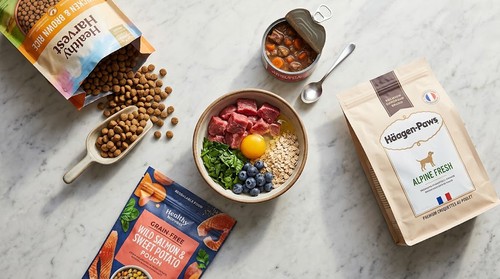
Top Dog Food Brands in Europe (2026)
The brands below are not ranked as a universal “best for every dog” list.
Instead, they illustrate different product-range structures, including life-stage and breed-size ranges, dry and wet formats, protein-rich formulas, organic products and separate dietetic ranges.
1. Farmina N&D — Broad Formula Range and Product-Level Information
Farmina N&D is worth comparing if you want to explore several recipe families within one brand. Its portfolio includes Prime, Pumpkin, Ocean and Ancestral Grain, with dry and wet options across parts of the range.
What sets the ranges apart? Ancestral Grain includes cereals such as spelt and oats, while other N&D ranges offer grain-free choices. These are different formulations: choosing between them requires comparing the actual products, rather than treating the N&D name as one recipe.
How to narrow your choice:
Start with products intended for the same life stage and relevant dog-size category.
Compare the full ingredient lists, analytical constituents and calorie information of your shortlisted recipes.
Use the recommended daily amount and local pack price to compare feeding costs. A cheaper bag does not necessarily mean a cheaper daily portion.
Main limitation: The number of N&D ranges can make similar-looking products difficult to compare. Check the full range name, recipe, size category and feeding format before buying or reordering.
Farmina also offers a separate Vet Life portfolio. If you are considering a diet for a diagnosed condition, discuss the specific product with your veterinarian.
Explore the official Farmina dog-food ranges.
2. Royal Canin — Broad Size, Life-Stage and Veterinary Ranges
Royal Canin offers a structured starting point for owners who want to narrow their choices by their dog’s age, size or breed. Its portfolio includes puppy, adult and mature-dog foods, selected breed-specific formulas and a separate veterinary range.
What makes comparison easier? The categories help you identify a smaller group of products before comparing individual recipes. For a growing puppy, for example, check the expected adult-size category as well as the puppy label.
How to narrow your choice:
Choose the relevant life-stage and size category before exploring breed-specific options.
Check whether the product belongs to the retail or veterinary range. Discuss veterinary diets with your veterinarian before choosing one for a health concern.
If combining wet and dry food, use the feeding guidance for the exact products rather than adding a full daily portion of each.
Main limitation: A breed-specific label cannot account for every dog’s activity, body condition or medical history. Use it to shortlist products, then check the individual formula and feeding guidance.
Explore the official Royal Canin dog-food ranges.
3. ORIJEN — Protein-Rich Complete Dry Food Range
ORIJEN is an option for owners comparing protein-rich dry dog foods. Its regional catalogue includes Original, Six Fish and Regional Red, alongside Puppy, Puppy Large Breed, Senior and Small Breed options.
What separates the recipes? Original combines poultry, fish and eggs, while Six Fish uses several fish species. These differences help you compare ingredient choices, but the recipe name alone does not tell you everything in the bag.
How to narrow your choice:
Read the full ingredient list, especially if you need to avoid a particular ingredient. Do not assume a recipe contains only one animal protein.
Check the detailed life-stage guidance, including any growth restrictions. For example, the regional Original formula excludes Great Dane puppies younger than 14 weeks from its all-life-stages suitability statement.
Compare calories per kilogram and measure portions in grams. When switching foods, use the new product’s feeding guide rather than carrying over the previous portion size.
Main limitation: High protein content and a long list of animal ingredients do not, on their own, establish that a food is the best choice for your dog. Check the complete formulation, feeding amount and suitability for your dog’s needs.
The linked regional catalogue covers complete dry foods; check local availability before choosing a recipe.
Explore the official ORIJEN dog-food range.
4. Bozita — Swedish Dry and Wet Dog Food Range
Bozita makes dog food in Sweden and offers both dry and wet recipes. Its catalogue includes puppy, adult and senior options, with further choices by dog size and activity level. Wet formats include pâté and chunks in jelly.
What makes it useful to compare? The range lets you explore different textures and feeding routines within one brand. For example, Original Adult Classic is a complete dry food for adult dogs with normal activity levels, while Reindeer Chunks in Jelly is labelled as a complete wet food that can also be used alongside dry food.
How to narrow your choice:
Match the exact product to your dog’s life stage and activity level; the adult example above is not a puppy-feeding recommendation.
For wet food, choose a pack size you can finish within its stated storage period after opening. Follow the refrigeration instructions on the pack.
Check the full recipe rather than relying on the named flavour. Reindeer Chunks in Jelly also lists chicken and beef.
Main limitation: Products within the range differ in ingredients, intended use and feeding amounts. If combining dry and wet food, plan portions using their energy information; equal weights are not interchangeable.
Explore the official Bozita dog-food range.
5. ACANA — Grain-Free, Grain-Inclusive and Limited-Ingredient Options
ACANA offers dry dog foods across several recipe types, including grain-free, grain-inclusive and limited-ingredient options. Its regional catalogue also includes puppy, adult, senior and selected breed-size formulas.
What separates the options? The range lets you compare both ingredient choices and life-stage formulas. Singles Beef With Pumpkin, for example, is marketed as a limited-ingredient recipe with beef as its animal protein source. Other recipes combine several animal protein sources.
How to narrow your choice:
Choose the relevant life stage and size category before comparing flavours or grain content.
Read the detailed suitability statement, not just the headline. Singles Beef With Pumpkin excludes growth of dogs expected to weigh 15 kg or more as adults, despite its “All Life Stages” heading.
Compare the full composition and calorie information of the exact recipes. Do not assume that all ACANA products use the same ingredients or feeding amounts.
Main limitation: “Limited ingredient” describes the recipe; it does not guarantee suitability for a dog with a suspected food allergy. Discuss that choice with your veterinarian rather than selecting a food from its marketing label alone.
The linked regional catalogue covers dry foods. Check the current label and availability in your country before buying.
Explore the official ACANA dog-food range.
6. Hill’s Science Plan — Everyday Foods by Life Stage and Dog Size
Hill’s Science Plan offers everyday dog foods organised by life stage and size, with dry and wet options across parts of the range. It provides a practical starting point for comparing puppy, adult and older-dog formulas.
What is the key distinction? Science Plan and Prescription Diet are separate product ranges. When browsing Hill’s foods, check the full range name before comparing products; a Science Plan recipe should not be treated as a substitute for a recommended Prescription Diet.
How to narrow your choice:
Match the product’s stated age range and size category to your dog. For puppies, check the expected adult size.
Read the intended use of the exact formula, particularly when comparing everyday feeding with weight-management or sensitivity-focused options.
If choosing both wet and dry food, check the mixed-feeding instructions for those products rather than giving a full daily serving of each.
Main limitation: Similar names and health-related descriptions can make products from different Hill’s ranges easy to confuse. If your dog has a diagnosed condition or already eats a veterinary diet, ask your veterinarian before switching.
Explore the official Hill’s dog-food catalogue and select the Science Plan filter to view this range.
7. Prins — Pressed and Extruded Dry Food Options
Prins is a Dutch pet-food company offering both pressed and extruded dry dog foods, alongside separate veterinary diets. Its ProCare ranges include pressed kibble, while Protection Croque offers extruded kibble.
What makes the range different? You can compare two kibble types within one brand. Pressing and extrusion are different manufacturing methods, but the method alone does not tell you whether a recipe meets your dog’s needs.
How to narrow your choice:
Check the full product name and intended life stage. ProCare Protection Puppy, for example, is a complete pressed food for young medium and larger-breed dogs; Protection Croque Lamb is an extruded food for adult medium and large breeds.
Compare the composition, calorie information and feeding guide of the exact products. Do not assume two foods are interchangeable because both carry the Prins name.
When switching between kibble types, weigh the recommended portion in grams rather than using the same scoop volume.
Main limitation: “Pressed” describes how the food is made, not proof that it is nutritionally better for every dog. Choose according to the complete formulation and your dog’s needs. If considering a veterinary diet, discuss the specific product with your veterinarian.
Explore the dog-food sections on the official Prins Petfoods website.
8. Yarrah — Organic Dry and Wet Dog Food Options
Yarrah offers organic dog foods in dry and wet formats, alongside vegetarian and vegan dog-food options. It is worth comparing if organic certification is one of your purchasing priorities.
What makes the range different? Its organic focus gives owners a clear sourcing criterion to investigate. However, organic, grain-free and vegan describe different features: an organic recipe is not necessarily grain-free or free from animal ingredients.
How to narrow your choice:
Check that the exact product is a complete food for your dog’s life stage. Keep snacks separate from foods intended as the main daily diet.
Read the full composition to distinguish meat-containing, vegetarian and vegan recipes. Check the specific product’s certification rather than assuming every label applies across the range.
Compare the recommended daily quantity and local price. For wet food, also consider pack size and storage instructions after opening.
Main limitation: Organic certification does not by itself establish that a recipe is nutritionally better or suitable for your individual dog. Life stage, complete-food status, calorie needs and any medical dietary requirements still matter.
Read about Yarrah’s certifications to understand the labels used across its products.
How to Choose from the Shortlist by Life Stage and Size
Use your dog’s life stage and size to narrow the eight brands to suitable products. Then compare feeding format, ingredients, calories and daily cost within that shortlist.
Your Dog | What to Check First | Practical Next Step |
|---|---|---|
Growing puppy | Complete food suitable for growth and the puppy’s expected adult size | Read the detailed suitability statement, including any large-breed growth restrictions |
Small adult dog | Complete adult food, manageable portion size and a texture the dog can eat comfortably | Compare feeding amounts and kibble size; wet food is another format to consider |
Medium or large adult dog | Complete adult food, calorie information and guidance appropriate to body weight and activity | Choose a measured starting portion and adjust according to weight and body condition |
Older dog | Body condition, appetite, eating comfort and medical history | Reassess the current diet rather than automatically choosing fewer calories because of age |
Dog with a diagnosed condition | The dietary requirements identified by the veterinary team | Ask which exact products are appropriate before changing food |
For a growing dog, see our guide to the best puppy food in Europe. For smaller adult dogs, our small-breed dog-food guide explains portioning and eating comfort in more detail.
Choose the feeding format next. For dry, wet or mixed feeding, check that the overall diet is complete for the intended life stage. If combining foods, use their calorie information and feeding guidance to plan portions.
Once you have selected a food, use our guides on how much to feed your dog and how often to feed your dog to plan the daily amount and meal schedule.
What EU Labels and FEDIAF Guidelines Tell You
When comparing dog foods sold in the European Union, distinguish legal labelling requirements from nutritional guidance.
EU labelling rules govern how pet food is described and marketed. They cover information such as the food type, intended animal, composition and instructions for use. The European Commission explains this framework in its feed-marketing guidance.
FEDIAF nutritional guidelines provide a scientific reference for manufacturers formulating and assessing foods for healthy dogs and cats. They include nutrient recommendations for growth, adult maintenance and reproduction. They are industry guidance, not a government approval or a ranking of brands.
For your shortlist, check whether the exact product is labelled as complete food for the intended life stage. A reference to FEDIAF does not, by itself, show that a product is the best choice for your dog or suitable for a medical condition.
You can consult the official FEDIAF nutritional guidelines for the underlying recommendations. For products sold outside the EU, check the applicable local labelling requirements.
A Practical Checklist for Comparing Dog Foods
Once you have shortlisted suitable products, compare them using the same checks:
Complete-food status and life stage. Confirm that the product is intended as a complete daily food for your dog’s life stage. Check any growth or breed-size restrictions in the detailed description.
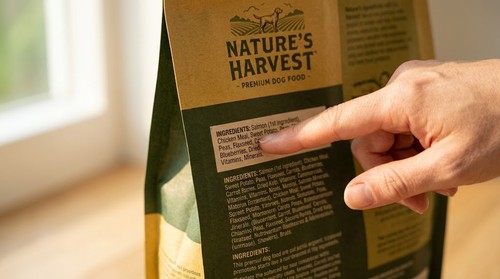
Ingredients and nutritional information. Read the full composition and analytical constituents. Use the ingredient list to identify what the food contains, not to rank quality from the first ingredient alone. When comparing nutrient percentages in wet and dry foods, account for their different moisture contents.
Calories and feeding amounts. Look for energy information and a feeding guide. Use the suggested amount as a starting point, then adjust according to your dog’s weight and body condition.
Manufacturer expertise and quality control. Look for clear answers about who formulates the food, their nutritional qualifications, and how ingredients and finished products are checked. Contact the company if important information is missing.
Practical fit. Check local availability, pack size, storage instructions and daily feeding cost. Choose a format you can portion and store reliably.
These manufacturer checks follow the approach outlined in the WSAVA Guidelines on Selecting Pet Foods.
For help interpreting individual label sections, see our European pet-food label guide. If grain content is part of your comparison, our grain-free vs regular dog-food guide explains that distinction in more detail.
How to Calculate Daily Feeding Cost
Compare the cost of the daily portion, not just the price of the bag.
Daily cost = pack price ÷ pack weight in grams × grams fed per day
For example, a hypothetical 12 kg bag costing €60, fed at 200 g per day, would cost:
€60 ÷ 12,000 g × 200 g = €1 per day
These figures are an illustration, not a current brand price or a feeding recommendation. Use the appropriate daily amount for each product; different foods may require different portions.
For mixed feeding, calculate the cost of each food’s planned portion and add them together. A lower daily cost is useful only when the overall diet also meets your dog’s nutritional needs.
Go Beyond the Brand Name
Use the comparison to shortlist suitable foods, then choose the exact recipe you can feed consistently, portion accurately and store correctly. After switching, monitor your dog’s appetite, stool quality, weight and body condition to assess how the feeding plan is working.
For a more personalised starting point, create your dog’s FAMMO profile using details such as age, breed, weight and sterilisation status.
FAMMO provides general nutrition guidance and does not diagnose illness or replace veterinary care. If your dog has a medical condition, unexplained weight changes or persistent symptoms, discuss food choices with your veterinarian.

FAQ — Best Dog Food Brands in Europe
Is expensive dog food always better?
No. Price alone does not establish nutritional quality or suitability. Compare complete-food status, life-stage suitability, manufacturer information and your dog’s needs. Calculate the daily feeding cost rather than judging value only from the bag price.
How should I compare dog food brands?
Shortlist complete foods suitable for your dog’s life stage and size. Then compare the exact recipes, calorie information, feeding amounts, manufacturer expertise and local availability. A brand’s reputation, protein percentage or first ingredient should not be your only deciding factor.
Is grain-free dog food better for dogs?
Not automatically. Grain-free describes an ingredient choice, not a quality ranking, and it does not mean carbohydrate-free. Evaluate the complete formulation. If you suspect a food reaction, ask your veterinarian about an appropriate assessment rather than repeatedly switching recipes.
What is the difference between complete and complementary dog food?
Complete food is intended to supply the nutrients needed for the stated life stage when fed as directed. Complementary food must be used alongside other foods or for a specified purpose. Do not assume a treat, topper or complementary product can replace a complete daily diet.
How should I choose food for a dog with digestive problems?
Persistent or recurring digestive signs need veterinary assessment; a “sensitive” label does not identify the cause. Record the current food, treats and symptoms to help your veterinarian assess the problem. Seek prompt care for repeated vomiting, blood in vomit or stool, marked lethargy, abdominal pain or inability to keep water down.
How should I switch my dog to a new food?
Unless your veterinarian advises otherwise, introduce the new food gradually over about seven days, increasing its share while reducing the old food. Monitor appetite and stool quality. Contact your veterinarian if vomiting, diarrhoea or other concerning signs develop; dogs on medical diets should follow their veterinary team’s transition plan.
Sources and Editorial Notes
Brand ranges and selected product details were checked on 21 October 2026 using official manufacturer information. This was a review of published information, not an independent audit of manufacturing or product performance.
Recipes, suitability statements, packaging and availability can change. Check the current label of the exact product sold in your country.
Nutrition and Food-Selection References
FEDIAF Nutritional Guidelines, European nutrient recommendations and guidance on complete and complementary foods.
WSAVA Guidelines on Selecting Pet Foods, Questions about formulation expertise, manufacturer transparency and quality control.
European Commission: Feed Marketing, The EU framework for feed marketing and labelling.
Merck Veterinary Manual: Cutaneous Food Allergy in Animals, Veterinary assessment of suspected food allergy and the role of elimination diets and dietary challenge.
AAHA: Transitioning Your Pet to a New Food, Practical guidance on gradual food changes.
VCA Animal Hospitals: Vomiting in Dogs, Veterinary assessment and warning signs associated with vomiting.
Manufacturer Information and Editorial Disclosure
Official manufacturer links appear in the brand sections. These sources were used for product descriptions and stated suitability, not as independent evidence that one brand is nutritionally superior.
Two product-specific references support the growth restrictions discussed above:
This article is editorially independent and contains no paid brand placements or affiliate links.