
Choosing the best puppy food in Europe is not about finding the most expensive bag or the longest ingredient list. The right choice is a complete growth diet that fits your puppy’s expected adult size, calorie needs, digestion, and feeding routine.
In this guide, you’ll learn what to look for on the label, how feeding needs change by breed size, and which puppy food options are worth comparing for different needs. We’ll also look at practical product picks available in Europe, so you can narrow down your choices without relying only on marketing claims.
If you want to compare manufacturers more broadly, see our guide to the best dog food brands in Europe.
Puppies grow quickly, but faster growth is not always better. The goal is steady development, an appropriate body condition, and a complete diet without unnecessary supplements or excessive calories.
Quick Answer: What Is the Best Puppy Food in Europe?
The best puppy food in Europe is a complete food formulated for growth and matched to your puppy’s expected adult size, calorie needs, and individual tolerance.
There is no single product that is best for every puppy. A small-breed puppy, a large-breed puppy, and a puppy with sensitive digestion may need different formulas.
Start by looking for a food that:
- is labelled as complete food for puppies or growing dogs
- matches small, medium, large, or giant-breed growth where relevant
- provides clear feeding instructions and calorie information
- comes from a transparent manufacturer with qualified nutrition expertise
- fits your puppy’s digestion, appetite, body condition, and feeding routine
- is consistently available where you live
Wet, dry, and mixed feeding can all work when the food is complete for growth and the total daily amount is measured correctly.
For large and giant-breed puppies, choose a formula specifically designed for controlled growth rather than simply using a high-calorie puppy or adult food.
In the next section, we compare practical puppy food options available in Europe by breed size and feeding need, so you can narrow down which products are worth considering.
Table of Contents
- Best Puppy Food Options in Europe by Puppy Type
- Why Puppies Need Different Food From Adult Dogs
- How to Choose the Best Puppy Food in Europe
- Puppy Food by Breed Size
- Wet vs Dry Puppy Food: Which Is Better?
- How to Read a European Puppy Food Label
- Ingredients: What Matters and What Does Not
- Puppy Food Mistakes to Avoid
- How Much and How Often Should You Feed a Puppy?
- How to Change Puppy Food Safely
- How to Tell Whether a Food Fits Your Puppy
- When to Ask a Veterinarian
- Frequently Asked Questions About Puppy Food
Best Puppy Food Options in Europe by Puppy Type
There is no single puppy food brand that is best for every dog. In this guide, “best” means choosing a complete growth food that fits your puppy’s expected adult size, digestion, appetite, and feeding routine.
The products below are examples worth comparing, not a universal ranking. Availability and formulas can vary by European country, so always check the current local label before buying.
| Puppy type or situation | Best food type to consider | Example products to compare | Why it may be suitable | What to verify |
|---|---|---|---|---|
| Small or toy-breed puppy | Complete small-breed puppy food | Royal Canin Mini Puppy; Hill’s Science Plan Small & Mini Puppy; Eukanuba Puppy Small Breed Rich in Fresh Chicken | Smaller texture and appropriate energy density may make feeding and portion control easier | Growth suitability, calorie density and measured portions |
| Medium-breed puppy | Complete puppy food matched to expected adult size | Hill’s Science Plan Medium Puppy; Eukanuba Puppy Medium Breed Rich in Fresh Chicken | Provides a practical balance for steady growth | Feeding guide, calories and body-condition monitoring |
| Large-breed puppy | Complete large-breed puppy formula | Royal Canin Maxi Puppy; Hill’s Science Plan Large Breed Puppy; Eukanuba Puppy Large Breed Rich in Fresh Chicken | Designed for the growth needs of larger puppies, where controlled energy and mineral balance matter | Clear large-breed growth statement and portion guidance |
| Giant-breed puppy | Large or giant-breed growth formula with veterinary guidance | Royal Canin Giant Puppy; compare other complete formulas specifically labelled for giant or very large-breed growth | Giant breeds require particularly careful control of growth rate, calories and mineral intake | Expected adult size, growth rate, complete-food declaration and veterinary guidance |
| Picky puppy | Complete wet puppy food or carefully measured mixed feeding | Royal Canin Mini Puppy in Gravy for small breeds; Royal Canin Maxi Puppy in Gravy for large breeds | Softer texture and stronger aroma may improve acceptance for some puppies | Nutritional completeness, breed-size suitability and combined daily calories |
| Puppy with sensitive digestion | A complete puppy formula designed for digestive tolerance and introduced gradually | Eukanuba Daily Care Sensitive Digestion Puppy All Breed | A consistent formula may make tolerance easier to assess and reduce repeated food switching | Complete growth suitability; persistent symptoms should be reviewed by a veterinarian |
| Budget-conscious household | Complete dry puppy food from a transparent manufacturer | Compare the daily feeding cost of suitable dry puppy formulas from several brands rather than choosing by bag price alone | Dry food is often easier to weigh, store and compare by daily feeding cost | Cost per day, calorie density, manufacturer information and completeness |
| Homemade feeding preference | A professionally formulated homemade growth diet | No standard commercial product pick — work with a qualified veterinary nutrition professional | Puppy diets require careful nutrient balance during development | Professional formulation and regular growth monitoring |
Why Puppies Need Different Food From Adult Dogs
Puppies are not simply smaller adult dogs.
During growth, their bodies are developing bone, muscle, organs, the nervous system, and immune function. They usually need a more energy-dense diet and a nutrient profile designed specifically for growth.
The FEDIAF Nutritional Guidelines for Cats and Dogs provide European recommendations for complete and complementary pet foods across different life stages, including growth. A puppy food labelled as complete should supply the nutrients required for the stated life stage when fed as directed.
Adult maintenance food is designed for a different physiological stage. Feeding adult food too early may not provide the nutrient and energy balance intended for a growing puppy.
The opposite can also be a problem. Feeding too much puppy food can accelerate weight gain without improving healthy development.
The objective is not maximum growth. It is controlled, steady growth while maintaining an appropriate body condition.
How to Choose the Best Puppy Food in Europe
1. Start With “Complete,” Not Marketing Words
The first label term to check is not “premium,” “natural,” “holistic,” or “high meat.”
Look for a statement showing that the product is a:
Complete pet food for puppies or growing dogs.
A complete food is intended to provide the daily nutrients required for the specified species and life stage when fed according to its instructions.
A complementary food is not automatically suitable as the entire daily diet. Complementary products may include treats, toppers, mixers, or foods intended to be combined with other products.
This distinction matters more than packaging design or an expensive price.
2. Match the Food to Expected Adult Size
The correct formula depends partly on how large your puppy is expected to become as an adult.
Breed size can affect:
- growth speed
- energy density
- kibble size
- portion size
- skeletal development
- the age at which adult food becomes appropriate
A Chihuahua puppy and a Great Dane puppy should not automatically receive the same growth formula.
For mixed-breed puppies, ask your veterinarian to help estimate expected adult size when it is unclear.
3. Evaluate the Manufacturer, Not Only the Ingredient List
A good ingredient list does not tell you everything about formulation quality.
The WSAVA Global Nutrition Guidelines and Toolkit recommend looking beyond the ingredient list and evaluating factors such as the manufacturer’s nutritional expertise, formulation process, quality control, research, and ability to provide detailed product information.
Useful questions include:
- Does the company employ a qualified nutritionist?
- Who formulates the recipes?
- What qualifications and experience do they have?
- How are ingredients and finished products tested?
- Does the company conduct or publish nutritional research?
- Can the manufacturer provide detailed nutrient information?
- Is there clear contact information for questions?
A transparent company should be able to explain how its food is formulated, tested, produced, and quality-controlled.
4. Check Calories and Feeding Instructions
Two puppy foods may look similar but provide very different calories per gram.
This affects how much food your puppy needs and how easy it is to overfeed.
Use the package feeding guide as a starting point, not an exact prescription. Adjustments may be needed based on:
- current weight
- expected adult size
- body condition
- activity level
- treats
- neuter status
- growth pattern
- veterinary advice
Measure food with a kitchen scale when possible. A few extra grams can make a meaningful difference for a very small puppy.
5. Consider Digestibility and Real-World Tolerance
A food is only useful if your puppy eats and tolerates it.
Monitor:
- appetite
- stool consistency
- vomiting
- excessive gas
- weight gain
- body condition
- energy
- skin and coat
- willingness to eat
One soft stool during a food change does not prove an allergy. Persistent digestive symptoms, poor growth, repeated vomiting, or significant itching should be discussed with a veterinarian rather than managed through repeated random food changes.
6. Choose a Food You Can Buy Consistently
Availability matters.
Changing brands every time a product disappears from stock makes feeding less consistent and can make it harder to identify the cause of digestive problems.
Before choosing a product, check:
- local availability
- delivery reliability
- package sizes
- daily feeding cost
- whether the same formula is sold consistently in your country
- whether the company provides local customer support
The best puppy food is not helpful if you cannot obtain it regularly.
Puppy Food by Breed Size
Expected adult size can influence growth rate, calorie needs, portion control, food texture, and the type of puppy formula to consider.

| Puppy profile | What to look for | Main risk to avoid |
|---|---|---|
| Toy and small breed | Complete puppy food, suitable energy density, small or manageable texture, clearly measured portions | Overfeeding small amounts, unsuitable kibble size, too many treats |
| Medium breed | Complete growth formula, balanced daily calories, consistent weight monitoring | Continuing to increase portions without checking body condition |
| Large breed | Formula specifically intended for large-breed puppy growth, controlled calorie intake, appropriate mineral balance | Rapid growth, excess food, calcium supplementation |
| Giant breed | Giant or large-breed growth formula with veterinary monitoring | Excess calories, uncontrolled growth, unsuitable all-purpose food |
| Mixed breed with unknown adult size | Complete puppy food and professional estimate of expected adult size | Choosing a formula based only on current weight |
Small and Toy-Breed Puppies
Small puppies have small stomachs but may have relatively high energy needs.
They may benefit from:
- smaller, more frequent meals
- manageable kibble size
- careful weighing of portions
- a complete formula designed for small puppies
Because their daily portions are small, treats and table food can quickly replace an important part of the balanced diet.
For more detail, read our guide to the best dog food for small breeds.
Medium-Breed Puppies
Medium-breed puppies usually have more flexibility than toy or giant breeds, but they still need a complete growth formula and controlled portions.
Monitor their shape and weight rather than judging the correct portion only by appetite. Some puppies continue eating after their energy needs have been met.
Large and Giant-Breed Puppies
Large and giant-breed puppies require the most careful growth management.
They should usually receive food specifically formulated for large-breed puppy growth. These diets are designed with controlled energy and an appropriate mineral profile.
Excess energy can encourage overly rapid weight gain. Excess calcium or unbalanced supplementation may also interfere with healthy skeletal development.
Do not add calcium, bone meal, mineral powder, or multivitamins to a complete large-breed puppy food unless your veterinarian has identified a specific need.
The goal is not to make a large puppy grow as quickly as possible. It is to support slow, steady development while keeping the puppy lean.
Veterinary guidance on nutrition for large and giant-breed puppies highlights the importance of controlled growth and an appropriate calcium-to-phosphorus balance.
Wet vs Dry Puppy Food: Which Is Better?
Both wet and dry puppy food can be appropriate.
The most important question is whether the chosen food is complete for puppy growth and whether the total daily calories are suitable.
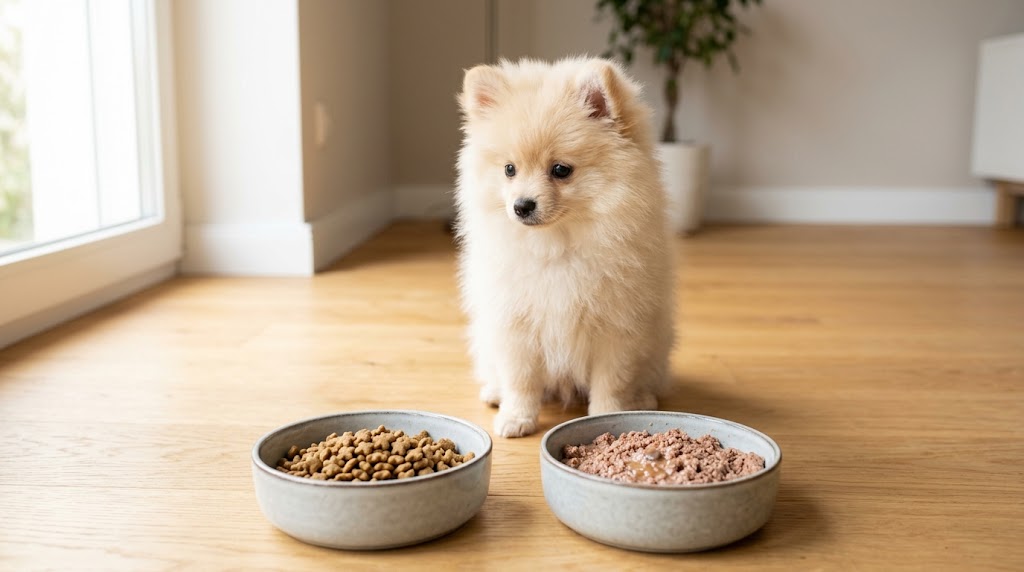
Dry Puppy Food
Dry food can be useful because it is:
- convenient to store
- easy to weigh
- usually less expensive per calorie
- practical for training portions
- available in breed-size-specific textures
However, measuring by cups can be inaccurate. Weighing the portion provides better control.
Wet Puppy Food
Wet food can offer:
- higher moisture
- softer texture
- stronger aroma
- easier eating for some puppies
- improved palatability for picky eaters
It is often more expensive per calorie and requires refrigeration after opening.
Mixed Feeding
Mixed feeding can combine the convenience of dry food with the texture and moisture of wet food.
The main mistake is feeding the full recommended wet portion and the full recommended dry portion together. The two amounts must be adjusted so the combined total matches the puppy’s daily calorie target.
For a deeper comparison, read our guide to wet vs dry dog food.
How to Read a European Puppy Food Label
European pet food labels contain important information, but marketing claims can distract from the most useful details.
The FEDIAF guide to understanding pet food labels explains the key information found on European pet food labels, including composition, additives, analytical constituents, and feeding guidance.
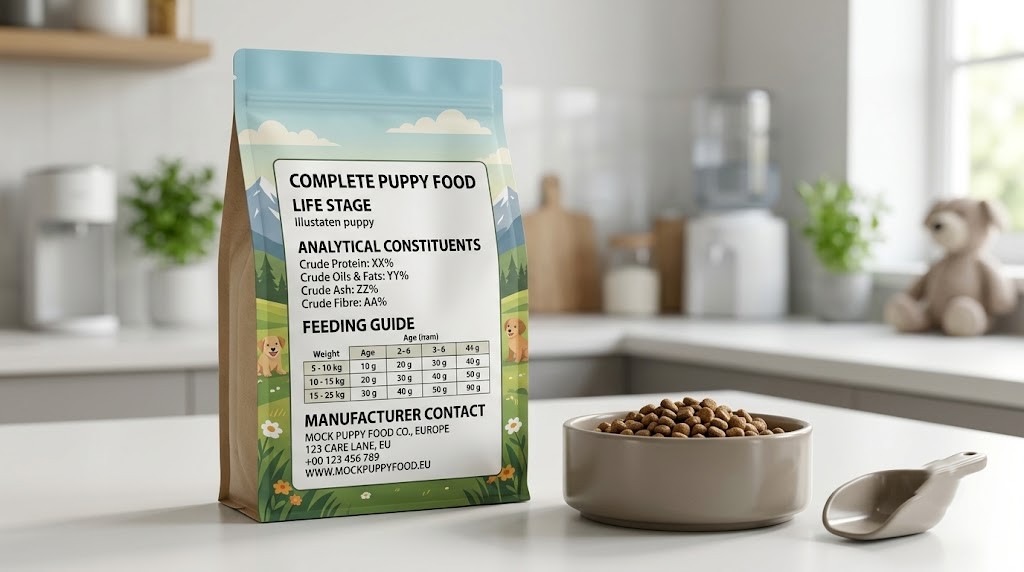
Check These Items
Product Description
Look for wording such as:
- Complete pet food for puppies
- Complete food for growing dogs
- Complete puppy food for small breeds
- Complete puppy food for large breeds
Life Stage
The product should clearly indicate that it is intended for growth, puppies, or the relevant life stage.
Composition
The composition list tells you which feed materials were used, but it does not provide a complete assessment of food quality.
Ingredients may be declared individually or through legally recognised categories.
Analytical Constituents
These commonly include:
- crude protein
- crude fat
- crude fibre
- crude ash
- moisture where required or voluntarily provided
The numbers should be interpreted together with calorie density, digestibility, the total formulation, and whether the food is wet or dry.
Additives
The label may list nutritional additives such as vitamins, trace elements, and amino acids.
The presence of technical names does not automatically mean the food contains unsafe or unnecessary chemicals.
Feeding Instructions
Check whether the guide is based on:
- current weight
- age
- expected adult weight
- breed size
- activity
- wet, dry, or mixed feeding
Manufacturer Information
The label should provide a company or distributor name and a way to contact them.
Useful questions include:
- What is the calorie content?
- Is the food formulated for my puppy’s expected adult size?
- Who formulated it?
- Is the finished product nutritionally analysed?
- Where is it manufactured?
- How is quality controlled?
Ingredients: What Matters and What Does Not
The First Ingredient Is Not the Whole Formula
A named animal protein can make a label easier to understand, but the first ingredient alone does not prove that the overall food is nutritionally appropriate.
Ingredients contain different amounts of water and may be listed before or after processing. The final nutrient balance matters more than one prominent ingredient.
More Protein Is Not Automatically Better
Puppies need sufficient protein for growth, but the food with the highest percentage is not automatically the best.
Protein must be evaluated together with:
- energy
- amino-acid balance
- digestibility
- minerals
- total formulation
- breed size
- growth rate
Grain-Free Is Not Automatically Healthier
Most puppies do not require a grain-free diet simply because they are puppies.
Grain-free does not mean carbohydrate-free, allergy-safe, or nutritionally superior.
Choose grain-free food only when the complete formulation fits the puppy and there is a clear reason for selecting it. Read our grain-free vs regular dog food guide before making the choice.
Supplements Can Unbalance a Complete Diet
A complete puppy food is formulated to provide the required nutrient balance.
Adding calcium, minerals, vitamins, oils, or other supplements without professional guidance can alter that balance. This is especially important for large and giant-breed puppies.
“Natural” and “Premium” Are Not Complete Evaluations
Marketing words do not answer:
- who formulated the food
- whether it is complete
- whether it matches growth needs
- how the product is tested
- whether the puppy tolerates it
- whether the daily calories are appropriate
Use measurable information before relying on front-of-pack claims.
Puppy Food Mistakes to Avoid
Even a nutritionally complete puppy food can cause problems when it is chosen or fed incorrectly.
Avoid these common mistakes:
Feeding Adult Dog Food Too Early
Adult maintenance food is not formulated for the same growth stage as puppy food. Continue using an appropriate complete growth diet until your puppy is ready to transition based on breed size, development, body condition, and veterinary guidance.
Choosing Food Only Because It Says “Premium” or “Natural”
Marketing terms do not confirm that a food is complete, suitable for growth, properly formulated, or supported by strong quality-control standards.
Always check the life-stage declaration, feeding instructions, manufacturer transparency, and nutritional completeness.
Adding Calcium or Vitamin Supplements to Complete Puppy Food
Adding calcium, bone meal, mineral powders, or multivitamins can disrupt the balance of an already complete growth diet.
This is particularly important for large and giant-breed puppies. Use supplements only when a veterinarian has identified a specific need.
Trying to Make a Large-Breed Puppy Grow Faster
Rapid weight gain is not the same as healthy development.
Large and giant-breed puppies should grow steadily while maintaining an appropriate body condition. Excess calories and uncontrolled portions may place unnecessary pressure on developing joints and bones.
Ignoring Treats and Training Rewards
Treats, chews, table food, and training rewards all contribute to the puppy’s total daily calorie intake.
Reduce the main food portion when extras become a meaningful part of the daily diet, and avoid allowing treats to replace complete puppy food.
Switching Foods After Every Minor Digestive Change
One soft stool does not automatically mean that a food is unsuitable or that the puppy has an allergy.
Repeatedly changing formulas can make digestive patterns harder to understand. Introduce foods gradually and seek veterinary advice when symptoms persist or become severe.
Feeding Full Wet and Dry Portions Together
Mixed feeding can work well, but the full feeding recommendation from both packages should not be combined.
Calculate the wet and dry portions together so the total daily calories remain appropriate.
Using an Unformulated Homemade Diet
Meat, rice, vegetables, and supplements do not automatically create a complete puppy diet.
Long-term homemade feeding for a growing puppy should be formulated by a qualified veterinary nutrition professional.
How Much and How Often Should You Feed a Puppy?
Food choice is only one part of puppy nutrition.
The correct daily amount depends on:
- age
- current weight
- expected adult weight
- calorie density
- body condition
- activity
- treats
- growth rate
For a complete portioning method, use our guide on how much to feed your dog.
Puppies generally need more frequent meals than adult dogs because they have smaller stomachs and are growing.
Meal frequency commonly decreases as the puppy matures. Instead of repeating the complete schedule here, use our detailed puppy-to-adult feeding schedule.
Changing the number of meals does not necessarily mean changing the total daily amount. The same daily portion may simply be divided across fewer meals.
How to Change Puppy Food Safely
Changing food suddenly can cause digestive upset in some puppies.
A gradual food transition over approximately 7–14 days is a practical starting point for reducing digestive upset.
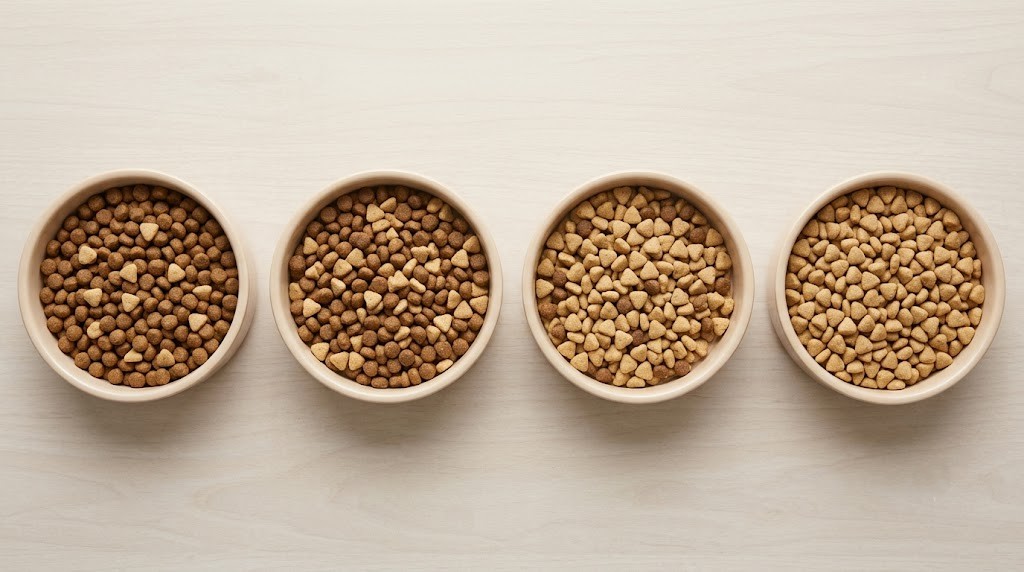
| Transition stage | Current food | New food |
|---|---|---|
| Days 1–3 | 75% | 25% |
| Days 4–6 | 50% | 50% |
| Days 7–9 | 25% | 75% |
| Day 10 onward | 0% | 100% |
This schedule can be slowed down when the puppy has a history of digestive sensitivity.
During the transition, monitor:
- appetite
- stool
- vomiting
- gas
- discomfort
- energy
- skin changes
Do not introduce several new treats, supplements, chews, and foods at the same time. Changing one variable makes it easier to understand how the puppy responds.
Contact your veterinarian if your puppy develops repeated vomiting, significant diarrhoea, blood in the stool, marked lethargy, poor appetite, or difficulty keeping water down.
How to Tell Whether a Food Fits Your Puppy
A suitable food should support steady development over time.
Positive signs may include:
- consistent appetite
- gradual weight gain
- appropriate body condition
- predictable stool
- normal energy for the individual puppy
- healthy-looking skin and coat
- no persistent vomiting or digestive discomfort
- willingness to eat the measured portion
Do not assess a food from one meal or one day.
Track the same indicators over several weeks:
- weekly weight
- monthly body-condition review
- daily food amount
- treats
- stool consistency
- appetite
- feeding speed
- activity
A puppy that is gaining weight very quickly is not necessarily growing better.
When to Ask a Veterinarian
General online guidance is intended for healthy puppies. Veterinary assessment is especially important when a puppy has:
- repeated vomiting or diarrhoea
- blood in vomit or stool
- poor growth
- unexpected weight loss
- persistent refusal to eat
- extreme hunger despite measured feeding
- a swollen or painful abdomen
- suspected food allergy
- a congenital or chronic health condition
- significant skin or digestive symptoms
- difficulty chewing or swallowing
- suspected toxin or foreign-object ingestion
A veterinarian can also help estimate expected adult size, evaluate body condition, review growth, and determine whether a specialised diet is needed.
Stop Guessing What Your Puppy Needs
Two puppies of the same age may need different food because their breed size, expected adult weight, activity, body condition, digestion, and feeding patterns are different.
FAMMO helps you organise these factors into a clearer, more personalised feeding profile.
Create your puppy’s profile to:
- record age, breed, weight, and expected size
- review feeding routines and portion patterns
- track appetite, digestion, and weight changes
- make more informed nutrition decisions
- recognise when professional veterinary guidance may be needed
Create Your Free Puppy Nutrition Profile
FAMMO supports better feeding decisions but does not replace veterinary diagnosis or treatment.
Frequently Asked Questions About Puppy Food
What is the best puppy food in Europe?
The best puppy food in Europe is a complete growth formula that matches your puppy’s expected adult size, calorie needs, body condition, and digestion. Manufacturer expertise, quality control, feeding instructions, and consistent availability are more useful than marketing words alone.
Is wet or dry food better for puppies?
Both wet and dry puppy food can work when they are complete for growth. Dry food is convenient and easy to weigh, while wet food provides more moisture and may appeal to picky puppies. Mixed feeding is also possible when the combined calories are measured correctly.
Is puppy food different from adult dog food?
Yes. Puppy food is formulated for growth and usually has a different energy and nutrient profile from adult maintenance food. Adult food should not be used as the main diet for a growing puppy unless a veterinarian has recommended it for a specific reason.
Do large-breed puppies need special food?
Large and giant-breed puppies usually need a growth formula specifically designed for their expected adult size. These foods help provide controlled energy and an appropriate mineral balance. Avoid calcium supplementation unless directed by a veterinarian.
How long should a dog eat puppy food?
The appropriate transition point depends on breed size, growth, body condition, and individual development. Small dogs usually mature earlier than large and giant breeds. Ask your veterinarian before switching if your puppy is still growing or you are unsure.
Is grain-free food better for puppies?
Not automatically. Most puppies do not need grain-free food simply because they are young. Grain-free food should still be complete for growth and suitable for the individual puppy. The total formulation matters more than the absence of grain.
Can puppies eat homemade food?
A homemade diet can be appropriate only when it is professionally formulated to provide complete nutrition for growth. Improvised meat-and-vegetable recipes can be deficient or unbalanced. Work with a qualified veterinary nutritionist for long-term homemade feeding.
How should I switch my puppy to a new food?
Introduce the new food gradually over approximately 7–14 days, increasing its proportion while reducing the previous food. Slow the transition if digestive symptoms appear, and contact your veterinarian if vomiting, diarrhoea, poor appetite, or lethargy persists.
How much food should I give my puppy?
The amount depends on the puppy’s age, current weight, expected adult weight, body condition, activity, treats, and the calorie density of the food. Use the package instructions as a starting point and monitor weight and body condition.
Key Takeaways
- Choose complete food formulated for puppy growth.
- Match the formula to expected adult breed size.
- Large and giant-breed puppies need controlled growth, not maximum growth.
- Evaluate manufacturer expertise and quality control, not only ingredients.
- Wet, dry, and mixed feeding can all work.
- Measure portions and include treats in the daily calorie total.
- Avoid unnecessary calcium or vitamin supplements.
- Change foods gradually.
- Monitor weight, body condition, appetite, stool, and digestion.
- Ask a veterinarian when symptoms persist or growth appears abnormal.