You are standing in a pet store, holding two bags of cat food.
One costs twice as much as the other. Both say “premium.” Both have a photo of a healthy cat on the front.
The question most cat owners ask at that point is simple:
Is the expensive one actually better?
The honest answer is: sometimes yes, sometimes no, and knowing the difference is what this guide is for.
If you are still comparing general brand quality, start with our full guide to Best Cat Food Brands in Europe 2026. This article goes one step deeper and focuses specifically on premium cat food brands, price, ingredient quality, and whether higher cost reflects better long-term nutrition.
Quick Answer: Is Premium Cat Food Worth It?
Premium cat food can be worth it if the higher price reflects better ingredient quality, clear animal protein sources, life-stage suitability, and a formula that matches your cat’s actual needs.
But expensive cat food is not automatically better.
Some premium brands offer stronger meat quality, clearer recipes, and more specialized formulas. Others cost more because of branding, packaging, or trend-based positioning.
The best premium cat food is not the most expensive one. It is the food that fits your cat’s age, weight, activity level, indoor lifestyle, sterilization status, and digestion.
What Makes Cat Food Premium?
The word “premium” is a marketing term, not a regulated standard in Europe. Any brand can use it. What actually matters is what is inside the bag or tin.
A cat food that earns a premium price should show:
Overall nutritional quality,judged from the complete formulation, nutritional adequacy, and suitability for your cat, not from the first ingredient alone
Complete and balanced labeling, meaning it meets nutritional standards for daily feeding
Life-stage targeting, whether for kittens, adult cats, seniors, or sterilized cats
Taurine support, cats cannot synthesize enough taurine on their own, so it must be present in the diet
Controlled minerals, especially for urinary health
Transparent ingredient lists with no vague ingredient categories
Clear feeding guidance based on weight and life stage
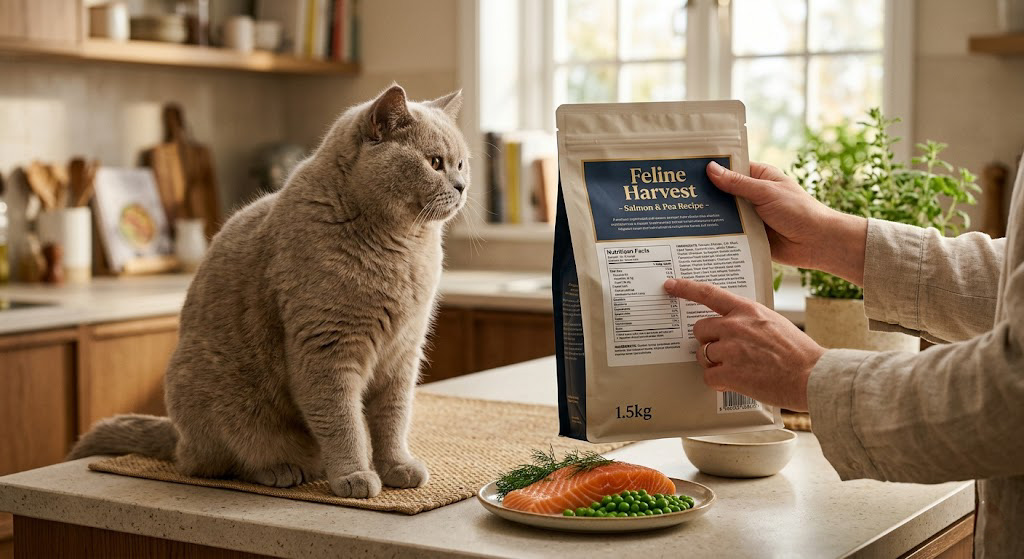
If you want to check these details on a real package, our step-by-step guide to reading a pet food label explains how to assess composition, analytical constituents, complete vs complementary status, and feeding instructions.
FEDIAF, the European Pet Food Industry Federation, provides nutritional guidelines used across Europe as a reference for complete and complementary pet food formulation: FEDIAF Nutritional Guidelines.
Premium should mean better nutritional fit, not just better packaging.
Premium vs Regular Cat Food: The Real Difference
“Premium” and “regular” are not reliable nutritional categories. A higher-priced food may offer features you value, but both expensive and lower-priced products should be assessed using the same checks. Compare the specific formulas rather than assuming the premium label guarantees better nutrition.
What to Compare | What to Check in Either Food |
|---|---|
Nutritional adequacy | Is it a complete food suitable for your cat’s life stage? |
Formulation expertise | Who formulates the food, and what relevant qualifications do they have? |
Quality control | What testing and quality-control information can the manufacturer provide? |
Feeding suitability | Does the formula fit your cat’s calorie needs, tolerance, and any veterinary requirements? |
Daily cost | What does an appropriate daily portion cost, rather than just the bag or tin? |
Does Expensive Cat Food Mean Better Ingredients?
Not always.
Expensive cat food may cost more because it uses higher-quality meat, more specialized formulas, smaller-batch production, or stronger ingredient transparency. But price can also reflect packaging design, marketing spend, import costs, or niche positioning.
Protein percentage alone does not tell you how well a food meets your cat’s needs. Compare the complete formulation, nutritional adequacy, and manufacturer information. A named meat ingredient does not, by itself, prove better digestibility or overall nutritional quality.
A more useful question than “is it expensive?” is: what exactly am I paying for?
When comparing premium cat food brands, look at:
Nutritional adequacy: Is the specific food complete and suitable for your cat’s life stage?
Manufacturer information: Can the company explain its formulation expertise, quality control, and nutritional analysis?
The moisture level, wet, dry, or mixed feeding?
The formula purpose, is it designed for indoor cats, sterilized cats, kittens, seniors, or sensitive digestion?
The feeding amount, a more expensive food may cost less per day if smaller portions are needed
The nutritional match, does it fit your cat’s weight, activity level, and health profile?
If you want to understand price and formulation more deeply, read our full guide on cost vs quality in cat food formulations.
Best Premium Cat Food Brands in Europe 2026
There is no single best premium cat food brand for every cat. The right choice depends on your cat’s needs and your budget.
Below is a practical guide to brands commonly compared by European cat owners in 2026, what each is best known for, and which cat profile it tends to suit.
This is a comparison shortlist, not a ranking from best to worst. Compare the specific product, not just the brand, by its complete or complementary status, life-stage suitability, calorie information, manufacturer transparency, local availability, and daily feeding cost. A brand may offer several ranges with different purposes.
1. Farmina
Best for: Cats whose owners want high animal protein content and ingredient transparency in dry food.
Farmina’s dry food lines are built around named animal protein and are often cited for clear ingredient lists. It tends to suit adult cats in good health whose owners want more visibility into what the food contains. Available across much of Europe, though often at a higher price point.
Watch out for: Higher daily cost compared to more accessible brands.
2. Royal Canin
Best for: Cats with specific, documented health needs, sterilized cats, breed-specific requirements, urinary support, or digestive sensitivity.
Royal Canin is one of the most widely used clinical-style brands in Europe because of its targeted formulation. It is commonly used in veterinary and clinic-adjacent nutrition discussions, especially for cats with specific dietary needs. Its ingredient lists are less “clean label” than some premium brands, but the formulation focus is strong.
Watch out for: Ingredient lists that include more plant-based components than some cat owners prefer.
3. Lily’s Kitchen
Best for: Owners who want recognizable, natural-style ingredients in both wet and dry formats, without clinical positioning.
Lily’s Kitchen appeals to owners who read ingredient labels carefully and prefer recipes with fewer additives. It works well for healthy adult cats whose owners value ingredient clarity. Widely available in the UK and increasingly across Europe.
Watch out for: Check that the product is labeled complete, not complementary, before using it as a daily diet.
4. Edgard & Cooper
Best for: Sustainability-conscious owners in Western Europe looking for modern, transparent pet food.
Edgard & Cooper has strong European availability and clear ingredient presentation. It suits adult cats in good health and tends to appeal to owners who care about both ingredient quality and brand ethics.
Watch out for: Some products are complementary rather than complete, verify the label before daily use.
5. Almo Nature
Best for: Cats that need more hydration or prefer wet food, and owners who want simple ingredient lists.
Almo Nature’s wet food lines use short ingredient lists and simple protein sources. They are popular for variety feeding and for cats that resist drinking enough water. However, many products in the range are complementary rather than complete.
Watch out for: Always check for the “complete” label. Many Almo Nature products are designed as a complement to, not a replacement for, a complete diet.
6. Schesir
Best for: Cats that prefer wet food texture and owners who want identifiable meat or fish ingredients.
Schesir is a well-regarded premium wet food brand in Europe. It is often used for variety feeding or alongside a complete dry food. Simple recipes, good ingredient visibility.
Watch out for: As with Almo Nature, check complete vs. complementary status before daily use.
7. Applaws
Best for: Cats that thrive on high meat content and owners who want minimal ingredient lists.
Applaws products are often high in named protein and low in filler. They suit cats that do well on meat-forward recipes and owners who prefer ingredient simplicity.
Watch out for: Many Applaws products are complementary. They work well as part of a mixed feeding plan but should not be used as a sole complete diet unless the label confirms it.
8. Leonardo
Best for: Owners in Germany and nearby European markets looking for a practical premium brand with both wet and dry options.
Leonardo is a German brand with good availability in German-speaking markets and reasonable ingredient transparency. It offers a balance between premium positioning and accessible daily cost.
Watch out for: Less well-known outside of the German-speaking market, so availability may vary.
9. Josera
Best for: Owners who want a reliable, accessible European dry food for sterilized, sensitive, or indoor cats without the pricing of luxury brands.
Josera sits at a practical mid-premium price point. It offers life-stage and health-specific formulas and is commonly available across Europe. Less “luxury” in image but solid in formulation.
Watch out for: Less well-suited if your priority is wet food or complementary feeding variety.
10. Yarrah
Best for: Owners who prioritize organic-certified ingredients and sustainability alongside nutritional completeness.
Yarrah products carry organic certification and are available in both wet and dry formats. They appeal to a specific type of owner rather than representing a universal premium choice.
Watch out for: Organic certification does not guarantee a better nutritional profile than a non-organic complete food. Compare formulations, not just certifications.
Quick Comparison: Premium Cat Food Brands in Europe
Formats, life stages, and nutritional status vary by product range. Check the exact product label before buying; the brand name alone does not establish suitability.
Brand | Format | Best Life Stage | Complete / Complementary |
|---|---|---|---|
Farmina | Dry + Wet | Adult, Kitten, Senior | Complete |
Royal Canin | Dry + Wet | All stages, health-specific | Complete |
Lily’s Kitchen | Dry + Wet | Adult | Check per product |
Edgard & Cooper | Dry + Wet | Adult | Check per product |
Almo Nature | Wet (mainly) | Adult | Often complementary |
Schesir | Wet | Adult | Often complementary |
Applaws | Wet + Dry | Adult | Often complementary |
Leonardo | Dry + Wet | Adult, Sterilized | Complete |
Josera | Dry | Adult, Sterilized, Sensitive | Complete |
Yarrah | Dry + Wet | Adult | Complete |
Premium Wet vs Dry Cat Food
Premium cat food can be wet, dry, or mixed, and the format matters as much as the brand.
Premium wet cat food tends to be more useful for:
Hydration support, wet food typically contains around 75–80% moisture, compared to roughly 10% in dry food
Source: PetMD — Cats and Protein
Cats that resist drinking enough water on their own
Senior cats or cats with urinary health considerations
Picky eaters who prefer softer textures
Cats that do better on lower-carbohydrate diets
Premium dry cat food tends to be more useful for:
Convenience and easier storage
Convenient portion measurement when weighed accurately
Lower cost per day in many cases
Cats that prefer kibble texture
A premium dry food is not automatically better than a standard wet food. The right format depends on your cat’s water intake, weight, digestion, and feeding routine.
If you are deciding between premium wet food, dry food, or mixed feeding, read our full guide on wet vs dry cat food before choosing a brand.
Premium Cat Food for Indoor, Sterilized, and Sensitive Cats
This is where premium cat food tends to justify its cost most clearly, when your cat has a specific, documented need.
Premium Food for Indoor Cats
Calorie needs vary with body condition, activity, age, neuter status, and health. Use feeding guidance as a starting point and adjust with your veterinary team according to your cat’s weight and body condition. For more guidance, see Cornell Feline Health Center: Feeding Your Cat.
A premium indoor cat food should support:
Controlled calorie intake
Healthy weight maintenance
Hairball management
Appropriate protein and fat levels for a less active lifestyle
For a deeper feeding plan, read our guide on the best diet for indoor cats.
Premium Food for Sterilized Cats
Sterilization lowers hormone-related metabolism, which means spayed and neutered cats typically need fewer calories to maintain a healthy weight.
Source: MedicAnimal — How to Determine the Right Amount of Food for Your Cat
A premium sterilized cat food should focus on:
Balanced calorie density
Satiety support
Lean body condition
Controlled mineral levels, particularly for urinary health
Premium Food for Sensitive Cats
Some cats need gentler formulas because of digestive sensitivity, stool quality, skin reactions, or picky eating behavior.
A premium sensitive cat food may include:
Limited ingredient or hypoallergenic formulas
Single named protein sources
Digestive support additives such as prebiotics
Wet food options for additional hydration
If your cat has ongoing vomiting, diarrhea, appetite loss, or unexplained weight loss, consult a veterinarian before changing food. The Cornell Feline Health Center notes that proper food, correct amounts, and appropriate feeding routines are important for feline wellbeing:
Cornell Feline Health Center: Feeding Your Cat.
Accessible vs Specialty Premium Brands
Not every premium brand serves the same purpose or the same owner.
More accessible brands, easier to find consistently across Europe, suitable for daily feeding:
Royal Canin
Josera
Leonardo
Edgard & Cooper
Lily’s Kitchen
A food that is nutritionally ideal on paper is not helpful if you cannot reliably buy it every month.
More specialty-focused brands, may suit specific needs but require more careful product selection:
Farmina (high-protein dry food focus)
Almo Nature and Schesir (mainly wet, often complementary)
Applaws (high meat, often complementary)
Yarrah (organic positioning)
With specialty brands, always confirm whether the specific product is complete or complementary before using it as your cat’s only food.
How to Choose Premium Cat Food Without Overpaying
The goal is not the most expensive food. The goal is the most appropriate food.
1. Check Complete or Complementary First
If the food is complementary, it cannot be the only thing your cat eats without additional nutritional planning.
2. Assess the Whole Formula, Not Just the First Ingredient
An ingredient list helps you understand what a food contains, but the first ingredient alone does not establish nutritional quality. Check nutritional adequacy, life-stage suitability, calorie information, and the manufacturer’s formulation and quality-control information.
3. Match the Formula to Your Cat’s Life Stage
A kitten, adult cat, and senior cat do not have the same nutritional requirements. Sterilized cats have lower calorie needs. Indoor cats need calorie-controlled food.
4. Calculate Daily Feeding Cost, Not Package Price
Compare the cost of feeding your cat, not just the price of the bag.
Daily cost = package price ÷ package weight in grams × daily portion in grams
Here is a hypothetical comparison of two complete dry foods. The prices and portions are examples, not current brand prices or feeding recommendations.
Comparison | Food A | Food B |
|---|---|---|
Package price | €24 | €36 |
Package weight | 2,000 g | 2,000 g |
Example daily portion | 60 g | 45 g |
Estimated daily cost | €0.72 | €0.81 |
Estimated cost over 30 days | €21.60 | €24.30 |
Food B costs 50% more per bag, but only 12.5% more per day in this example. That does not prove it is nutritionally better—it shows why package price alone can be misleading.
Use portions appropriate for the same cat and check each food’s calorie content. Do not reduce a portion simply to make a food look cheaper. For mixed feeding, add the daily cost of both foods.
Once you know the daily cost, compare nutritional suitability, manufacturer information, availability, and how well your cat tolerates the food.
5. Consider Moisture Format
If your cat does not drink much water, wet food may be more beneficial regardless of brand. Mixed feeding, wet food in one meal and dry in another, can be a practical balance.
6. Use the WSAVA Questions
The World Small Animal Veterinary Association provides guidance and questions to ask when evaluating pet food brands, including whether the company employs qualified nutrition experts and maintains documented quality control: WSAVA Global Nutrition Guidelines.
Common Mistakes
Assuming Expensive Means Better
Higher price does not automatically reflect better nutrition. Some foods cost more because of packaging design, branding, or import logistics.
Ignoring Your Cat’s Actual Profile
A high-protein dry food may not be the right choice for an overweight indoor cat with low water intake. A premium food for active cats may be too calorie-dense for a sedentary one.
Choosing Grain-Free Without Checking the Carbohydrates
Grain-free does not mean low-carbohydrate. Many grain-free formulas replace grains with peas, potatoes, tapioca, or legumes, which can result in similar or higher starch levels. Read our full guide on Best Grain-Free Cat Food in Europe 2026.
Not Checking Complete vs Complementary
Some of the most attractive-looking premium wet foods are complementary products. They are not designed to be a sole complete diet.
Switching Too Quickly
Even a high-quality food can cause digestive upset if introduced abruptly. Transition over 7–10 days by mixing the new food gradually into the old unless your veterinarian advises otherwise.
Final Thoughts: Premium Should Mean Better Fit, Not Just Higher Price
Premium cat food can genuinely be worth the cost, when the formula offers better protein quality, clearer ingredients, appropriate moisture, life-stage suitability, and a real match for your cat’s daily needs.
It is not worth the cost when the price mainly reflects packaging or brand positioning rather than what is in the bowl.
The brands and formulas worth paying for are the ones that help you feed your cat with more clarity, consistency, and confidence, not just more expense.
What is in your cat’s bowl right now?
Whether you have found the perfect premium brand or are still struggling to decipher the labels, you don’t have to figure it out alone. Join the conversation in Paw Talk, our community forum for European pet owners, and share your experiences with different brands, formulas, and picky eaters!
FAQ: Premium Cat Food Brands
What are the best premium cat food brands in Europe?
Brands commonly compared in Europe include Farmina, Royal Canin, Lily’s Kitchen, Edgard & Cooper, Almo Nature, Schesir, Applaws, Leonardo, Josera, and Yarrah. The best option depends on your cat’s age, weight, digestion, indoor or outdoor lifestyle, and whether the food is complete or complementary.
Is premium cat food worth it?
It can be, if the higher price reflects better ingredients, clearer protein sources, stronger formulation, and a better match for your cat’s needs. It is not worth it if the higher price mainly reflects branding or packaging.
Does expensive cat food mean better quality?
Not automatically. Price can reflect ingredient quality, but also packaging, marketing, import costs, or niche positioning. Always compare ingredient quality, complete-and-balanced status, feeding amounts, and your cat’s individual needs.
What is the difference between complete and complementary cat food?
A complete food is formulated to provide the required nutrients for its stated life stage when fed as directed. Complementary food is not a complete daily diet. Serving it alongside complete food does not automatically make any proportion nutritionally balanced; follow product guidance and ask your veterinary team when unsure.
What is the best premium wet cat food in Europe?
The answer depends on whether your cat needs hydration support, softer textures, weight control, or variety. Almo Nature, Schesir, Lily’s Kitchen, Edgard & Cooper, Applaws, and Farmina are often compared in Europe for premium wet food, but always check whether the specific product is complete or complementary.
What is the best premium dry cat food in Europe?
The answer depends on your cat’s life stage, weight, digestion, and indoor lifestyle. Farmina, Royal Canin, Josera, Leonardo, Edgard & Cooper, and Lily’s Kitchen are commonly compared in Europe.
Is premium cat food better for indoor or sterilized cats?
It can be, when the formula addresses their specific needs: lower calorie density, hairball support, and appropriate protein and fat levels for a less active lifestyle. Both indoor and sterilized cats have lower daily calorie requirements than active outdoor cats, so calorie content and portion sizing matter significantly.
Is grain-free premium cat food better?
Not automatically. Grain-free formulas can still be high in carbohydrates from peas, potatoes, tapioca, or legumes. The more useful question is whether the food is complete, appropriately balanced, and suited to your cat’s needs, not simply whether it contains grains.
How do I choose premium cat food without overpaying?
Calculate cost per day, not package price. Check the protein source, moisture level, complete-and-balanced status, feeding amount, life-stage suitability, and whether the formula addresses a real need for your cat.
Should I ask a vet before switching to premium cat food?
For healthy cats, a gradual transition to a new complete and balanced food is generally straightforward. If your cat has urinary issues, kidney concerns, obesity, allergies, vomiting, diarrhea, or unexplained appetite changes, speak with a veterinarian before changing the diet.
Stop Guessing. Start Personalizing. 🐾
Reading labels is a great first step, but every cat’s metabolism and daily needs are completely unique. What keeps a highly active kitten healthy is not the same formula that keeps a less active adult indoor cat in peak shape.
You don’t have to navigate the confusing world of pet food alone. Take the guesswork out of your cat’s diet with FAMMO.
By building your cat’s unique health profile, our AI-powered platform analyzes their weight, age, activity level, and specific needs to recommend a smarter nutritional fit, so you can compare premium foods with more clarity and avoid paying only for marketing claims.
Ready to find the food that actually fits your cat?
👉 Create Your Cat’s Free Profile on FAMMO Today and join a growing community of smart European pet owners making data-driven decisions for their feline friends.