
Choosing cat food by price alone can be misleading. A higher price does not automatically mean better nutrition, and a lower-priced food is not automatically a poor choice.
The more useful question is whether the food provides appropriate nutrition, clear feeding information, and practical value for the amount you actually feed each day.
When comparing cat food, look beyond the price of the bag. Consider whether the food is complete for your cat’s life stage, how much they need per day, the food’s calorie density and moisture level, ingredient transparency, and how well it fits their individual needs.
If you want to compare products more confidently, our step-by-step guide to reading a pet food label explains how to check nutritional adequacy, ingredient declarations, feeding guidance, and other label information before judging a food by price.
This guide explains how to compare cat food cost vs quality, including daily feeding cost, label information, wet and dry food differences, premium claims, and the factors that can make one food better value than another.
Quick Answer: How Do You Compare Cat Food Cost vs Quality?
The price of a cat food does not tell you its quality on its own. A more useful comparison is to look at what the food provides, how much your cat needs each day, and what that daily feeding amount actually costs.
When comparing two cat foods, start with these six factors:
Complete nutrition: Is the food labelled as complete for your cat’s life stage, or is it complementary?
Daily feeding cost: How much does the recommended daily amount actually cost, rather than just the price of the package?
Feeding amount and calorie density: How much food does your cat need each day to meet their energy needs?
Moisture and food format: Is it wet, dry, or part of a mixed-feeding routine, and does that format suit your cat?
Label transparency: Does the label clearly explain the ingredients, analytical information, feeding guidance, and intended life stage?
Individual fit: Does the food suit your cat’s age, weight, body condition, activity level, feeding habits, and any veterinary guidance?
A higher-priced food may offer better value if it provides appropriate nutrition, useful transparency, and a feeding amount that suits your cat. But a lower-priced complete food can also be a good choice when it meets your cat’s needs.
The goal is not to find the cheapest or most expensive food. It is to find the option that offers the best practical value for your individual cat.
Why Cat Food Price Alone Does Not Tell You Its Value
The price on the package tells you what the product costs to buy, but it does not tell you how much it costs to feed your cat each day or whether the food is the right nutritional fit.
Two foods with very different package prices may have similar daily feeding costs if their recommended feeding amounts, calorie density, package size, or food format are different. This is why comparing only the price per bag, pouch, or can can be misleading.
What Should You Compare Instead?
When comparing value, look at the food as a complete product rather than judging it by price or one ingredient alone.
Check:
Nutritional adequacy: Is the food complete for your cat’s life stage, or is it intended only as a complementary food?
Recommended daily amount: How much does your cat actually need according to the feeding guidance?
Daily feeding cost: What does that recommended amount cost per day?
Calorie density: Foods with different energy densities may require different serving sizes.
Wet, dry, or mixed feeding: Different formats have different moisture levels, serving sizes, storage needs, and costs.
Label transparency: Can you understand what the product is, who it is intended for, how much to feed, and what nutritional information is provided?
Individual fit: Does the food suit your cat’s age, weight, body condition, activity level, preferences, and any veterinary recommendations?
For European cat owners, pet food labelling and marketing are governed by EU feed rules designed to support clear and consistent product information. You can review the official framework on the European Commission’s feed marketing page.
A lower-priced complete food may provide good value for one cat, while a more expensive food may be worth the additional cost for another. Price becomes meaningful only when you compare it with the food’s daily use, nutritional adequacy, and suitability for the individual cat.
Practical takeaway: Compare the cost of feeding your cat per day, not just the price printed on the package.
What Does Personalized Cat Nutrition Actually Mean?
Custom pet food formulation means adjusting a food or feeding approach around the needs of an individual cat rather than assuming that every cat needs exactly the same thing.
That does not necessarily mean creating a completely different recipe for every animal. In practice, personalisation can also mean choosing and adjusting a suitable feeding plan based on factors such as:
Age and life stage: a kitten, adult cat, and senior cat have different nutritional considerations.
Weight and body condition: the right feeding amount depends on more than body weight alone.
Activity and lifestyle: an active outdoor cat may have different energy needs from a less active indoor cat.
Food format and feeding routine: wet, dry, or mixed feeding can change portion sizes, moisture intake, storage needs, and daily cost.
Individual tolerance and preferences: appetite, digestion, food acceptance, and feeding habits can differ between cats.
Health status: diagnosed medical conditions may change nutritional needs and should be assessed with a veterinarian.
The important point is that personalised does not automatically mean better. A custom or premium formulation still needs to provide appropriate nutrition and make sense for the individual cat.
The WSAVA Global Nutrition Guidelines emphasise nutritional assessment and an individually appropriate nutrition plan rather than relying on a one-size-fits-all approach.
Cost vs Quality Analysis in Custom Pet Food Formulations
A cost vs quality analysis should answer a practical question:
What does your cat actually receive for the money you spend each day?
A higher-priced food may cost more because of its formulation, production process, quality-control systems, specialised ingredients, packaging, or positioning. But price alone cannot tell you whether it is nutritionally appropriate or better suited to your cat.
The same applies to lower-priced foods. A less expensive food should not automatically be considered lower quality if it is nutritionally complete, appropriate for the cat, clearly labelled, and produced with suitable quality controls.
When comparing custom, premium, or standard cat food options, use the same criteria for all of them:
Evaluation Factor | What to Check | Why It Matters |
|---|---|---|
Nutritional adequacy | Is the food complete for your cat’s species and life stage, or is it complementary? | A food needs to provide the required nutrients before price becomes a meaningful comparison. |
Daily feeding cost | How much does the recommended daily amount actually cost? | Package price alone can make two foods look more different than their real daily cost. |
Feeding amount and energy density | How much food does your cat need each day according to the feeding guidance? | Foods with different energy densities can require different serving sizes. |
Food format and moisture | Is the food wet, dry, or intended for mixed feeding? | Format affects portion size, moisture intake, storage, feeding routine, and cost. |
Label and manufacturer transparency | Are the intended life stage, feeding guidance, nutritional information, manufacturer details, and product purpose clear? | Clear information makes it easier to evaluate the food rather than relying on marketing claims. |
Individual fit | Does the food suit your cat’s age, body condition, activity, preferences, feeding routine, and any veterinary guidance? | A nutritionally appropriate food can still be a poor practical fit for a particular cat. |
A Simple Way to Compare Daily Value
Instead of asking:
“Which bag is cheaper?”
ask:
“What does it cost to feed my cat the recommended amount each day, and what am I getting for that cost?”
To calculate the daily feeding cost, use the package price, package size, and recommended daily feeding amount.
Then compare that cost alongside:
whether the food is complete or complementary
the recommended feeding amount
your cat’s life stage
food format
label transparency
how well the food fits your cat’s individual needs
This gives you a more useful comparison than choosing a product simply because it has a lower price or a “premium” label.
Practical takeaway: The best-value cat food is not automatically the cheapest, the most expensive, or the most personalised. It is the option that combines appropriate nutrition, a practical daily feeding cost, and a good fit for the individual cat.
Where Personalisation Can Help
Personalisation becomes useful when it helps you interpret those factors for your own cat.
For example, knowing your cat’s age, weight, body condition, activity level, feeding habits, and current food can make it easier to understand whether the recommended feeding amount and food format are appropriate.
FAMMO uses this type of profile information to help owners explore more personalised nutrition guidance. You can learn more about how the FAMMO nutrition engine works.
Personalised guidance should not be used to diagnose a medical problem or replace veterinary advice. Cats with diagnosed conditions, unexplained weight changes, persistent digestive problems, or other health concerns may require individual veterinary assessment.
If your main question is whether to prepare food at home or use a commercially produced diet, that is a different comparison. See our guide to homemade vs commercial pet food.
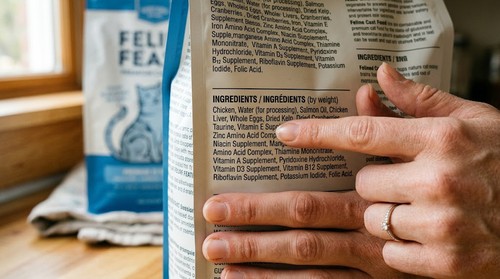
How to Read a Cat Food Label for Cost and Quality
A cat food label can help you compare products, but no single ingredient or number tells you whether a food is “high quality.”
For European cat owners, a more useful approach is to check the label in a simple order: what the food is designed to provide, how much your cat needs, what information the manufacturer gives you, and what that feeding amount costs.
FEDIAF’s guide to understanding pet food labels explains that European pet food labels include information such as composition, additives, analytical constituents, and feeding guidance.
1. Check Whether the Food Is Complete or Complementary
Start here before comparing ingredients.
A complete cat food is intended to provide the nutrients your cat needs when fed as directed for the relevant life stage.
A complementary food is designed to be used alongside other foods and may not provide complete daily nutrition on its own.
This distinction matters more than whether the front of the package says “premium,” “natural,” or “grain-free.”
2. Check the Intended Life Stage
Look for information showing whether the food is intended for:
kittens or growth
adult maintenance
senior cats, where specified by the manufacturer
another particular nutritional purpose
A food can be well formulated but still be the wrong choice for a particular cat or life stage.
3. Read the Feeding Guide
Check how much food the manufacturer recommends for a cat of your cat’s size and situation.
Feeding guides are starting points rather than exact prescriptions. Your cat’s body condition, activity, age, neuter status, treats, and other foods can change how much they actually need.
The recommended amount is also what allows you to compare the real daily feeding cost of two products.
4. Read the Composition, but Do Not Judge the Food by One Ingredient
Ingredients are generally listed by weight, but ingredient order does not tell you everything about the nutritional quality of the finished food.
For example, ingredients with a high water content may appear higher in the list because they weigh more before processing.
A clearly described composition can be useful for transparency, especially if you need to identify particular ingredients. However, a named first ingredient does not automatically make one food nutritionally better than another.
The overall formulation, nutritional adequacy, manufacturer expertise, quality control, and suitability for your cat matter more than one ingredient at the top of the list.
5. Check the Analytical Constituents
European labels usually provide analytical information such as protein, fat, fibre, and other declared constituents.
These numbers can help compare products, but wet and dry foods should not be compared directly without considering their very different moisture contents.
For example, a wet food can show a lower protein percentage on the label simply because much more of the product is water.
If you want to understand this difference in more detail, read our guide to wet vs dry cat food.
6. Look Beyond Marketing Terms
Words such as “premium,” “natural,” or “grain-free” can describe or market a product, but they do not tell you on their own whether the food offers better nutritional value for your cat.
Instead, ask:
Label Question | What It Helps You Understand |
|---|---|
Is the food complete or complementary? | Whether it is intended to provide complete daily nutrition |
What life stage is it designed for? | Whether the product matches your cat’s current needs |
How much should be fed each day? | Portion size and real daily feeding cost |
What does the composition show? | Which ingredients are used and how clearly they are described |
What do the analytical constituents show? | Declared levels of key nutritional components |
Is calorie information available? | How energy-dense the food may be |
Can you contact the manufacturer? | Whether you can ask for additional nutritional or quality-control information |
Practical takeaway: Use the label to build a complete picture. Do not judge cat food quality from the package price, the first ingredient, or a marketing term alone.
Cat Food Cost vs Quality: A Practical Comparison
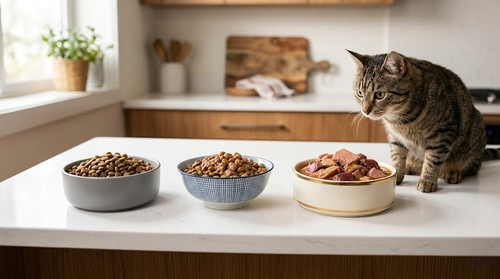
Cat food prices can vary a lot, but price alone does not tell you whether one food is better than another.
A lower-cost food can still be a good option if it is complete, appropriate for your cat’s life stage, clearly labelled, and practical to feed. A more expensive food may offer useful features such as different ingredients, specialised formulations, greater transparency, or personalised feeding guidance, but those features still need to be relevant to your cat.
Here is a simpler way to compare the options.
Type of Food | What You May Find | What to Check Before Paying More |
|---|---|---|
Lower-cost options | Complete dry or wet foods, simpler formulations, widely available products | Is it complete for your cat’s life stage? What is the daily feeding cost? Is the feeding guide clear? |
Mid-priced options | More food-format choices, different protein sources, specialised recipes, or greater product variety | Are the extra features useful for your cat, or are you mainly paying for positioning and packaging? |
Premium or specialised options | Specialised formulations, selected ingredients, greater product information, personalised or lifestyle-focused options | Does the food provide a real benefit for your cat’s needs, and is that benefit worth the higher daily cost? |
What Makes a Cat Food Good Value?
Good value is not the same as low price.
A food offers better practical value when it combines:
appropriate nutrition for your cat’s life stage
a realistic daily feeding cost
a feeding amount that works for your cat
clear information about how the food should be used
a food format your cat accepts and you can feed consistently
enough manufacturer and label information to make an informed decision
For example, a cheaper package may not be the cheaper option per day if your cat needs a larger serving. On the other hand, a premium food is not automatically better value simply because it costs more.
When Is Paying More Worth It?
Paying more can make sense when the additional cost gives you something useful, such as:
a formulation that better suits your cat’s life stage or feeding needs
a food format that works better for your routine
clearer nutritional and feeding information
greater manufacturer transparency
a specialised option recommended for a specific reason
personalised guidance that helps you make a more informed feeding decision
But if two foods are both complete, appropriate for your cat, and practical to feed, the more expensive option is not automatically the better choice.
Practical takeaway: Ask what the higher price actually gives you. If you cannot identify a useful nutritional, practical, or transparency benefit for your cat, paying more may not provide better value.
If you want to compare real products after learning these basics, see our guide to the best cat food brands in Europe.
Is Grain-Free Cat Food Worth Paying More For?
Not necessarily.
A grain-free label does not automatically mean that a cat food is healthier, higher in protein, lower in carbohydrates, or better quality.
Grain-free foods simply leave out cereal grains such as wheat, corn, rice, barley, or oats. They may use other ingredients instead, including peas, lentils, chickpeas, potatoes, or sweet potatoes.
So if a grain-free food costs more, the important question is:
What are you actually getting for the extra cost?
What Should You Compare?
Before paying more for a grain-free formula, check:
Is it complete for your cat’s life stage?
What is the daily feeding cost?
What ingredients replace the grains?
Does the food provide clear feeding and nutritional information?
Does your cat actually need a grain-free diet?
Does the food suit your cat’s preferences, feeding routine, and individual needs?
According to FEDIAF’s guidance on grain-free pet food, the most important consideration is whether the food provides complete and balanced nutrition, regardless of whether it contains grains.
What About Food Allergies?
Grain-free food should not automatically be chosen because you suspect a food allergy.
Cats can react to different food ingredients, and commonly reported food allergens include animal proteins such as beef, fish, and chicken.
If your cat has persistent itching, digestive problems, or other symptoms that make you concerned about a food reaction, talk to your veterinarian rather than simply switching to a grain-free food. Proper investigation may require a controlled diet trial.
Practical takeaway: Do not pay more just for the words “grain-free.” Compare the complete food, daily cost, nutritional information, and whether the formula offers a real benefit for your individual cat.
If you specifically want to compare grain-free products and understand what to look for, see our Best Grain-Free Cat Food in Europe guide.
What Does “Quality” Actually Mean in Cat Food?
A higher-quality cat food is not simply the one with the highest price, the longest ingredient list, or the biggest protein number on the package.
The more useful question is whether the food provides the nutrition your cat needs and whether the product gives you enough information to judge that properly.
Cats are obligate carnivores. According to the Cornell Feline Health Center, they depend on nutrients found in animal products and have specific requirements for protein, fat, amino acids, vitamins, minerals, and other nutrients.
But that does not mean that simply choosing the food with the most meat on the front of the package automatically gives you the best diet.
For cat owners in Europe, FEDIAF’s nutritional guidelines provide reference nutrient levels for complete cat foods and different nutritional needs.
A Better Way to Think About Food Quality
Instead of asking whether a food looks “premium,” check whether it gives you clear answers to these questions:
Is it complete for your cat’s life stage?
Does the feeding amount make sense for your cat?
Can you understand the nutritional information on the label?
Does the manufacturer provide useful product and feeding information?
Does the food format suit your cat and your feeding routine?
What does the recommended daily amount actually cost?
These factors tell you much more about practical value than packaging or price alone.
More Is Not Always Better
A food does not automatically become better because it has more protein, more fat, more ingredients, or a higher price.
Your cat needs the right nutrients in appropriate amounts, and those needs can change with life stage, body condition, activity, health, and overall feeding routine.
This is why two complete cat foods can both be suitable even if their ingredient lists, nutrient levels, formats, and prices look very different.
Practical takeaway: Good cat food quality is about nutritional adequacy, suitability, transparency, and practical value, not simply choosing the most expensive or most “premium-looking” option.

A Simple Example: How to Compare Two Cat Foods
Imagine you are choosing between two complete cat foods.
One costs less to buy. The other has a higher package price and is marketed as a more premium option.
Instead of deciding from the price alone, compare them step by step.
Step 1: Check What Each Food Is Designed For
First, confirm that both foods are complete and suitable for your cat’s life stage.
If one is only complementary, the comparison is already different because it is not intended to provide complete daily nutrition on its own.
Step 2: Compare the Daily Feeding Amount
Next, check how much of each food your cat would normally need per day.
A cheaper package does not always mean a lower daily feeding cost. The recommended serving size, energy density, and package size can all change the real cost.
Step 3: Compare the Label Information
Look at:
feeding guidance
analytical constituents
composition
calorie information, if provided
intended life stage
manufacturer information
Do not choose one food simply because the first ingredient looks more attractive or the packaging says “premium.”
Step 4: Consider Food Format
If you are comparing wet and dry food, remember that their moisture content and serving sizes can be very different.
That means package price and protein percentages cannot always be compared directly.
Step 5: Think About Your Cat
Finally, ask whether the food actually fits your cat’s:
age and life stage
body condition
activity level
food preferences
feeding routine
any veterinary guidance
A food can look excellent on paper but still be impractical if your cat will not eat it or if it does not fit your feeding routine.
So Which Food Offers Better Value?
There is no automatic winner.
The lower-priced food may offer excellent value if it is complete, suitable, clearly labelled, and practical to feed.
The more expensive food may be worth paying for if it provides a feature or benefit that is genuinely useful for your cat.
The important question is not:
“Which one costs more?”
It is:
“Which one gives my cat the best combination of appropriate nutrition, practical feeding, clear information, and daily value?”
FAMMO can help organise information such as your cat’s age, weight, activity, body condition, feeding habits, and current food so that comparisons are easier to understand.
Practical takeaway: Compare the whole feeding decision, not just the price tag.

FAQ: Cat Food Cost vs Quality
Is expensive cat food always better quality?
No. A higher price does not automatically mean better nutrition.
Price can reflect ingredients, production, packaging, specialised formulations, quality-control processes, or brand positioning. But an expensive food can still be a poor fit for your cat.
A better comparison is to check whether the food is complete for your cat’s life stage, how much you need to feed each day, how clear the label is, and what the recommended daily amount actually costs.
How do I compare the daily cost of two cat foods?
Do not compare package prices alone.
Use three pieces of information:
the price of the package
the amount of food in the package
the recommended daily feeding amount
This gives you a much more useful idea of what each food costs to feed per day.
Then compare that daily cost with nutritional adequacy, food format, label information, and how well the food fits your cat.
What protein percentage should I look for in cat food?
There is no single protein percentage that automatically tells you whether a cat food is good quality.
Cats have specific protein and amino-acid requirements, but the right way to evaluate a commercial food is to consider the complete formulation rather than choosing the product with the highest protein number.
Also remember that protein percentages on wet and dry foods cannot always be compared directly because their moisture contents are very different.
For European products, check that the food is complete and appropriate for your cat’s life stage. FEDIAF provides recommended nutrient levels for complete cat foods, but these should not be treated as a simple “higher is always better” target for pet owners.
Is grain-free cat food healthier?
Not automatically.
A grain-free food can still contain carbohydrates from ingredients such as peas, lentils, chickpeas, or potatoes. What matters most is whether the overall food is complete, appropriate for your cat, and suitable for their individual needs.
Do not pay more simply because a package says “grain-free.”
If you suspect a food allergy, changing to a grain-free food is not a reliable way to diagnose the problem. Food reactions can involve different ingredients and may require a veterinarian-supervised diet trial.
What ingredients should I avoid in cat food?
There is no short list of ingredients that every healthy cat must avoid.
An ingredient should not be labelled “bad” simply because its name sounds unfamiliar, appears lower or higher on the ingredient list, or comes from a plant source.
Instead, focus on the complete food:
Is it nutritionally complete for your cat’s life stage?
Is the label clear?
Is the feeding guidance practical?
Does your cat tolerate and eat it well?
Has your veterinarian advised avoiding a specific ingredient?
If your cat has a confirmed food allergy or another medical condition, follow your veterinarian’s guidance rather than removing ingredients at random.
Can the ingredient list tell me if a cat food is high quality?
Not by itself.
The ingredient list tells you what ingredients are used and generally lists them by weight, but it does not tell you everything about nutrient balance, digestibility, quality control, or how suitable the finished food is for your cat.
A named first ingredient may provide useful information, but it should not be used as the only test of food quality.
Look at the entire label, nutritional adequacy, feeding guidance, manufacturer information, and your cat’s individual needs.
How does custom pet food formulation work?
Custom pet food formulation means adapting a food or feeding approach around an individual cat rather than relying only on a generic average.
Factors may include:
age and life stage
weight and body condition
activity level
food format
feeding habits
preferences and tolerance
health information where appropriate
Personalisation can make feeding guidance more relevant, but it does not automatically make a food nutritionally better.
A custom or personalised option still needs to provide appropriate nutrition and should not replace veterinary advice when a medical condition is involved.
What is cost vs quality analysis in custom pet food formulations?
It means comparing what a personalised or specialised feeding option provides with what it actually costs to feed each day.
Instead of asking only whether a custom food is expensive, compare:
nutritional adequacy
recommended daily feeding amount
daily feeding cost
food format
label and manufacturer transparency
suitability for the individual cat
The cheapest option is not automatically the best value, and the most personalised option is not automatically the highest quality.
The better choice is the one that provides appropriate nutrition and useful value for that particular cat.
Can AI help me compare cat food?
AI can help organise information and make comparisons easier.
For example, FAMMO can use information such as your cat’s age, weight, body condition, activity, feeding habits, and current food to help you explore more personalised nutrition guidance.
AI can support questions such as:
What factors should I compare between two foods?
How does my cat’s profile affect feeding decisions?
What information on the label should I pay attention to?
It should not be used to diagnose disease, prescribe a therapeutic diet, or replace advice from a veterinarian.
How often should I reassess my cat’s food?
There is no fixed schedule that applies to every cat.
Reassess the feeding plan when something meaningful changes, such as:
moving from kitten to adult life stage
significant weight or body-condition change
activity changes
changes in appetite or food acceptance
persistent digestive or other health concerns
a new veterinary diagnosis or recommendation
It is also sensible to discuss nutrition during routine veterinary health checks.
What is the difference between complete and complementary cat food?
A complete cat food is designed to provide the nutrients your cat needs when fed as directed for the intended life stage.
A complementary food is designed to be only part of the diet and should not normally be used as the sole source of daily nutrition.
Always check the label before assuming that a pouch, topper, treat, or other product is suitable as your cat’s main food.
Final Note: Better Value Starts With Better Information
The best cat food is not automatically the cheapest or the most expensive.
A better choice comes from looking at the whole picture: whether the food is complete, how much your cat needs each day, what that feeding amount costs, what the label tells you, and how well the food fits your individual cat.
Price can be useful information, but it only becomes meaningful when you compare it with nutrition, feeding needs, and practical value.
FAMMO helps you organise information about your cat, such as age, weight, body condition, activity, feeding habits, and current food, so you can make more informed nutrition decisions.
If your cat has persistent vomiting or diarrhoea, unexplained weight changes, urinary problems, major appetite changes, or other concerning symptoms, speak with a veterinarian before making significant diet changes.
Want to see how your cat’s current food fits their individual needs?
Create your free FAMMO nutrition profile →
This article is for informational purposes only and does not replace veterinary advice, diagnosis, or treatment.