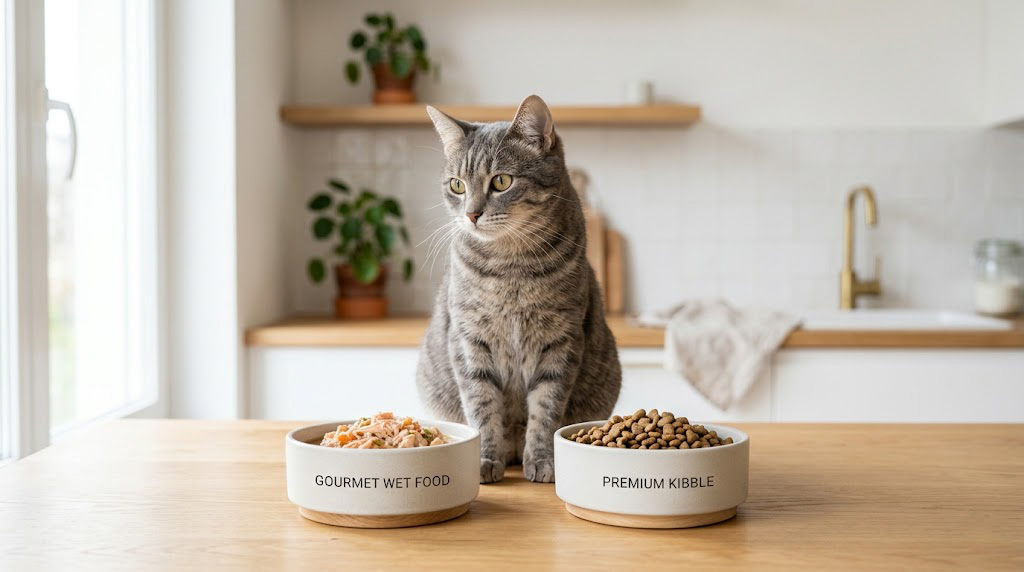
One of the most common questions cat owners ask is:
“Should I feed my cat wet food or dry food?”
The answer is not as simple as choosing one over the other.
The type of food you choose can influence your cat’s:
- water intake through food
- calorie intake
- portion size
- daily feeding routine
If you are also comparing specific products, our guide to the best cat food brands in Europe explains how to evaluate nutritional completeness, life-stage suitability, manufacturer transparency, and calorie density.
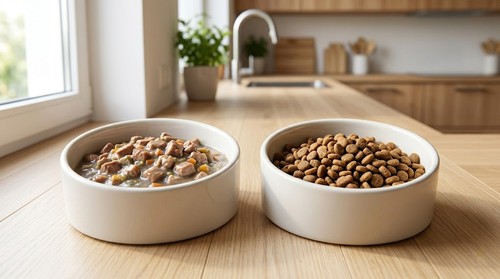
Table of Contents
- Quick Answer: Is Wet or Dry Food Better for Cats?
- Wet vs Dry Cat Food: Key Differences
- How to Choose Between Wet and Dry Cat Food
- Wet Cat Food: Advantages and Limitations
- Dry Cat Food: Advantages and Limitations
- How Food Moisture Affects Daily Hydration
- Wet or Dry Food for Indoor Cats?
- Can Cats Eat Dry Food Only?
- How to Combine Wet and Dry Cat Food
- Common Mistakes When Choosing Wet or Dry Cat Food
- Frequently Asked Questions
Quick Answer: Is Wet or Dry Food Better for Cats?
Neither wet nor dry food is automatically better for every cat.
Wet food provides substantially more water through meals and is often less calorie-dense per gram. Dry food is easier to store, measure, and use in a consistent feeding routine.
The better choice depends on your cat’s age, body condition, activity level, drinking habits, food preferences, calorie needs, and medical history.
Wet, dry, or mixed feeding can all be appropriate when the food is complete for the cat’s life stage and total daily calories are properly controlled.
If your cat drinks very little or has urinary, kidney, weight-related, or other medical concerns, ask your veterinarian before making a major change to the feeding plan.
Wet Cat Food vs Dry Cat Food: Key Differences at a Glance
| Factor | Wet Cat Food | Dry Cat Food |
|---|---|---|
| Moisture | High moisture, commonly around 70–80% | Low moisture, commonly around 6–10% |
| Water provided through food | Provides substantially more water with each meal | Provides less water through food, so drinking habits matter more |
| Calorie density | Often less calorie-dense per gram because of its higher water content | Often more calorie-dense per gram, so portions should be measured carefully |
| Storage | Requires refrigeration after opening and should be used within the recommended time | Easier to store and usually remains usable longer after opening when handled correctly |
| Cost | Often costs more per calorie or daily portion, depending on the product | Often costs less per calorie, although prices vary by formulation and brand |
| Texture | Soft texture may be easier to eat or preferred by some cats | Crunchy texture may suit some cats’ preferences |
| Portion control | Larger food volume may make portions feel more substantial | Smaller portions can contain more calories than owners expect |
| Dental considerations | Does not provide a mechanical cleaning effect | Standard kibble should not be treated as a replacement for dental care |
| May suit | Cats that prefer softer food, drink little, or may benefit from more food moisture | Cats that tolerate dry food well and households needing convenient storage and measured feeding |
The clearest difference between wet and dry cat food is moisture. Wet food provides substantially more water through meals, while cats eating dry food need to obtain more of their water by drinking.
Moisture alone does not determine whether a food is suitable or nutritionally complete. Whichever format you choose, check that the food is complete for your cat’s species and life stage, and consider calorie density, portion size, body condition, drinking habits, preferences, and medical history.
If cost is an important part of your decision, our guide to cost vs quality in cat food formulations explains how calorie density, portion size, nutritional completeness, and product transparency can affect the real daily cost of feeding.
How to Choose Between Wet and Dry Cat Food
The right food format depends less on finding one universal winner and more on matching the diet to your cat’s needs and your ability to feed consistent, measured portions.
Use the following considerations as a practical starting point:
| Your cat or feeding situation | What to consider |
|---|---|
| Your cat drinks very little water | Wet food provides substantially more water through meals. Fresh drinking water should still always be available. |
| Your cat is gaining excess weight | Compare calories per portion rather than judging food only by volume. Wet food is often less calorie-dense per gram, but total daily intake still matters most. |
| Your cat prefers soft textures | Wet food may be easier to accept, although texture preference varies between individual cats. |
| You need convenient storage and measured portions | Dry food is generally easier to store and portion, but small amounts can contain more calories than expected. |
| Your cat accepts both formats | Mixed feeding can provide flexibility, provided the calories from wet and dry food are calculated together. |
| Your cat is an indoor adult | Activity level, body condition, sterilisation status, treats, and total calorie intake may matter more than food format alone. |
| Your cat is a kitten or senior | Choose a complete food intended for the correct life stage. Texture, appetite, chewing ability, and individual health needs should also be considered. |
| Your cat has a diagnosed medical condition | Ask your veterinarian before changing the feeding plan, particularly for urinary, kidney, digestive, diabetic, or weight-related conditions. |
A practical choice also needs to work consistently. A theoretically suitable feeding plan will not help if portions cannot be measured accurately, opened food is stored incorrectly, or the cat regularly refuses to eat it.
Before choosing a product, check that the label identifies it as complete food for cats and that it is suitable for your cat’s life stage. FEDIAF explains that complete pet food is formulated to provide the required nutrients in appropriate amounts, while nutritional needs can vary by life stage, activity level, and health status. Read the FEDIAF guidance on the nutritional needs of cats and dogs.
Wet, dry, and mixed feeding can all be appropriate when nutritional completeness, calorie intake, water access, and individual tolerance are considered together.
Wet Cat Food: Advantages and Limitations
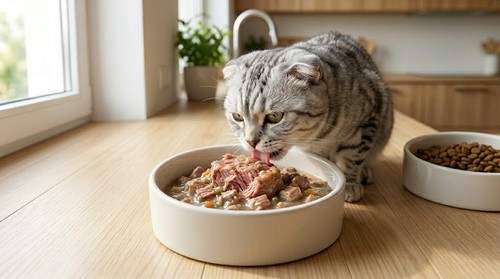
Wet food provides substantially more water through meals than dry food. However, food format alone does not determine whether a diet is nutritionally appropriate.
Advantages of wet cat food
- provides more water through meals
- offers a soft texture that some cats prefer
- may be easier for some cats to accept or eat
- is available in complete formulas for different life stages
- is often less calorie-dense per gram because of its higher water content
Limitations to consider
- opened food normally requires refrigeration
- unfinished portions should not be left out for long periods
- it often costs more per calorie or daily portion
- larger food volumes do not remove the need for portion control
- not every wet product is complete food, so the label must be checked
Wet food can increase the amount of water a cat receives through meals. It should not, however, be described as preventing urinary or kidney disease. Cats with urinary, kidney, or other medical conditions need an individually appropriate feeding plan reviewed with a veterinarian.
Dry Cat Food: Advantages and Limitations
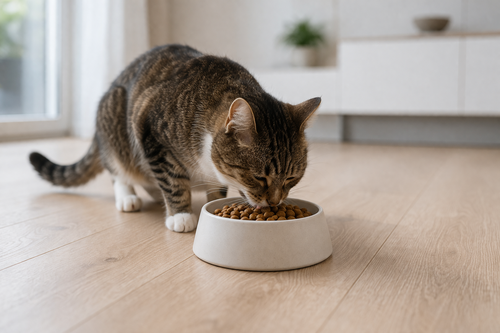
Dry food is widely used because it is convenient to store, portion, and include in a consistent feeding routine.
Advantages of dry cat food
- easy to store and measure
- often costs less per calorie
- remains usable longer after opening when stored correctly
- can be practical for measured meals and some feeding routines
- is available in complete formulas for different life stages
Limitations to consider
- provides much less water through food
- is often more calorie-dense, so small portions may contain more calories than expected
- free-feeding can make total daily intake difficult to monitor
- standard kibble should not be treated as a replacement for dental care
- suitability still depends on the complete formulation and the individual cat
Carbohydrate content varies between products. Dry food should not be judged only by whether it contains grains, because grain-free formulas may still use other starch sources.
Standard kibble should not be treated as dental care. Some foods are specifically designed as dental diets, but routine oral care and veterinary dental assessment may still be needed. See the AAHA guidance on nutrition and dental health.
Considering grain-free wet or dry food?
Grain-free does not automatically mean low-carbohydrate or healthier. Our guide to the best grain-free cat food in Europe explains what to check beyond the front-of-pack claim.
How Food Moisture Affects Daily Hydration
Wet food provides substantially more water through meals, while cats eating dry food need to obtain a larger share of their water by drinking.
This difference can matter for cats that naturally drink very little. However, feeding dry food does not automatically cause dehydration, and wet food should not be described as preventing urinary or kidney disease.
Whichever format you choose:
- provide fresh drinking water at all times
- monitor changes in drinking and urination
- check that the food is complete for your cat’s life stage
- consider total calorie intake as well as moisture
- speak with a veterinarian if your cat has an existing medical condition
Cats with urinary disease, kidney disease, diabetes, repeated digestive problems, or unexplained changes in drinking or urination need individual veterinary assessment before their feeding plan is changed.
Wet or Dry Food for Indoor Cats?
Indoor cats may have lower activity levels than cats with regular outdoor access, although this varies considerably between individuals. Their food choice should therefore be based on body condition, actual activity, sterilisation status, treat intake, and total daily calories, not indoor living alone.
Wet food may be useful for an indoor cat that drinks little or benefits from a larger food volume with fewer calories per gram. Dry food can also be appropriate when portions are measured carefully and the cat has reliable access to fresh water.
Mixed feeding is another option, but it is not automatically better. The calories from wet food, dry food, treats, and other extras must all be included in the cat’s total daily intake.
When choosing a feeding format for an indoor cat, consider:
- current weight and body condition
- actual daily activity
- sterilisation status
- drinking habits
- calorie density of the food
- portion size and treat intake
- food preferences and individual tolerance
Monitor weight and body condition over time rather than relying only on the feeding guide printed on the package.
For more detailed guidance, read our guide to the best diet for indoor cats.
Can Cats Eat Dry Food Only?
Some healthy cats can eat dry food as their main diet when it is complete for their life stage, portions are measured accurately, and fresh drinking water is always available.
However, dry-only feeding is not the best fit for every cat. Because dry food provides relatively little water through meals and is often calorie-dense, drinking habits and portion control become especially important.
If you feed dry food only:
- check that the label identifies it as complete food for cats
- choose a formula suitable for your cat’s life stage
- measure portions rather than leaving food available without limits
- include treats and extras in the total daily calorie intake
- provide fresh water in clean, accessible locations
- monitor weight, body condition, appetite, drinking, and urination
A cat that drinks little is not automatically dehydrated, but unexplained changes in drinking or urination should not be ignored.
Ask your veterinarian before using a dry-only feeding plan if your cat has urinary or kidney disease, diabetes, obesity, recurring digestive problems, difficulty chewing, or another diagnosed medical condition.
How to Combine Wet and Dry Cat Food
Mixed feeding can be a practical option for cats that accept both formats. It may provide more food moisture than dry-only feeding while retaining some of the convenience of dry food.
The key rule is simple: do not add wet food on top of your cat’s existing full dry-food portion. Calories from wet food, dry food, treats, and other extras must be counted together.
A practical mixed-feeding approach
-
Check the feeding guidance for both products.
Use the package guides as starting points rather than exact prescriptions. -
Decide how the daily food will be divided.
For example, you may offer wet food for one meal and dry food for another. -
Reduce the dry-food portion when adding wet food.
Do not continue feeding the original full dry-food amount. -
Measure both portions carefully.
Weighing dry food is usually more accurate than estimating it by eye. -
Include treats and extras.
Treats, toppers, and table food also contribute to total daily calorie intake. -
Monitor your cat’s response.
Watch appetite, stool quality, body weight, body condition, drinking habits, and acceptance of each food.
Example routine
- Morning → a measured portion of wet food
- Evening → a reduced, measured portion of dry food
- Throughout the day → fresh drinking water
This is only an example of meal timing. Appropriate portions depend on the calorie content of the specific foods and your cat’s age, body condition, activity level, and health status.
When introducing a new food or changing the wet-to-dry balance, make the transition gradually unless your veterinarian advises otherwise. Seek veterinary guidance if your cat repeatedly refuses food, develops persistent vomiting or diarrhoea, or shows other concerning changes.
Feeding a kitten? Kittens generally need an age-appropriate routine with smaller, more frequent meals than adult cats. See our age-by-age kitten feeding guide for weaning stages, meal frequency, and wet and dry feeding guidance.
Common Mistakes When Choosing Wet or Dry Cat Food
Choosing the right format is only part of a suitable feeding plan. Common mistakes include:
- choosing food based only on whether it is wet or dry
- assuming wet food is automatically healthier
- assuming dry food is automatically harmful
- adding wet food without reducing the existing dry-food portion
- overlooking calorie density and total daily intake
- leaving dry food available without monitoring how much the cat eats
- not checking whether the food is complete for the cat’s life stage
- changing foods too quickly
- ignoring changes in weight, body condition, appetite, drinking, or urination
The most useful approach is to evaluate the complete diet, measure portions, introduce changes gradually, and monitor how the individual cat responds.
For a broader checklist covering feeding, grooming, environment, and preventive care, read our guide to common mistakes in cat care and how to avoid them.
Conclusion
Wet and dry cat food both have benefits.
But the best choice depends on your cat’s individual needs.
Wet, dry, or mixed feeding can all be appropriate when the food is complete, portions are controlled, and the routine matches the cat’s age, body condition, water intake, preferences, and health needs.
FAQ: Wet vs Dry Cat Food
Is wet or dry food better for cats?
Neither format is automatically better for every cat. Wet food provides substantially more water through meals, while dry food is generally easier to store and measure. The right choice depends on your cat’s life stage, body condition, drinking habits, preferences, calorie needs, and medical history.
Can cats eat dry food only?
Some healthy cats can eat dry food as their main diet when it is complete for their life stage, portions are measured, and fresh water is always available. Dry-only feeding may not suit every cat, particularly when drinking habits, calorie control, chewing ability, or medical conditions are concerns.
Should I mix wet and dry cat food?
Mixed feeding can be practical when both foods are complete and suitable for your cat. The calories from wet food, dry food, treats, and extras must be calculated together. Wet food should not simply be added on top of an existing full dry-food portion.
Is wet food better for indoor cats?
Not automatically. Wet food may provide more food moisture and is often less calorie-dense per gram, but an indoor cat’s feeding plan should also consider actual activity, body condition, sterilisation status, treats, and total daily calorie intake.
Is dry cat food bad for cats?
Dry cat food is not automatically harmful. A complete dry food can be appropriate for many cats when portions are controlled and fresh water is available. Its suitability depends on the complete formulation, calorie density, life stage, drinking habits, and the individual cat.
Get Personalised Feeding Guidance for Your Cat
Choosing between wet and dry food is only one part of building a suitable feeding routine.
Your cat’s age, weight, body condition, activity, drinking habits, food preferences, and health history can all influence the decision.
FAMMO helps you organise these details and receive more personalised feeding guidance based on your cat’s profile. It does not replace veterinary diagnosis or treatment.
Create your free account and build your cat’s nutrition profile