
Wet and dry dog food can both be suitable choices when the food is complete, nutritionally appropriate for your dog’s life stage, and fed in the right amount. Wet food provides more moisture and may suit picky eaters, senior dogs, or dogs that need a softer texture. Dry food is usually more affordable, convenient, and easier to store and portion. Mixed feeding can combine the advantages of both formats.
The right choice depends on your dog’s age, activity level, appetite, hydration habits, chewing comfort, calorie needs, daily routine, health background, and budget. If you are also comparing specific products, see our guide to Best Dog Food Brands in Europe 2026.
Quick Answer: Is Wet or Dry Dog Food Better?
Neither format is universally better. Wet food is generally more useful when moisture, palatability, or softer texture matters. Dry food is generally more practical when cost, storage, convenience, and precise portioning matter. For many healthy dogs, mixed feeding can provide a practical balance.
Feeding option | May suit | Main advantages | Main limitations |
|---|---|---|---|
Wet dog food | Picky eaters, senior dogs, dogs needing more dietary moisture or softer food | Higher moisture, stronger aroma, softer texture | Usually costs more and needs refrigeration after opening |
Dry dog food | Healthy adult dogs, active dogs, structured feeding routines and budget-conscious households | Convenient, easy to store and portion, usually lower cost per calorie | Low moisture and may be less appealing to some dogs |
Mixed feeding | Dogs and owners who benefit from both formats | Combines moisture, variety and convenience | Portions must be adjusted to avoid excess calories |
Veterinary note: If your dog has a diagnosed kidney, urinary, digestive, pancreatic, dental, or other medical condition, ask your veterinarian before making a significant diet change.
Wet vs. Dry Dog Food: Key Differences
Wet and dry dog food differ mainly in moisture, energy density, texture, storage and feeding practicality.
Neither format is automatically healthier. The more important questions are whether the food is complete, suitable for your dog’s life stage, provided in an appropriate portion and produced with reliable nutritional and quality-control standards.
What Is Wet Dog Food?
Wet dog food is usually sold in cans, trays or pouches. It contains substantially more moisture than dry food and normally has a softer texture and stronger aroma.
This may make wet food useful for dogs that:
prefer more aromatic meals
need a softer texture
drink relatively little water
have a reduced appetite
benefit from more moisture in their meals
Wet food usually provides fewer calories per gram than dry food because a larger proportion of its weight is water. As a result, a dog may need a larger food volume to obtain the same number of calories.
Some wet products are labelled as complete pet food, while others are complementary foods, toppers or occasional additions. Under European pet-food terminology, complete food is intended to provide the nutrients needed for a daily ration when fed as directed, while complementary food must be combined with other foods. See the FEDIAF Nutritional Guidelines for Complete and Complementary Pet Food for the current European framework.
A complementary product should not replace a complete daily diet unless the overall feeding plan has been properly formulated.
What Is Dry Dog Food?
Dry dog food, commonly called kibble, contains much less moisture and is usually more energy-dense than wet food.
It is generally easier to store, weigh, transport and use with automatic or puzzle feeders. It also tends to cost less per calorie, which may make it more practical for medium, large or highly active dogs.
Most kibble is produced through extrusion, a process in which ingredients are mixed, cooked, shaped and dried. Processing alone does not determine whether a food is nutritionally appropriate. The quality of the final formulation, nutritional adequacy, manufacturer expertise and quality-control procedures matter more.
Dry food provides relatively little water through the meal, so dogs eating primarily kibble obtain most of their water by drinking.
Standard kibble should not be treated as a substitute for toothbrushing, appropriate dental products or veterinary dental care. Some specially designed dental diets may have supporting evidence, but this does not apply automatically to every dry food.
Wet vs. Dry Dog Food Comparison
Factor | Wet Dog Food | Dry Dog Food |
|---|---|---|
Moisture | Substantially higher | Substantially lower |
Energy density | Usually lower per gram | Usually higher per gram |
Meal volume | More food volume for the same calories | Less food volume for the same calories |
Texture | Soft | Firm or crunchy |
Aroma and palatability | Often stronger and more appealing | Varies between products and dogs |
Water provided through food | Higher | Lower |
Portion measurement | Must be measured by weight or calories | Easy to weigh, but small excess portions can add significant calories |
Storage after opening | Usually requires refrigeration and prompt use | Usually stored in a cool, dry place according to package instructions |
Cost per calorie | Usually higher | Usually lower |
Travel and automatic feeders | Less convenient | More convenient |
Chewing comfort | May suit dogs needing softer food | May be uncomfortable for dogs with dental pain |
Dental care | Does not clean teeth | Standard kibble should not be relied on for dental cleaning |
Complete-diet status | May be complete or complementary | Often complete, but the label must still be checked |
Mixed feeding | Can replace part of the dry-food calories | Can provide the measured base of a mixed diet |
Exact moisture, calorie and nutrient values vary substantially between products. Always check the individual label rather than assuming that all wet foods or all dry foods are nutritionally similar.

What Matters More Than Food Format?
Before choosing wet, dry or mixed feeding, check:
whether the product is complete or complementary
the intended species and life stage
calories per 100 grams or serving
your dog’s current weight and body condition
appetite and chewing comfort
activity level
voluntary water intake
digestive response
relevant medical conditions
realistic cost and storage requirements
manufacturer nutritional expertise and quality-control information
The food format is only one part of the decision. The specific formulation, total calorie intake and suitability for the individual dog matter more than whether the food comes from a can or a bag.
For a step-by-step explanation of complete food, complementary food, analytical constituents and feeding instructions, read How to Read a Pet Food Label in Europe.
Veterinary note: Dogs with diagnosed kidney disease, urinary disorders, pancreatitis, diabetes, persistent digestive problems or other medical conditions may need a therapeutic or individually selected diet. Do not base these decisions on food format alone.
Pros and Cons of Wet and Dry Dog Food
Wet Dog Food: Pros and Cons
Pros: More water through meals, softer texture and a stronger aroma that may appeal to some dogs.
Cons: Usually higher cost per calorie, refrigeration after opening and larger portions for the same calorie intake. Some products are complementary foods rather than complete daily diets.
Dry Dog Food: Pros and Cons
Pros: Convenient storage, easy weighing, lower cost per calorie in many products and practical use during travel or with suitable feeders.
Cons: Less water through meals, higher calorie density and a hard texture that may be uncomfortable for dogs with dental pain.
Neither format is automatically healthier. Choose a complete food appropriate for your dog’s life stage, measure portions and check how your dog responds. Ordinary kibble should not be treated as a substitute for dental care.
Wet vs Dry Dog Food: Compare Cost per Day
Compare cost for the same number of calories, rather than comparing package prices alone.
Daily food cost = grams fed per day × price per kilogram ÷ 1,000
The example below uses hypothetical prices and a 300-kcal food allowance solely to explain the calculation. It is not a feeding recommendation or a market-price survey.
Feeding option | Example calorie density | Example price | Amount providing 300 kcal | Approximate cost |
|---|---|---|---|---|
Dry food | 360 kcal per 100 g | €5 per kg | 83.3 g | €0.42 |
Wet food | 100 kcal per 100 g | €4 per kg | 300 g | €1.20 |
Mixed: 70% dry / 30% wet calories | Same example products | Same example prices | 58.3 g dry + 90 g wet | €0.65 |
Repeat the calculation using your products’ actual prices and calorie information. Your dog’s appropriate calorie intake depends on their individual needs.

What Veterinary Nutrition Guidance Says About Wet and Dry Dog Food
Veterinary nutrition guidance does not identify wet food or dry food as universally superior.
The more important questions are whether the food is nutritionally appropriate, suitable for the dog’s life stage, fed in an appropriate amount and produced with reliable formulation and quality-control standards.
The WSAVA Global Nutrition Guidelines recommend an individually tailored approach that considers the animal, the diet, the feeding method and relevant health factors.
Nutritional Adequacy Matters More Than Format
A food should not be judged only by whether it is wet or dry.
For a healthy dog, important checks include:
whether the product is complete or complementary
whether it is suitable for the correct life stage
its calorie density
the dog’s current weight and body condition
feeding amount and treat intake
appetite and digestive response
manufacturer nutritional expertise
quality-control and product-testing procedures
The ingredient list alone cannot show whether the finished food provides an appropriate nutrient balance. WSAVA’s guidance on selecting pet food recommends looking beyond marketing language and asking about formulation expertise, nutritional adequacy and quality control.
A well-formulated dry food may be more appropriate than a poorly selected wet food, and the reverse can also be true.
Moisture Changes How Dogs Obtain Water
Wet food provides substantially more water through meals than dry food. Dogs eating primarily dry food obtain a greater proportion of their water by drinking.
For many healthy dogs, either approach can work when fresh water is always available and total intake is adequate.
A higher-moisture diet may be practically useful when a dog:
drinks relatively little water
prefers softer, more aromatic meals
has difficulty chewing hard food
needs encouragement to eat
is following a veterinarian-directed feeding plan that includes increased dietary moisture
However, observed drinking behaviour alone does not establish whether a dog is adequately hydrated. Water needs and drinking patterns can vary with food moisture, body size, activity, environmental temperature, health status and other factors.
For this reason, this guide does not provide one universal daily water target for every dog.
Wet Food Is Not Automatically a Kidney or Urinary Diet
Higher-moisture food can increase the amount of water consumed through meals, but moisture alone does not make a product appropriate for kidney disease, bladder stones, urinary problems or another medical condition.
A therapeutic diet may also need specifically controlled levels of nutrients such as:
phosphorus
sodium
protein
fat
fibre
minerals
calories
The relevant requirements depend on the diagnosis and the individual dog.
Do not replace a prescribed veterinary diet with ordinary wet food simply because it contains more moisture. Dogs with kidney disease, urinary disorders, pancreatitis, diabetes or persistent digestive problems need a feeding plan selected with their veterinarian.
Standard Kibble Is Not Dental Care
The idea that all dry food cleans a dog’s teeth is an oversimplification.
Standard kibble may create some chewing friction, but it should not be relied on to prevent plaque, tartar or periodontal disease. Many pieces of kibble break apart without producing meaningful cleaning across the tooth surface.
Some specially designed dental diets and oral-care products have supporting evidence. The Veterinary Oral Health Council’s accepted-products list identifies products that have met its standards for helping control plaque or tartar.
For routine dental care, appropriate toothbrushing, evidence-supported dental products and veterinary dental assessment are more reliable than assuming ordinary kibble will clean the teeth.
Processing Does Not Determine Quality by Itself
Dry food is generally cooked and dried, commonly through extrusion. Wet food is also processed and usually cooked and sealed in cans, trays or pouches.
The fact that a food is processed does not by itself show whether it is nutritionally appropriate or inappropriate.
More useful questions include:
Was the food formulated by appropriately qualified professionals?
Does the finished product meet its intended nutritional profile?
Does the manufacturer analyse the final diet?
Are ingredient and finished-product quality controls in place?
Is the company able to provide meaningful nutritional information?
Is the product appropriate for the individual dog?
Processing method is one factor in food production, but the quality and suitability of the finished diet matter more than broad labels such as “processed,” “natural” or “premium.”
When Food Format Requires Veterinary Guidance
Ask a veterinarian before making a substantial feeding change when your dog has:
diagnosed kidney or urinary disease
pancreatitis or a history of fat intolerance
diabetes
recurring vomiting or diarrhoea
suspected food allergy
significant dental pain
unexplained weight loss or gain
persistent appetite changes
a prescribed therapeutic diet
difficulty maintaining an appropriate body condition
In these situations, choosing wet or dry food is only one part of the decision. The specific nutrient profile, calorie intake, feeding schedule and medical plan may all be important.
Key takeaway: Veterinary nutrition guidance supports choosing food according to nutritional adequacy and the individual dog—not declaring wet food or dry food universally better.
Which Dogs May Benefit from Wet, Dry or Mixed Feeding?
The most suitable food format depends on what the individual dog needs from the meal.
Wet food may be more practical when moisture, softer texture or stronger meal appeal matters. Dry food may be more practical when energy density, affordability, storage or feeding convenience matters. Mixed feeding may help when a dog benefits from features of both formats.
The examples below are general decision factors, not medical prescriptions.
Dog or household situation | Format that may be practical | Why it may help | What to check |
|---|---|---|---|
Reduced appetite or picky eating | Wet or mixed feeding | Stronger aroma and softer texture may improve meal interest | Sudden appetite changes require investigation |
Dental pain or chewing difficulty | Wet food or softened complete food | Softer texture may be easier to eat | Dental pain needs veterinary assessment |
Low voluntary water intake | Wet or mixed feeding | Provides more water through meals | Low drinking does not automatically mean dehydration |
Large or highly active dog | Dry or mixed feeding | Higher calorie density and lower cost per calorie | Portions must still match body condition |
Busy household or frequent travel | Dry food | Easier storage, transport and use in feeders | Fresh water must remain available |
Dog needing more meal variety | Mixed feeding | Combines different textures and aromas | Do not add wet food without reducing other calories |
Dog prone to weight gain | Any format with measured calories | Total calorie intake matters more than format alone | Monitor weight and body condition |
Puppy or growing large-breed dog | Complete growth food in any suitable format | Growth-stage nutritional adequacy is the priority | Use food intended for growth and appropriate breed size |
Older dog with appetite or chewing changes | Wet or mixed feeding may be useful | May provide softer texture and stronger meal appeal | Age alone does not determine the correct diet |
Diagnosed medical condition | Veterinarian-selected diet | Specific nutrient levels may be required | Do not choose only by moisture or texture |
If mixed feeding suits your dog, the next section explains how to replace dry-food calories with wet-food calories without unintentionally increasing total calorie intake.
When Food Format Is Not the Main Decision
For some dogs, the specific nutrient profile matters more than whether the food is wet or dry.
This includes dogs with:
kidney or urinary disease
pancreatitis
diabetes
food allergies requiring veterinary assessment
chronic digestive disease
obesity or unexplained weight loss
a prescribed therapeutic diet
In these situations, an ordinary wet food is not automatically safer than dry food, and an ordinary dry food is not automatically more complete or appropriate.
The diet may need controlled levels of fat, protein, phosphorus, sodium, fibre, minerals or calories. Follow veterinary guidance rather than choosing by format alone.
Key takeaway: Choose wet, dry or mixed feeding according to the individual dog’s nutritional needs, calorie requirements, eating comfort and daily routine. Breed, age or food format alone should not make the decision.
Can You Mix Wet and Dry Dog Food?
Yes. Wet and dry dog food can be combined when the portions are adjusted by calories and the overall diet remains nutritionally appropriate for the dog.
Mixed feeding may provide:
more water through meals than dry food alone
stronger aroma and meal appeal
a balance between convenience and palatability
more texture variety
lower daily cost than an all-wet diet
a gradual way to move between food formats
The main risk is accidental overfeeding. Wet food should not simply be added on top of the dog’s normal dry-food portion.
Instead, the calories added from wet food should replace approximately the same number of calories removed from dry food.
Quick answer: There is no universal wet-to-dry ratio for dogs. Calculate the combination from the calorie information on both product labels.
How to Calculate a Wet-to-Dry Dog Food Ratio
Use these five steps.
Step 1: Start With the Dog’s Current Daily Calories
First identify approximately how many calories the dog currently receives each day from meals, treats and other food.
The feeding guide on the package can provide a starting point, but the appropriate amount also depends on:
current weight
body condition
life stage
activity level
neuter status
health status
weight trend
treat intake
For more help with portions and calorie-based feeding, read How Much Should I Feed My Dog?.
Feeding guides are starting estimates rather than guaranteed requirements. Monitor the dog’s body condition and weight trend and adjust the amount when necessary.
Step 2: Check the Calories in Both Foods
Find the calorie information for the dry and wet products.
It may be shown as:
kcal per 100 grams
kcal per gram
kcal per cup
kcal per can, pouch or tray
Using grams is usually more precise than estimating portions with cups, scoops or visual bowl volume.
When a label provides calories per 100 grams, calculate calories per gram like this:
Calories per gram = kcal per 100 g ÷ 100
For example:
360 kcal per 100 g ÷ 100 = 3.6 kcal per gram
Step 3: Decide How Many Calories to Replace
There is no standard percentage that every dog should receive from wet food.
A small amount may be enough when the goal is to improve aroma or meal acceptance. A larger proportion may be used when more dietary moisture or a softer meal is desired.
The chosen proportion should still fit:
total calorie needs
body condition
digestive tolerance
budget
feeding routine
the nutritional status of both products
any veterinary recommendations
Ratios such as 75/25, 70/30 or 50/50 should describe the percentage of calories, not equal weights or equal bowl volumes.
Step 4: Remove Dry-Food Calories
Calculate how many calories will come from wet food and remove approximately the same number from the dry-food portion.
Dry-food grams to remove =
Calories being replaced ÷ Dry-food calories per gram
Step 5: Add the Equivalent Wet-Food Calories
Next, calculate how many grams of wet food provide the calories being replaced.
Wet-food grams to add =
Calories being replaced ÷ Wet-food calories per gram
The two food weights will usually be very different because wet food contains substantially more water and is generally less calorie-dense.
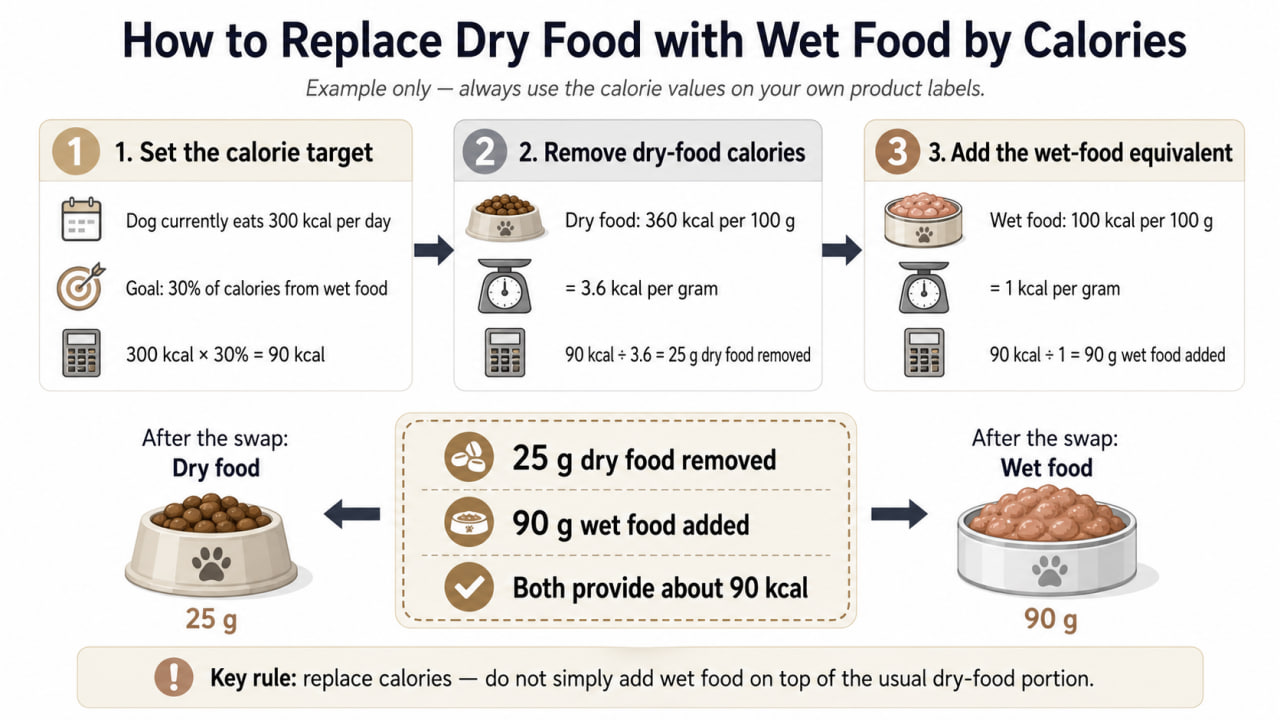
Worked Wet-to-Dry Conversion Example
This example is for explaining the calculation only. Use the calorie values from the actual products you feed.
Assume a dog currently receives:
300 kcal per day from dry food
dry food containing 360 kcal per 100 g
wet food containing 100 kcal per 100 g
The owner wants 30% of the meal calories to come from wet food.
1. Calculate the Wet-Food Calorie Target
300 kcal × 30% = 90 kcal from wet food
2. Calculate How Much Dry Food to Remove
The dry food contains:
360 kcal per 100 g = 3.6 kcal per gram
Therefore:
90 kcal ÷ 3.6 kcal per gram = 25 g dry food removed
3. Calculate How Much Wet Food to Add
The wet food contains:
100 kcal per 100 g = 1 kcal per gram
Therefore:
90 kcal ÷ 1 kcal per gram = 90 g wet food added
In this example, the owner would remove approximately 25 grams of dry food and add approximately 90 grams of wet food.
The calorie replacement is approximately equal even though the food weights are not.
Change | Amount | Calories |
|---|---|---|
Dry food removed | 25 g | 90 kcal |
Wet food added | 90 g | 90 kcal |
Approximate calorie change | — | 0 kcal |
This does not mean that 25 grams of every dry food always equals 90 grams of every wet food. Calorie density varies substantially between products.
Complete Food vs. Complementary Toppers
Check whether the wet product is labelled as complete pet food or complementary pet food.
A complete food is formulated to provide the required daily nutrients when fed appropriately for its intended life stage. A complementary food, topper or treat is intended to be combined with other food and may not provide a complete nutrient profile on its own.
For a healthy dog, combining two complete foods intended for the same appropriate life stage may be practical when calories are controlled.
Complementary products require more caution. They should not displace a substantial amount of a complete diet unless the total feeding plan has been properly formulated.
Do not assume that a food is complete because it is sold in a full-size can, pouch or tray. Check the label.
Can Wet and Dry Food Be Served in the Same Bowl?
Yes. For many healthy dogs, wet and dry food can be:
mixed together in the same bowl
served in separate meals
offered as a measured wet portion over kibble
alternated within the same day
The best method depends on the dog’s preferences and the owner’s routine.
Serving the foods separately can make it easier to see which product a dog eats or refuses. Mixing them may improve aroma and texture but can make uneaten wet food less suitable to leave at room temperature.
Follow the wet-food package instructions for refrigeration and disposal after opening or serving.
How to Introduce Mixed Feeding
Introduce a meaningful food change gradually when practical, particularly for dogs with a history of digestive sensitivity.
A gradual transition may look like:
Transition stage | Existing diet | New mixed-feeding plan |
|---|---|---|
First stage | About 75% | About 25% |
Second stage | About 50% | About 50% |
Third stage | About 25% | About 75% |
Final stage | 0% | 100% of the intended new plan |
The percentages in this table describe the transition from the old feeding plan to the new feeding plan—not the final wet-to-dry ratio.
The transition may take approximately 7–10 days, but some dogs may need a slower change. Follow veterinary advice when a rapid or medically directed diet change is required.
During the transition, monitor:
stool consistency
vomiting
appetite
abdominal discomfort
energy
body weight
skin or ear changes when food sensitivity is a concern
Pause the transition and seek veterinary advice when significant or persistent symptoms occur.
Common Mixed-Feeding Mistakes
Adding Wet Food Without Reducing Dry Food
This increases total calorie intake and may contribute to gradual weight gain.
Comparing Wet and Dry Food by Weight Alone
One gram of dry food usually contains more calories than one gram of wet food. Equal weights are rarely calorie-equivalent.
Using Bowl Volume as the Main Measurement
A spoonful, scoop or cup can vary in weight. A kitchen scale provides more consistent portions.
Treating a Complementary Topper as a Complete Meal
Complementary food may improve taste but may not provide all required nutrients.
Ignoring Treats and Table Food
Treats, chews, training rewards and leftovers also contribute calories. They should be included when assessing the total daily intake.
Using a Fixed Ratio for Every Dog
A 50/50 or 70/30 ratio is not automatically appropriate. The right proportion depends on the two products and the individual dog.
Changing Several Foods at Once
Changing multiple products, treats and supplements simultaneously can make it difficult to identify what caused a digestive or appetite change.
When Mixed Feeding Needs Veterinary Guidance
Ask a veterinarian before creating a mixed feeding plan when the dog has:
a prescribed therapeutic diet
kidney or urinary disease
pancreatitis or a history of fat intolerance
diabetes
chronic digestive disease
suspected food allergy
significant obesity or unexplained weight loss
a medical need for controlled phosphorus, sodium, fat, protein or other nutrients
Mixing an ordinary wet food with a therapeutic dry diet can alter the intended nutrient profile. A product should not be added to a prescribed diet only because it appears healthy or provides more moisture.
Key takeaway: Calculate mixed feeding by calories. Remove the calories supplied by wet food from the existing dry-food portion, check that the overall diet remains appropriate and monitor the dog’s body condition over time.
How to Compare Wet and Dry Dog Food Labels
Wet and dry dog food labels cannot always be compared directly because the products contain very different amounts of water.
A wet food may show a lower protein or fat percentage on the label simply because water makes up a larger proportion of its total weight. Converting the values to a dry matter basis removes the moisture difference and allows a more consistent nutrient comparison.
Quick answer: Use dry matter basis to compare nutrient percentages. Use calorie information to compare feeding amounts.
What Is Dry Matter Basis?
Dry matter is the part of the food that remains after its moisture is removed from the calculation.
To convert a nutrient from its as-fed value to dry matter basis, first calculate the dry matter percentage:
Dry matter % = 100 − Moisture %
Then use:
Nutrient on a dry matter basis =
(Nutrient % as fed ÷ Dry matter %) × 100
Dry Matter Basis Example
Assume two example products show:
Wet food: 8% protein and 78% moisture
Dry food: 26% protein and 10% moisture
Wet Food
First calculate the dry matter:
100 − 78 = 22% dry matter
Then calculate protein on a dry matter basis:
8 ÷ 22 × 100 = 36.4% protein on a dry matter basis
Dry Food
First calculate the dry matter:
100 − 10 = 90% dry matter
Then calculate protein on a dry matter basis:
26 ÷ 90 × 100 = 28.9% protein on a dry matter basis
Example product | Protein as fed | Moisture | Protein on a dry matter basis |
|---|---|---|---|
Wet food | 8% | 78% | 36.4% |
Dry food | 26% | 10% | 28.9% |

In this example, the wet food contains a higher proportion of protein after moisture is removed from the comparison.
This does not mean that wet food is generally higher in protein than dry food. The result applies only to the two example products. Always calculate from the values on the products you are actually comparing.
When Is Dry Matter Basis Useful?
Dry matter basis can be useful when comparing:
protein levels in wet and dry food
fat levels between different formats
fibre or mineral values when both products provide them
a wet food with a dry food intended for the same life stage
how a substantial wet-food addition may change the overall nutrient profile
It is most useful when the products have very different moisture levels.
For ordinary portion planning, however, calories remain more important than dry matter percentages. A food may show a high protein percentage on a dry matter basis while still providing a very different number of calories per 100 grams.
What Dry Matter Basis Cannot Tell You
Dry matter basis does not show:
protein digestibility or amino-acid quality
whether the overall diet is nutritionally complete
whether the food is appropriate for the dog’s life stage
calories per serving
ingredient or finished-product quality control
whether a therapeutic nutrient target is met
how well the individual dog will tolerate the food
It should therefore be used as one comparison tool, not as a complete food-quality score.
A higher protein or lower carbohydrate percentage does not automatically make one product more appropriate for every dog.
Understanding European Pet Food Labels
European pet-food labels commonly provide nutritional information under analytical constituents.
This normally includes:
crude protein
crude oils and fats
crude fibre
crude ash
moisture when declaration is required
FEDIAF’s guide to understanding pet food labels explains that European labels also include composition, additives, analytical constituents and feeding guidance.
If moisture is not shown on a dry-food label, check the manufacturer’s product information before performing a dry matter calculation. Do not silently assume a moisture value when an accurate comparison matters.
Can You Estimate Carbohydrates From the Label?
Carbohydrate is not always listed directly on European dog-food labels.
When all required values are available, an approximate as-fed carbohydrate value can be calculated by difference:
Estimated carbohydrate % =
100 − protein − fat − fibre − moisture − ash
This is an estimate, sometimes referred to as nitrogen-free extract, rather than a directly measured carbohydrate declaration.
The calculation becomes less reliable when moisture or ash is missing, and it does not describe the type, digestibility or nutritional role of the carbohydrate.
Comparing Foods for a Medical Condition
Do not use a general dry matter calculation by itself to select food for kidney disease, pancreatitis, diabetes, urinary disease or another diagnosed condition.
For example, a veterinarian may need nutrient values that are:
unavailable on the retail label
expressed per 1,000 kcal rather than as a percentage
based on laboratory or manufacturer data
interpreted alongside bloodwork, diagnosis and calorie intake
When a specific nutrient limit matters medically, request the relevant information from the manufacturer and review it with the veterinarian managing the dog.
Key takeaway: Dry matter basis helps compare nutrient percentages after accounting for moisture. Calories determine portion replacement, and the complete formulation determines whether the food is appropriate.
How to Choose Wet, Dry or Mixed Feeding by Life Stage
A dog’s life stage changes which nutrients, calorie levels and feeding routines are appropriate.
Wet, dry and mixed feeding can all be suitable, but the food must first be complete and intended for the dog’s current life stage. Food format should support the dog’s needs, it should not replace life-stage suitability.
Puppies and Growing Dogs
Puppies need food formulated for growth. Adult-maintenance food should not be used as the main diet for a growing puppy unless a veterinarian has specifically directed otherwise.
Wet puppy food, dry puppy food and mixed feeding can all work when the products are:
labelled as complete for growth
appropriate for the puppy’s expected adult size
fed in measured portions
introduced gradually
adjusted as the puppy grows
well tolerated
Softer wet food or moistened puppy food may be easier during early weaning and food transition. Dry puppy food may be convenient for measured meals, training and gradual texture development.
For large-breed puppies, nutritional adequacy for controlled growth matters more than whether the food is wet or dry. Do not add calcium, mineral supplements or unbalanced toppers to a complete growth diet without professional guidance.
For more detail on evaluating complete growth formulas, read Best Puppy Food in Europe.
Healthy Adult Dogs
For many healthy adult dogs, any of the three feeding formats can be practical:
Wet food may suit dogs that prefer softer, more aromatic meals or benefit from more water through food.
Dry food may suit dogs that eat consistently, drink normally and benefit from convenient, calorie-dense portions.
Mixed feeding may suit dogs that benefit from both moisture and feeding convenience.
The correct choice depends less on the dog being an “adult” and more on:
body condition
activity level
appetite
calorie requirements
chewing comfort
water intake
digestive tolerance
daily routine
neuter status
treat intake
A healthy adult dog gaining excess weight does not necessarily need a different food format. The first issue may be total calorie intake, portion accuracy or treat consumption.
Older Dogs
There is no single age at which every dog becomes senior. Large dogs may show age-related changes earlier than smaller dogs, and individual health and body condition matter more than a fixed birthday.
Wet or mixed feeding may be practical for an older dog that:
has reduced appetite
prefers stronger aromas
needs a softer texture
has chewing discomfort
benefits from more water through meals
Dry food may remain appropriate when the dog chews comfortably, drinks adequately and maintains a healthy body condition.
Older dogs do not automatically need low-protein food, supplements or a wet-only diet. Their nutritional needs depend on muscle condition, activity, weight trend, organ function and diagnosed medical conditions.
Unexplained weight loss, reduced appetite, increased thirst, dental pain or persistent digestive changes require veterinary assessment rather than repeated food-format changes.
Pregnant or Lactating Dogs
Pregnancy and lactation substantially change energy and nutrient requirements.
A pregnant or nursing dog should receive a complete food appropriate for reproduction or growth, according to veterinary or manufacturer guidance. Wet, dry or mixed feeding may be used, but ordinary adult-maintenance food may not provide the correct nutritional profile.
During lactation, the dog’s calorie needs may increase considerably. Feeding decisions should consider:
litter size
body condition
appetite
calorie density
water availability
digestive tolerance
veterinary guidance
Do not use homemade additions, calcium supplements or large amounts of complementary food without professional advice, because these can alter the nutrient balance of an otherwise complete diet.
Neutered Dogs and Dogs Prone to Weight Gain
Neutering does not determine whether a dog should eat wet or dry food, but calorie requirements and appetite may change.
Wet food may provide a larger food volume for the same number of calories, depending on the product. Dry food may be easier to weigh precisely but is usually more calorie-dense.
Mixed feeding can also work when the calories from both products are calculated accurately.
The most important controls are:
weighing portions
counting treats and chews
monitoring body condition
checking weight trends
adjusting calories when activity changes
A food labelled “light” or “weight management” is not automatically appropriate for every dog. Check its calorie content, nutritional adequacy and intended use.
Active, Working or Sporting Dogs
Highly active dogs may need more calories than sedentary household dogs.
Dry food may be practical because it provides more calories in a smaller volume. Wet or mixed feeding may still help with palatability and meal moisture.
However, highly active dogs should not automatically receive unrestricted portions. Energy requirements vary according to:
exercise type and duration
environmental temperature
body size
training schedule
recovery needs
body condition
individual metabolism
Monitor performance, weight and body condition rather than relying only on breed labels or general feeding charts.
Monitor the Dog, Not Only the Feeding Plan
After selecting a feeding format, monitor:
body weight
body condition
muscle condition
appetite
stool quality
vomiting or regurgitation
energy and activity
chewing comfort
water intake
skin and coat changes
A feeding plan that looked suitable on paper may still need adjustment based on the dog’s response.
For guidance on adjusting meal schedules alongside food format, read How Often Should I Feed My Dog?.
Key takeaway: First choose a complete food suitable for the dog’s life stage. Then choose wet, dry or mixed feeding according to calories, body condition, appetite, eating comfort, tolerance and daily practicality.
European Dog Food Labels: What to Check Before Choosing Wet or Dry Food
Before choosing wet or dry dog food in Europe, check whether the product is labelled as complete or complementary and whether it is intended for your dog’s life stage.
Compare calorie information when planning portions. Use dry matter basis when comparing nutrient percentages across foods with different moisture levels. If information you need is missing, ask the manufacturer rather than assuming a value.
Packaging terms such as “premium” or “natural” do not replace these checks. For a detailed walkthrough, read How to Read a Pet Food Label in Europe.
Wet vs. Dry Dog Food and Sustainability
The environmental impact of dog food cannot be determined from the words wet or dry alone.
A meaningful comparison should consider the product’s full life cycle, including:
ingredient sourcing
food formulation
calorie density
manufacturing
packaging
transport
storage
food waste
end-of-life packaging disposal
The Product Environmental Footprint Category Rules for Pet Food provide a standardised European framework for assessing these impacts across the full product life cycle.
Ingredients May Matter More Than Format
Ingredient selection can be a major part of a pet food’s environmental footprint.
A product containing large amounts of resource-intensive ingredients may have a different impact from one that makes effective use of suitable by-products from the human food chain.
This does not mean that owners should choose food only according to a sustainability claim. The food must still be:
nutritionally complete when used as the main diet
suitable for the dog’s life stage
well tolerated
fed in an appropriate amount
safe and practical to store
Practical Steps for Dog Owners
To reduce unnecessary environmental impact without compromising nutrition:
avoid consistent overfeeding
measure portions to reduce food waste
store food according to package instructions
choose package sizes that can be used before the food deteriorates
follow local recycling guidance
look for specific, verifiable environmental information rather than vague “eco-friendly” claims
contact the manufacturer when sourcing or packaging information is unclear
Mixed feeding is not automatically more or less sustainable. Its impact depends on the specific wet and dry products, the proportions used and whether the feeding plan reduces or increases waste.
Key takeaway: Sustainability should be assessed across ingredients, formulation, packaging, transport and waste. Choose a nutritionally appropriate food first, then compare credible environmental information between suitable products.
Wet vs. Dry Dog Food FAQ
Is wet food better than dry food for dogs?
Neither format is universally better.
Wet food may be more practical when a dog benefits from more water through meals, softer texture or stronger aroma. Dry food may be more practical when affordability, storage, calorie density and easy portioning matter.
The better choice is the complete food that suits the dog’s life stage, calorie needs, body condition, eating comfort and health status.
Which is better for hydration, dental health and cost?
Each format has a different practical advantage:
Hydration: Wet food provides substantially more water through meals.
Cost: Dry food is usually less expensive per calorie.
Dental health: Ordinary dry food should not be relied on to clean teeth, and wet food does not provide dental cleaning either.
For dental health, toothbrushing, evidence-supported dental products and veterinary dental care are more reliable than choosing food based only on texture.
Mixed feeding may offer a balance between dietary moisture, meal appeal and cost, provided the portions are calculated correctly.
Can I mix wet and dry dog food together?
Yes. Wet and dry food can be mixed in the same bowl or served in separate meals.
The important rule is to calculate the total calories from both foods. Do not add wet food on top of the usual full dry-food portion, because this may increase daily calorie intake and contribute to weight gain.
Both foods should also be appropriate for the dog’s life stage. Check whether the wet product is complete or complementary before using it as a substantial part of the diet.
How much wet food is equivalent to dry food?
There is no fixed wet-to-dry conversion that works for every product.
Use the calorie values on the two labels:
Dry-food grams to remove =
Calories being replaced ÷ Dry-food calories per gram
Wet-food grams to add =
Calories being replaced ÷ Wet-food calories per gram
For example, if 25 grams of a particular dry food provides 90 kcal and 90 grams of a particular wet food also provides 90 kcal, those portions are approximately calorie-equivalent.
The calculation must be repeated with the actual calorie density of the foods being used.
Is it okay to feed only wet food or only dry food?
Yes. Either format may be used as the main diet when the product is:
labelled as complete
suitable for the correct life stage
fed in an appropriate amount
well tolerated by the dog
A wet-only diet is not automatically healthier, and a dry-only diet is not automatically incomplete.
Dogs eating primarily dry food need consistent access to fresh water. Dogs eating primarily wet food still require appropriate dental care and accurate calorie control.
Should I add water to dry dog food?
Water can be added to dry food when a softer texture, stronger aroma or more meal moisture is useful.
Use clean water, prepare only the amount needed and avoid leaving moistened kibble at room temperature for extended periods. Follow the storage and feeding instructions provided by the manufacturer.
Adding water changes texture and moisture, but it does not turn an ordinary dry food into a therapeutic kidney, urinary or digestive diet.
Can puppies and older dogs eat wet or dry food?
Yes. Puppies and older dogs may eat wet, dry or mixed diets when the food is appropriate for their life stage and individual needs.
Puppies require a complete growth formula. Large-breed puppies may need food designed to support controlled growth.
Older dogs do not automatically need wet food. Wet or mixed feeding may be useful when appetite, chewing comfort or meal moisture becomes important, while dry food may remain suitable for an older dog that eats, drinks and maintains body condition normally.
When should I ask a veterinarian before changing food format?
Seek veterinary guidance before making a substantial feeding change when the dog has:
a prescribed therapeutic diet
kidney or urinary disease
pancreatitis or fat intolerance
diabetes
chronic vomiting or diarrhoea
suspected food allergy
significant dental pain
unexplained weight loss or gain
persistent appetite changes
In these situations, the nutrient profile of the food may matter more than whether it is wet or dry.
Final Answer: Is Wet, Dry or Mixed Feeding Best?
Neither wet nor dry dog food is universally better.
Wet food may be more practical when a dog benefits from more water through meals, a softer texture or stronger meal appeal. Dry food may be more practical when affordability, storage, calorie density and feeding convenience matter. Mixed feeding may combine features of both formats when portions are calculated correctly.
The best choice is a food or feeding combination that is:
complete for the dog’s current life stage
appropriate for the dog’s calorie needs
fed in a measured amount
comfortable for the dog to eat
well tolerated
practical to store and serve consistently
adjusted according to weight and body condition
Food format is only one part of the decision. The specific formulation, calorie density, nutritional adequacy and suitability for the individual dog matter more than whether the food comes from a can, pouch or bag.
When combining wet and dry food, replace calories rather than simply adding wet food to the existing dry-food portion. Check whether both products are complete or complementary and monitor the dog’s weight, body condition, appetite and digestive response.
Dogs with prescribed therapeutic diets, kidney or urinary disease, pancreatitis, diabetes, chronic digestive problems, significant dental pain or unexplained appetite and weight changes need veterinary guidance before a substantial diet change.
Get a More Personalised Starting Point
Choosing between wet, dry and mixed feeding becomes easier when the decision starts with the individual dog.
FAMMO can help organise the first steps around your dog’s profile and feeding needs.
Start Your Dog’s FAMMO Profile
Use personalised guidance as a starting point. It does not replace veterinary diagnosis or treatment.
Sources and Editorial Notes
This guide was developed using veterinary nutrition, European pet-food labelling and oral-health guidance from recognised professional and industry organisations.
The sources below informed the general principles on nutritional adequacy, complete and complementary food, individual assessment, food labels, dental-care claims and environmental-footprint evaluation.
WSAVA Global Nutrition Guidelines
Used for individual nutritional assessment, body-condition monitoring and the importance of considering the animal, diet and feeding method together.WSAVA Global Nutrition Toolkit — Selecting a Pet Food
Used for manufacturer expertise, nutritional adequacy, finished-product analysis and quality-control considerations.FEDIAF Nutritional Guidelines for Complete and Complementary Pet Food
Used for European terminology, nutritional adequacy and the distinction between complete and complementary pet food.FEDIAF Guide to Understanding Pet Food Labels
Used for European label terminology, analytical constituents, composition and feeding information.Veterinary Oral Health Council — Accepted Products
Used to distinguish evidence-supported dental products from general claims about ordinary dry food.Product Environmental Footprint Category Rules for Pet Food
Used for the life-cycle approach to assessing pet-food environmental impact.
This article provides general educational information. It does not diagnose disease, prescribe a therapeutic diet or replace advice from a veterinarian who has examined the dog.