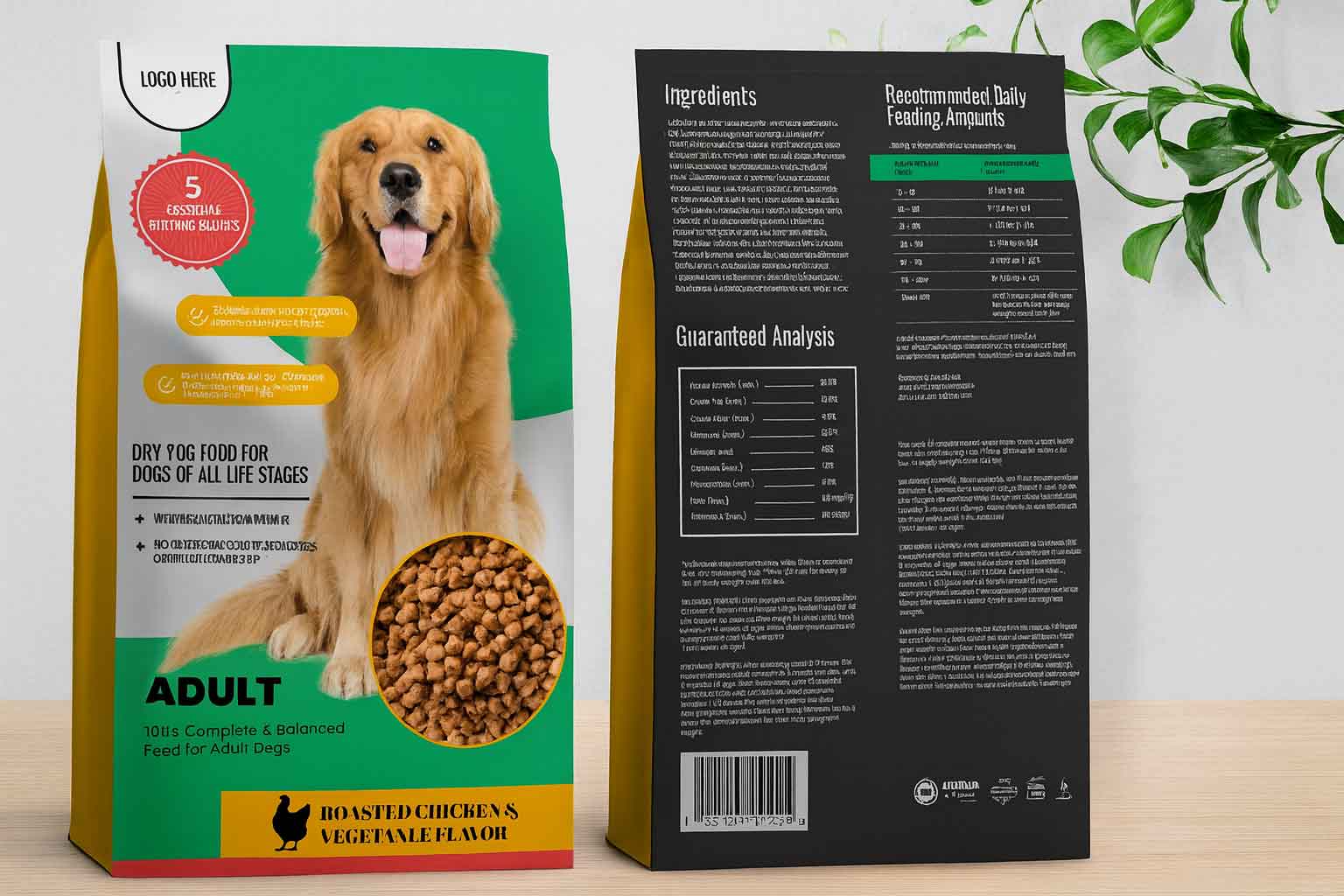
Pet food labels in Europe use terms such as complete, complementary, composition, analytical constituents, and additives. These sections help explain whether the product is intended as a complete daily diet or a complementary food, what it contains, and how it should be fed.
Reading the label helps you look beyond packaging claims and compare pet foods more carefully. However, a label cannot prove that one food is automatically the best choice for every pet. Species, life stage, body condition, activity, health status, and total calorie needs still matter.
Once you understand the label, you can apply the same checks when comparing the best dog food brands in Europe or the best cat food brands in Europe.
This guide explains how to read a European pet food label step by step, understand its most important sections, and identify the details that deserve a closer look.
Quick Answer: How Do You Read a Pet Food Label?
Start by checking whether the product is labelled complete or complementary. Then confirm the intended species and life stage, read the composition, review the analytical constituents and additives, and use the feeding instructions as a starting point.
Finally, check the best-before date, batch information, and the responsible company’s contact details. A label helps you compare foods, but pets with medical conditions or specific nutritional needs may require veterinary guidance.
European Pet Food Labels at a Glance
Before examining each section in detail, use this overview to understand what the main parts of a European pet food label tell you and what you should check. The terminology below follows the European labelling framework and the FEDIAF Code of Good Labelling Practice for Pet Food.
Label section | What it tells you | What to check |
|---|---|---|
Complete or complementary | Whether the product is intended to provide a complete daily diet or to be fed alongside other foods | If it will be your pet’s main food, confirm that it is labelled complete for the correct species and life stage |
Species and life stage | Whether the food is designed for dogs or cats and, where stated, puppies, kittens, adults or other life stages | Make sure the product matches your pet’s species and current life stage |
Composition | The feed materials used in the recipe, generally listed in descending order by weight | Review the whole formulation rather than judging the food from only the first ingredient |
Analytical constituents | Declared levels such as crude protein, crude oils and fats, crude fibre, crude ash and, where required, moisture | Compare similar food formats and use dry matter values when comparing foods with very different moisture levels |
Additives | Nutritional, technological, sensory or other authorised additives used in the product | Check what has been added and why; the presence of an additive does not automatically make a food harmful |
Feeding instructions | The manufacturer’s suggested daily amount based on factors such as body weight | Treat the amount as a starting point and monitor body weight, body condition, activity and treat intake |
Marketing claims | Features promoted on the packaging, such as “natural,” “grain-free,” “with chicken” or “high in omega-3” | Check whether the composition, analytical constituents or additive declarations support the claim |
Best-before date, batch and company details | Information related to freshness, traceability and the business responsible for the product | Check that the packaging is intact and that the date, batch information and contact details are clearly available |
A useful label-reading process starts with the product’s intended use, not with attractive packaging or a single ingredient. The following sections explain each part in more detail.

Step 1: Check Whether the Food Is Complete or Complementary
The first question is not whether the packaging looks premium or which ingredient appears first. It is whether the product is labelled complete or complementary.
Complete pet food is intended to provide the daily diet for the species and life stage stated on the label when fed according to the manufacturer’s instructions.
Complementary pet food is designed to be fed alongside other foods. Treats, toppers, and some supplements may fall into this category and should not be fed as the sole daily diet.
Look for wording such as:
Complete pet food for adult dogs
Complete pet food for puppies
Complete pet food for adult cats
Complete pet food for kittens
Complementary pet food for cats
Complementary feed for dogs
Also confirm that the product matches both your pet’s species and life stage. A food labelled complete for an adult dog is not automatically suitable as the main diet for a growing puppy. Dog food should not be used as the main diet for cats, and cat food should not be used as the main diet for dogs.
Whether a product is wet, dry, raw, or marketed as fresh does not tell you whether it is nutritionally complete. The declaration on the label is what matters. The FEDIAF guide to understanding pet food labels explains how complete and complementary foods, composition, and analytical information are presented.
Practical check: If the product will provide most or all of your pet’s daily food, confirm that the label identifies it as complete for the correct species and life stage. If it is complementary, follow the feeding instructions and consider how it fits into the rest of your pet’s diet.
Step 2: Read the Composition List Carefully
The composition section shows the feed materials used to make the product. In European pet food, these materials are generally listed in descending order by weight at the time they are added to the recipe.
Manufacturers may declare feed materials in two main ways:
By specific name, such as chicken, salmon oil, dried beet pulp, or rice.
By category, such as meat and animal derivatives, cereals, vegetables, or oils and fats.
A more specific list may make it easier to understand the recipe, but a broad category term does not automatically mean that the ingredients are unsafe or nutritionally poor. The complete formulation, nutrient profile, intended use, and manufacturer’s quality controls also matter.
Do Not Judge the Food by the First Ingredient Alone
The composition list is generally arranged in descending order by weight, but the first listed feed material or category does not tell you everything about the finished food.
Fresh meat contains a substantial amount of water, while ingredients described as dried, dehydrated, powdered, or as a meal have already had much of their moisture removed. This can affect where each material appears in the composition list.
The first few ingredients also cannot tell you:
whether the food is nutritionally complete
how digestible the finished product is
how much energy it provides
whether the nutrient levels suit your individual pet
how consistently the product is manufactured
Check Whether Front-of-Pack Claims Match the Composition
If the front of the package highlights an ingredient such as chicken, beef, salmon, or liver, look for that material and its declared percentage in the composition list.
Also remember that attractive images of meat, vegetables, or herbs do not show how much of each material is present. The written declaration is more useful than the packaging design.
Practical check: Read the full composition instead of focusing only on the first ingredient. Look for clear ingredient or category declarations, check the percentages of prominently advertised materials, and avoid judging the food from one ingredient alone.
Step 3: Understand the Analytical Constituents
The analytical constituents section provides a nutritional analysis of the finished pet food. It is different from the composition list: composition tells you which feed materials were used, while analytical constituents describe declared levels of certain nutrient groups in the final product.
You will commonly see terms such as:
Analytical constituent | What it generally represents | Important limitation |
|---|---|---|
Crude protein | The declared protein level in the food | A higher percentage does not automatically mean better protein quality, digestibility, or suitability for your pet |
Crude oils and fats | The declared fat content, which contributes energy and supplies fatty acids | The percentage alone does not explain the types or balance of fatty acids present |
Crude fibre | A laboratory measure of part of the food’s fibre content | It does not represent all soluble and insoluble dietary fibre in the product |
Crude ash | The mineral residue remaining after the food is analysed at high temperature | It does not mean that ash has been added as an ingredient |
Moisture | The amount of water present in the food | Moisture can make direct comparisons between wet and dry foods misleading |
The word crude refers to the laboratory method used to measure these values. It does not mean that the nutrient is dirty, harmful, or low quality.
Do Not Judge a Food by One Percentage
Analytical values should be interpreted together rather than one at a time. For example, a food with more protein is not automatically more appropriate for every dog or cat.
The label percentages do not fully explain:
the digestibility of the nutrients
the biological quality of the protein
the food’s calorie density
the balance of essential amino acids, fatty acids, vitamins, and minerals
whether the complete diet suits your pet’s individual needs
the manufacturer’s formulation and quality-control standards
The product’s complete or complementary status, species, life stage, feeding instructions, total formulation, and your pet’s condition all remain important.
Compare Wet and Dry Foods on the Same Basis
The percentages shown on most labels describe the food as sold, including its water content. This is sometimes called an as-fed basis.
Wet food contains much more moisture than dry food, so its protein or fat percentages often appear lower on the label. That does not necessarily mean it provides less protein or fat once the water is removed from the comparison.
For a fairer comparison between foods with very different moisture levels, compare their nutrients on a dry matter basis. For more context on how food format affects the comparison, read our guides to wet vs dry dog food and wet vs dry cat food.
Practical check: Use analytical constituents to understand the finished food, but do not select a product from one percentage alone. Compare similar food formats, account for moisture, and interpret the numbers alongside the product’s intended use and full formulation.
Step 4: Review the Additives
The additives section identifies substances added to the food for a particular nutritional, technological, sensory, or other authorised purpose.
Common categories may include:
Nutritional additives, such as vitamins, minerals, trace elements, and amino acids
Technological additives, such as preservatives, antioxidants, emulsifiers, or stabilisers
Sensory additives, such as flavourings or colourants
Zootechnical additives, which may be used for functions such as supporting digestibility or helping to stabilise gut flora
The additives declaration is different from the composition list. Composition describes the feed materials used in the recipe, while additives are included for specific functions.
An Additive Is Not Automatically a Red Flag
The word additive does not automatically mean that a substance is unsafe, unnecessary, or nutritionally poor. In the European Union, feed additives must be authorised for specified uses and conditions before they can be marketed and used in feed.
For example:
vitamins and minerals may help a complete food meet its intended nutritional profile
antioxidants may help protect ingredients from oxidation
preservatives may help maintain product stability during its intended shelf life
flavourings may affect the smell or taste of the food
Terms such as natural, artificial, or additive-free do not by themselves establish the overall safety or nutritional quality of a product. The function, authorised use, dose, total formulation, and suitability for the intended pet all matter.
Look at the Function, Not Just the Name
Some additive names may sound unfamiliar or technical. An unfamiliar name is not evidence that the substance is harmful.
Instead, ask:
What function does the additive perform?
Is it nutritional, technological, sensory, or zootechnical?
Does the label provide enough information to identify it?
Does the product make a health claim that goes beyond what the label can demonstrate?
Is the food complete for the correct species and life stage?
Also remember that not every ingredient promoted for a functional benefit is legally listed as an additive. Ingredients such as fish oil, beet pulp, herbs, or yeast products may appear in the composition section instead, depending on how they are used and declared.
The EU framework for feed additives explains that only authorised additives may be marketed and used under specified conditions.
Practical check: Do not reject a food simply because it contains additives or unfamiliar technical names. Identify the additive’s function, consider it within the full formulation, and be cautious of packaging that turns one added substance into an exaggerated health promise.
Step 5: Use the Feeding Instructions as a Starting Point
The feeding instructions show the manufacturer’s suggested daily amount for the product. They are usually based on factors such as body weight, life stage, and the energy provided by that particular food.
Use this amount as a starting point rather than a fixed prescription. Two pets of the same weight may need different portions because their activity, body condition, age, neuter status, environment, health status, and treat intake can differ.
Do Not Copy the Portion from Another Product
Pet foods can vary considerably in calorie density. The correct amount of one food may be very different from the amount recommended for another, even when both products are complete foods for the same species and life stage.
Whenever you change products:
read the new feeding instructions
check whether the amount is shown per day or per meal
confirm whether the guide uses your pet’s current or target body weight
check whether separate guidance is provided for activity or life stage
transition gradually when changing foods, unless your veterinarian advises otherwise
avoid assuming that the previous portion still applies
Count Treats, Toppers, and Other Extras
The feeding guide may assume that the labelled food provides most or all of the daily diet. Treats, chews, table food, toppers, and complementary products also contribute to total intake.
If extras are added without adjusting the main food, your pet may receive more energy than intended. However, reducing a complete food too heavily to make room for extras may also reduce the intake of essential nutrients.
For more detailed dog-portion guidance, read How Much Should I Feed My Dog?.
Measure, Monitor, and Adjust Carefully
Measuring food by weight in grams is generally more consistent than estimating portions by eye. After choosing a starting amount, monitor:
body weight
body condition
appetite
activity
stool quality
changes in treat or extra-food intake
Small adjustments may be needed over time. Pets who are growing, pregnant, nursing, unwell, or managing a diagnosed medical condition may need individual veterinary guidance, especially if appetite, digestion, or weight changes unexpectedly.
Practical check: Start with the feeding instructions for the exact product, measure the total daily amount carefully, include treats and extras in your assessment, and adjust gradually according to your pet’s weight and body condition.
Step 6: Check the Best-Before Date, Batch, Storage, and Company Details
The nutritional information is only part of the label. The package should also provide practical details that help you store the food correctly, identify the product, and contact the responsible company if needed.
Check the Best-Before Date and Package Condition
Find the best-before date and make sure it is clearly readable. This date generally applies when the unopened product has been stored according to the manufacturer’s instructions.
Before buying or feeding the product, also check that:
bags are properly sealed and not torn
cans are not leaking, swollen, or severely damaged
trays and pouches are not punctured
the packaging shows no obvious signs of moisture, heat damage, or unsuitable storage
the product does not look or smell unusual when opened
After opening, the product may need to be used within a shorter period. Follow any instructions about refrigeration, resealing, storage temperature, and how long the food should be kept after opening.
Keep the Batch or Lot Information
The batch or lot number identifies a particular production run. It can help the manufacturer or authorities trace the product if there is a quality concern, customer complaint, or product recall.
Keep the packaging or take a clear photo of the batch number, best-before date, and product name when:
introducing a new food
reporting an unexpected problem
contacting the manufacturer
returning a product
checking whether a recall affects your package
Identify the Responsible Company
The label should identify the business responsible for the product and provide its name and address.
This information allows you to contact the company if you need clarification about:
whether the product is complete for a particular life stage
how a highlighted ingredient or additive is used
the calorie content of the food
storage instructions after opening
additional product or quality-control information
A website, telephone number, email address, or customer-care channel can make contacting the company easier when these details are provided. However, a recognisable brand name alone does not demonstrate transparency or manufacturing quality.
For a deeper look at transparency and quality-control questions, see our pet food manufacturer report.
Practical check: Before buying the food, check the best-before date, package condition, storage instructions, batch number, and responsible company details. Keep this information until the product has been fully used.
How to Evaluate Pet Food Marketing Claims
Front-of-pack claims can help you understand how a product is positioned, but they should not replace the detailed declarations in the composition, analytical constituents, additives, and feeding instructions.
A claim should be treated as a reason to check the label more closely—not as proof that the product is automatically healthier, safer, or more suitable for your pet.
Match Ingredient Claims to the Composition
When the front of the package highlights an ingredient such as chicken, beef, salmon, liver, rice, or vegetables, check the composition list for the named material and its declared percentage.
Images can also create an ingredient claim or impression. A large picture of fresh meat or vegetables does not necessarily show how much of those materials the product contains.
The FEDIAF Code of Good Labelling Practice for Pet Food provides reference levels for certain major-component claims. Common examples include:
Claim wording | FEDIAF reference level |
|---|---|
“X flavour” | 0% of the named major component; the taste comes from a declared flavouring |
“Flavoured with X” | More than 0% but less than 4% of the named material |
“With X” or “contains X” | At least 4% of the named material |
“Rich in X,” “high in X,” or “with extra X” | At least 14% of the named material |
“X dinner” or “X menu” | At least 26% of the named material |
These reference levels apply to named major-component claims. Claims involving minor ingredients, additives, nutrients, or functional benefits may follow different substantiation requirements.
Where several materials are named, the required reference level may apply separately to each material. Always check the exact wording and declared percentages on the product.
These descriptions also do not necessarily mean that the stated percentage consists entirely of muscle meat. For example, a chicken claim may refer to authorised feed materials derived from chicken, so the wording in the composition still matters.
Read “No Added” and “Free From” Claims Carefully
Negative claims require careful reading because similar phrases may have different meanings.
No added X or made without X generally means that the substance was not added directly through the formulation or indirectly through feed materials or additives. However, very small traces may still occur through cross-contact.
Free from X is a stronger absence claim. Under FEDIAF guidance, it implies that even traces of the named substance are absent and should therefore be supported by appropriate controls.
A grain-free, wheat-free, additive-free, or preservative-free claim does not by itself prove that the overall food is better for every dog or cat. Check what the product contains, whether it is complete, and whether the formulation is appropriate for your pet.
Check What “Natural,” “Fresh,” and Similar Terms Describe
Terms such as natural, fresh, and authentic should be read in context.
A product may state that it is made with natural ingredients rather than claiming that the entire formulation is natural. Check whether the label identifies which materials the claim applies to.
Similarly, a prominent image of fresh meat should not be treated as evidence that every animal-derived ingredient is fresh. Review the exact wording and composition declaration.
In the European Union, prepacked pet food marketed as organic is subject to specific labelling rules. Look for the EU organic logo, the control-body code, and the accompanying origin information rather than relying on the word organic alone.
Do not assume that words such as premium, holistic, or superfood provide a complete nutritional assessment. Look for specific, verifiable information elsewhere on the label.
Evaluate Lifestyle and Health Claims in Context
Labels may position products for particular breeds, sterilised pets, indoor pets, sensitive digestion, weight management, skin and coat support, or other intended uses.
These claims are not automatically meaningful or meaningless. Check whether the product’s:
complete or complementary status
intended species and life stage
composition
analytical constituents
calorie content
additives
feeding instructions
support the way the product is presented.
Be especially cautious of wording that appears to promise that a standard pet food can prevent, treat, or cure a disease. Pets with diagnosed medical conditions may require veterinary assessment and a diet selected for their individual needs.
Practical check: Treat the front of the package as a summary, not the final answer. Verify ingredient, absence, lifestyle, and functional claims against the detailed declarations elsewhere on the label.
What a Pet Food Label Cannot Tell You
A pet food label provides important information about the product’s intended use, composition, analytical constituents, additives, feeding instructions, and traceability. However, it cannot provide a complete assessment of how well the food will suit every individual dog or cat.
It Cannot Predict Individual Tolerance
Two pets of the same species, age, and body weight may respond differently to the same food. Individual tolerance can be influenced by factors such as:
health status
previous diet
appetite
digestive sensitivity
activity level
body condition
treats and other food intake
whether diet changes are gradual or sudden
A food may meet its declared nutritional purpose and still not be the most suitable option for every individual pet. The label cannot predict whether a particular animal will enjoy the food, digest it comfortably, maintain an appropriate weight, or tolerate every ingredient.
It Does Not Fully Explain Digestibility or Nutrient Availability
The composition and analytical constituents describe what the food contains and the declared levels of certain nutrient groups. They do not fully show how easily the finished food is digested or how effectively an individual pet will use its nutrients.
A higher protein or fat percentage does not automatically mean that the food is more digestible, nutritionally superior, or more appropriate. Digestibility may depend on the ingredients, processing, formulation, and the individual pet.
It Does Not Show Every Manufacturing and Quality-Control Detail
The label identifies the responsible company and provides required product information, but it may not explain every aspect of how the food was formulated, tested, manufactured, or monitored.
Information that may require further research or direct questions to the company includes:
who formulates the food
where the product is manufactured
how ingredient suppliers are assessed
what quality-control procedures are used
whether finished products are routinely tested
how calorie content was calculated or measured
how formulation changes are communicated
A detailed label is useful, but manufacturer transparency and quality-control practices should also be considered when comparing products.
It Cannot Diagnose the Cause of Symptoms
Changes in weight, appetite, stool, skin, coat, energy, or behaviour may occur for many reasons. They do not automatically prove that the current food is unsuitable.
For example, vomiting, diarrhoea, weight loss, itching, or reduced appetite may relate to feeding habits, an abrupt diet change, environmental factors, parasites, medication, or an underlying medical condition.
Changing food without understanding the possible cause may delay appropriate care or make it harder to identify what is happening.
Practical check: Use the label to understand what the product is, what it contains, how it should be fed, and whether it matches your pet’s species and life stage. Then consider your pet’s body condition, appetite, digestion, health status, and response over time. A label is an important decision tool, but it is not a diagnosis or a guarantee of individual suitability.
When to Ask a Veterinarian Before Changing Food
For a generally healthy pet, changing from one appropriate complete food to another can often be done gradually while monitoring appetite, digestion, weight, and body condition.
However, a food change should not be used as the first or only response when your pet has persistent symptoms, a diagnosed medical condition, unusual nutritional needs, or a history of adverse reactions. In these situations, ask a veterinarian before making a major change.
The WSAVA Global Nutrition Guidelines emphasise individual nutritional assessment and nutrition plans adapted to each pet’s needs.
Ask Before Changing a Veterinary or Therapeutic Diet
Speak with your veterinarian before changing food if your pet:
has a diagnosed medical condition
is eating a veterinary or therapeutic diet
is taking medication that may affect appetite, digestion, weight, or nutritional needs
has a condition for which diet is part of management, such as kidney disease, diabetes, pancreatitis, certain urinary conditions, or chronic digestive disease
is recovering from surgery, illness, or a period of poor food intake
has been given a specific feeding plan by a veterinarian
A food that is labelled complete for the correct species and life stage may still be unsuitable for a pet whose condition requires a particular nutrient profile, calorie level, texture, or feeding method.
Do not stop a veterinary or prescribed diet because another product appears more natural, contains a preferred ingredient, or has a more attractive analytical profile. The reason for the original recommendation should be reviewed first.
Ask for Guidance During Special Life Stages or Complex Feeding Situations
Some pets may require more individual guidance even when they do not have a diagnosed illness.
Veterinary advice may be particularly useful for:
puppies and kittens with poor growth or feeding difficulties
pregnant or nursing dogs and cats
senior pets losing weight, muscle, or appetite
pets who are significantly underweight or overweight
growing large-breed puppies
pets whose diets include substantial amounts of homemade food, raw food, treats, toppers, or supplements
pets whose main food is labelled complementary rather than complete
These situations may involve nutritional needs that cannot be assessed from front-of-pack claims or from protein and fat percentages alone.
Do Not Diagnose a Food Allergy by Trial and Error
Itching, recurrent ear problems, vomiting, loose stool, or skin changes do not automatically confirm a food allergy or intolerance. Similar signs may have several possible causes.
Repeatedly switching between different proteins, grain-free foods, limited-ingredient products, or “sensitive” formulas can make the pattern more difficult to interpret. It may also expose the pet to multiple ingredients without providing a clear answer about the cause.
If a food-related reaction is suspected, a veterinarian may recommend a structured dietary assessment. This may involve a carefully selected diet, a defined feeding period, strict control of treats and extras, and planned follow-up.
Random food changes are not equivalent to a properly managed elimination diet.
Persistent Symptoms Need Assessment, Not Just a New Food
Contact a veterinarian if your pet has symptoms that continue, return repeatedly, or worsen, including:
recurring vomiting or regurgitation
persistent diarrhoea or constipation
unexplained weight loss or weight gain
reduced appetite or recurring refusal to eat
ongoing itching, skin inflammation, or recurrent ear problems
marked changes in thirst or urination
ongoing difficulty chewing
a persistent reduction in energy or activity
a sudden and significant change in eating behaviour
These signs may be related to food, but they may also result from dental problems, parasites, infection, medication, stress, feeding practices, or an underlying medical condition.
Changing the diet without investigating the wider pattern may alter the symptoms without addressing their cause.
Seek Prompt Veterinary Care for Warning Signs
Do not wait for a gradual food transition if your pet shows potentially urgent signs such as:
repeated vomiting over a short period or inability to keep water down
blood in vomit or stool
severe or frequent watery diarrhoea
collapse, marked weakness, or extreme lethargy
a swollen or painful abdomen
difficulty breathing
choking or difficulty swallowing
suspected poisoning or ingestion of a foreign object
rapid or unexplained weight loss
prolonged refusal to eat, especially in cats, puppies, kittens, senior pets, or medically vulnerable animals
In these situations, selecting a different food is not the immediate priority. Prompt veterinary assessment is more important.
Prepare Useful Information Before the Appointment
When discussing food with a veterinarian, bring or record:
the full product name and exact variety
whether it is complete or complementary
the species and life stage stated on the label
the composition and analytical constituents
the feeding amount offered and the amount usually eaten
treats, chews, toppers, supplements, and table food
how long your pet has eaten the product
when the symptoms started
recent changes in weight, appetite, stool, or behaviour
the batch number and best-before date if a product problem is suspected
Photos of the package, label, feeding guide, and batch information can be useful if bringing the original packaging is not practical.
Practical check: Ask a veterinarian before changing food when your pet has a diagnosed condition, persistent symptoms, special nutritional needs, or a history of food-related problems. For urgent warning signs, seek veterinary care rather than trying another product first.
A Quick Pet Food Label Checklist
Use this quick checklist when comparing pet foods in a shop or online. It will not replace a full nutritional assessment, but it can help you identify the most important information before buying.
Check whether it is complete or complementary.
If the product will provide most or all of your pet’s daily diet, confirm that it is labelled complete.Confirm the species and life stage.
Make sure the food is intended for a dog or cat and, where relevant, for the correct life stage or reproductive status, such as puppy or kitten growth, adult maintenance, pregnancy, or nursing.Read the full composition.
Check which feed materials are listed and whether prominently advertised ingredients appear with a declared percentage. Do not judge the food from the first ingredient alone.Review the analytical constituents.
Look at protein, fat, fibre, ash, and moisture together. Compare similar food formats, and compare on a dry matter basis when evaluating foods with very different moisture levels.Check the additives and their purpose.
Identify whether additives are nutritional, technological, sensory, or zootechnical. An unfamiliar name does not automatically indicate a problem.Read the feeding instructions carefully.
Check whether the amount is stated per day or per meal, whether it is based on current or target weight, and how treats and other extras affect the total amount.Verify front-of-pack claims.
Check whether claims such as “with chicken,” “grain-free,” “natural,” “high in,” or “no added” are supported by the composition and other detailed declarations.Check the date, batch, storage, and company details.
Confirm that the package is intact, the best-before date is readable, storage instructions are clear, and the batch number and responsible company can be identified.
Before choosing the product, ask yourself:
Is it complete for the correct species and life stage?
Do the detailed declarations support the front-of-pack claims?
Are the feeding instructions practical and clear?
Can I identify and contact the responsible company?
Does my pet have a medical condition or unusual nutritional need that requires veterinary guidance?
Practical check: If you cannot confirm the product’s intended use, species, life stage, feeding instructions, or responsible company, look for more information before using it as your pet’s main food. For pets with medical conditions or unusual nutritional needs, seek veterinary guidance rather than relying on the label alone.

Frequently Asked Questions About Pet Food Labels
What Is the Difference Between Complete and Complementary Pet Food?
Complete pet food is intended to provide the nutrients needed in the daily ration for the species and life stage stated on the label when fed according to the manufacturer’s instructions.
Complementary pet food is intended to be combined with other foods or used as part of the overall diet. Treats, toppers, and some supplements are often complementary. This does not automatically make these products unsuitable, but they should not normally replace an appropriate complete food as the main diet unless the feeding instructions explain how they should be used as part of the overall diet.
What Is the Difference Between Composition and Analytical Constituents?
The composition lists the feed materials used to make the product, generally in descending order by weight when they are added to the recipe.
The analytical constituents describe declared levels of nutrient groups in the finished food, such as crude protein, crude oils and fats, crude fibre, crude ash, and moisture.
Composition explains what was used, while analytical constituents describe parts of the resulting nutritional profile. Neither section alone proves the food’s digestibility, overall quality, or suitability for an individual pet.
What Does Crude Ash Mean on a Pet Food Label?
Crude ash represents the mineral residue remaining after a food sample is analysed at high temperature. It does not mean that fireplace ash or a similar material has been added to the food.
The value reflects the food’s total mineral content but does not show the amount of every individual mineral. A higher or lower crude ash percentage should therefore not be used alone to judge food quality or suitability.
Is a Higher Protein Percentage Always Better?
No. A higher crude protein percentage does not automatically mean that a food contains better-quality protein, is more digestible, or is more appropriate for every dog or cat.
Protein should be considered alongside the food’s moisture, calorie density, complete or complementary status, species and life stage, full formulation, and the individual pet’s needs.
Direct comparisons can also be misleading when one product is wet and another is dry because their water content is very different.
How Do I Compare Wet and Dry Pet Food Labels?
Most analytical values are shown on an as-fed basis, meaning that the food’s water content is included in the percentage.
Because wet food usually contains much more moisture than dry food, its protein and fat percentages may appear lower even when the difference is smaller after moisture is accounted for.
For a fairer comparison, evaluate foods with very different moisture levels on a dry matter basis. However, moisture-adjusted percentages still do not explain digestibility, calorie density, nutrient balance, or individual suitability.
Does “With Chicken” Mean the Food Is Mostly Chicken?
Not necessarily. In the FEDIAF Code of Good Labelling Practice, a major-component claim such as “with chicken” generally indicates at least 4% of the named material.
The wording does not necessarily mean that chicken is the largest ingredient or that the declared percentage consists entirely of muscle meat. Check the composition list and any stated percentages to understand how the named material is declared.
Claims such as “rich in chicken” or “chicken menu” use different reference levels, so the exact wording matters.
Are Additives in Pet Food Harmful?
The presence of an additive does not automatically mean that a pet food is harmful or low quality.
Additives may perform nutritional, technological, sensory, or zootechnical functions. For example, they may provide vitamins and minerals, protect ingredients from oxidation, support product stability, or influence flavour.
An unfamiliar or technical name is not evidence of danger. Consider the additive’s purpose, authorised use, amount, and role within the complete formulation rather than judging it from its name alone.
Can the Ingredient List Tell Me Whether a Pet Food Is High Quality?
The ingredient list can help you understand which feed materials were used and how prominently advertised ingredients are declared, but it cannot provide a complete quality assessment.
It does not fully reveal nutrient digestibility, amino-acid balance, calorie density, manufacturing consistency, finished-product testing, or how well an individual pet will tolerate the food.
Use the composition together with the complete or complementary declaration, analytical constituents, feeding instructions, manufacturer information, and your pet’s species, life stage, body condition, and health needs.
Where Can I Find the Calorie Content on a Pet Food Label?
Energy content may be shown as metabolisable energy or ME, often in kilocalories per 100 g or per kilogram. However, it is not displayed on every pet food package.
If the energy value is not provided on the label, check the manufacturer’s product page or contact the responsible company. This information is particularly useful when comparing calorie density, changing products, calculating portions, or managing your pet’s weight.
Do not compare foods only by the recommended serving size, because products can provide very different amounts of energy per gram.
Final Thoughts
Reading a pet food label is not about finding one perfect ingredient or choosing the product with the highest protein percentage. It is about confirming the food’s intended use, understanding the declared information, checking whether marketing claims are supported, and recognising what the label cannot tell you.
A more informed choice combines the label with your pet’s species, life stage, body weight, body condition, activity, current diet, health status, and response over time. Use the feeding instructions as a starting point, monitor meaningful changes, and seek veterinary guidance when medical conditions or persistent symptoms are involved.
Make your next pet food comparison more relevant to your pet.
Create a FAMMO profile for your dog or cat and use your pet’s information alongside the label—not instead of it—to explore more personalised nutrition guidance.
FAMMO provides educational nutrition and preventive-health guidance. It does not diagnose medical conditions or replace veterinary care.