Premium dog food can cost much more than regular food, but a higher price does not automatically mean better nutrition.
If you are comparing products, start with what the food actually provides for your dog, not the words on the bag. If you want to compare specific options, our guide to dog food brands available in Europe can help.
The useful question is not simply, “Is this food premium?”
It is: What am I actually paying more for?
A higher price may reflect better quality control, nutritional expertise, clearer feeding information, or a formula that suits your dog well. But it can also reflect packaging, branding, unusual ingredients, or marketing claims that do not automatically make the food a better choice.
This guide will show you what is worth checking before you pay more.
Quick Answer: Is Expensive Dog Food Actually Worth the Cost?
Sometimes, but not simply because it is labelled “premium” or costs more.
A higher price may be worth paying when the food is complete for your dog’s life stage, comes from a manufacturer with strong quality controls, provides clear nutritional and feeding information, and suits your dog’s individual needs.
Do not judge value by price, packaging, ingredient lists, or marketing words alone.
A better way to compare dog food is to look at nutritional suitability, manufacturer transparency, daily feeding cost, and how well the food works for your dog.
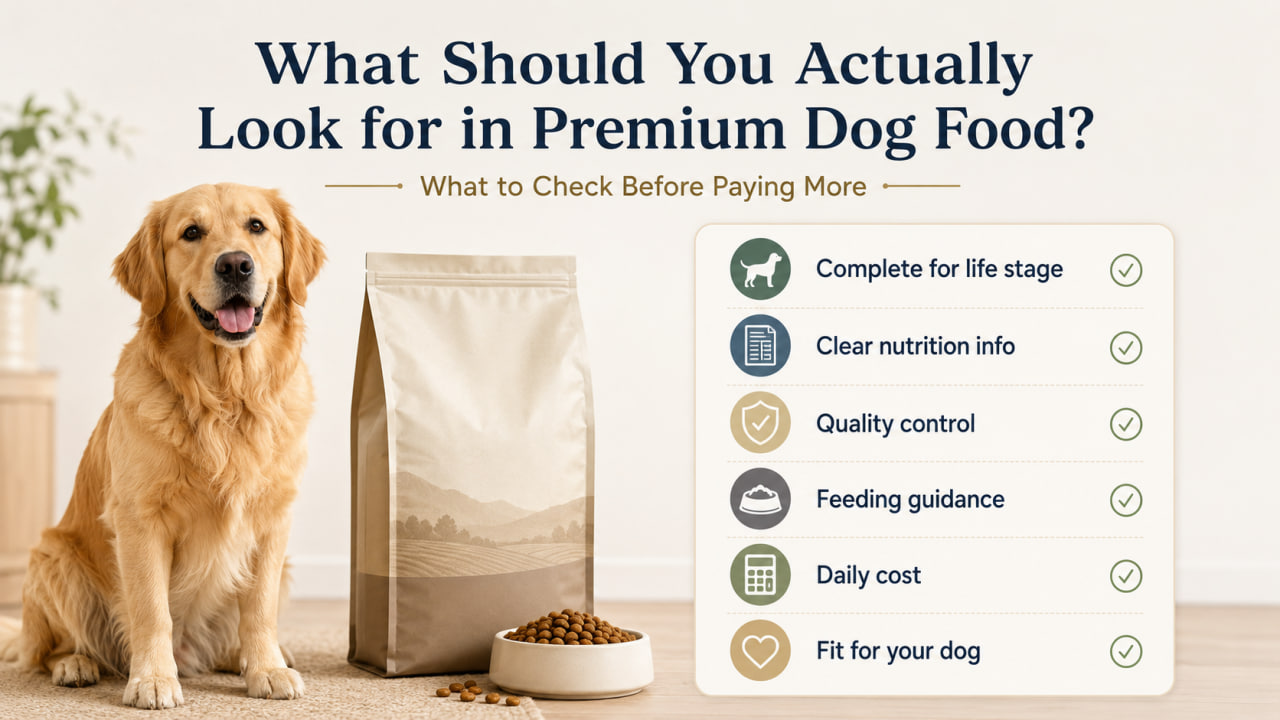
What Should You Actually Look for in Premium Dog Food?
A higher price is only useful if you can see what you are paying more for.
Instead of judging a food by words such as “premium,” “luxury,” or “natural,” look for information that helps you assess whether the food is nutritionally suitable, clearly explained, and appropriate for your dog.
Use this checklist when comparing two foods:
What to Check | Why It Matters | What to Look For |
|---|---|---|
Complete nutrition | Your dog needs a diet that provides the nutrients required for their life stage | Check that the food is labelled as complete and suitable for your dog’s life stage |
Manufacturer transparency | Clear information makes it easier to understand what you are buying | Look for accessible product information, feeding guidance, contact details, and clear nutritional information |
Quality-control standards | Consistent manufacturing and safety controls matter more than premium packaging | Look for information about manufacturing, testing, sourcing, and quality-control processes |
Nutritional expertise | A well-designed formula requires more than an attractive ingredient list | Check whether the company explains who develops its diets and how nutritional decisions are made |
Calories and feeding guidance | Two foods with similar bag prices may have very different daily feeding costs | Check calorie information and how much your dog is expected to eat each day |
Fit for your dog | An expensive food can still be the wrong choice for an individual dog | Consider life stage, body condition, activity level, size, health needs, and how your dog responds to the food |
Evidence behind claims | Marketing claims do not automatically prove better nutrition | Look for specific, explainable claims rather than relying only on words such as “premium” or “natural” |
The main takeaway
A premium price is easier to justify when it comes with something you can actually verify.
That may include stronger quality control, clearer nutritional information, appropriate formulation, useful feeding guidance, or greater transparency.
If the main difference is packaging, branding, or vague marketing language, a higher price alone does not tell you that the food is better for your dog.
Why Does Some Dog Food Cost More?
Two bags of dog food can have very different prices, even when both are designed to provide complete daily nutrition.
The important question is not whether one costs more. It is what the higher price represents.
Several things can affect the price of a dog food. Some may add meaningful value, while others may have little to do with how suitable the food is for your dog.
What May Affect the Price | What It Could Mean | What You Should Check |
|---|---|---|
Formulation and nutritional expertise | Developing and reviewing a diet requires specialist knowledge | Does the company explain who formulates its food and what nutritional standards it follows? |
Manufacturing and quality control | Testing and production controls can require additional resources | Does the manufacturer provide clear information about where the food is made and how quality is checked? |
Ingredients and sourcing | Some ingredients or sourcing methods may cost more | Do not judge the food by one expensive ingredient. Look at the nutritional value of the complete formula |
Research and product testing | Some companies invest more in evaluating their diets | Look for specific information rather than broad claims such as “science-based” |
Packaging and distribution | Packaging, transport, storage, and retail channels all affect the final price | Remember that these costs do not automatically improve nutrition |
Branding and marketing | Premium positioning can increase what consumers are willing to pay | Ask whether the higher price comes with benefits you can actually verify |
Price is only one part of the decision
A more expensive food may offer stronger quality controls, greater nutritional expertise, or clearer product information.
But price alone cannot tell you whether a food is the right choice.
Before comparing products, learn how to read the important information on a pet food label. The ingredient list is only one part of the picture.
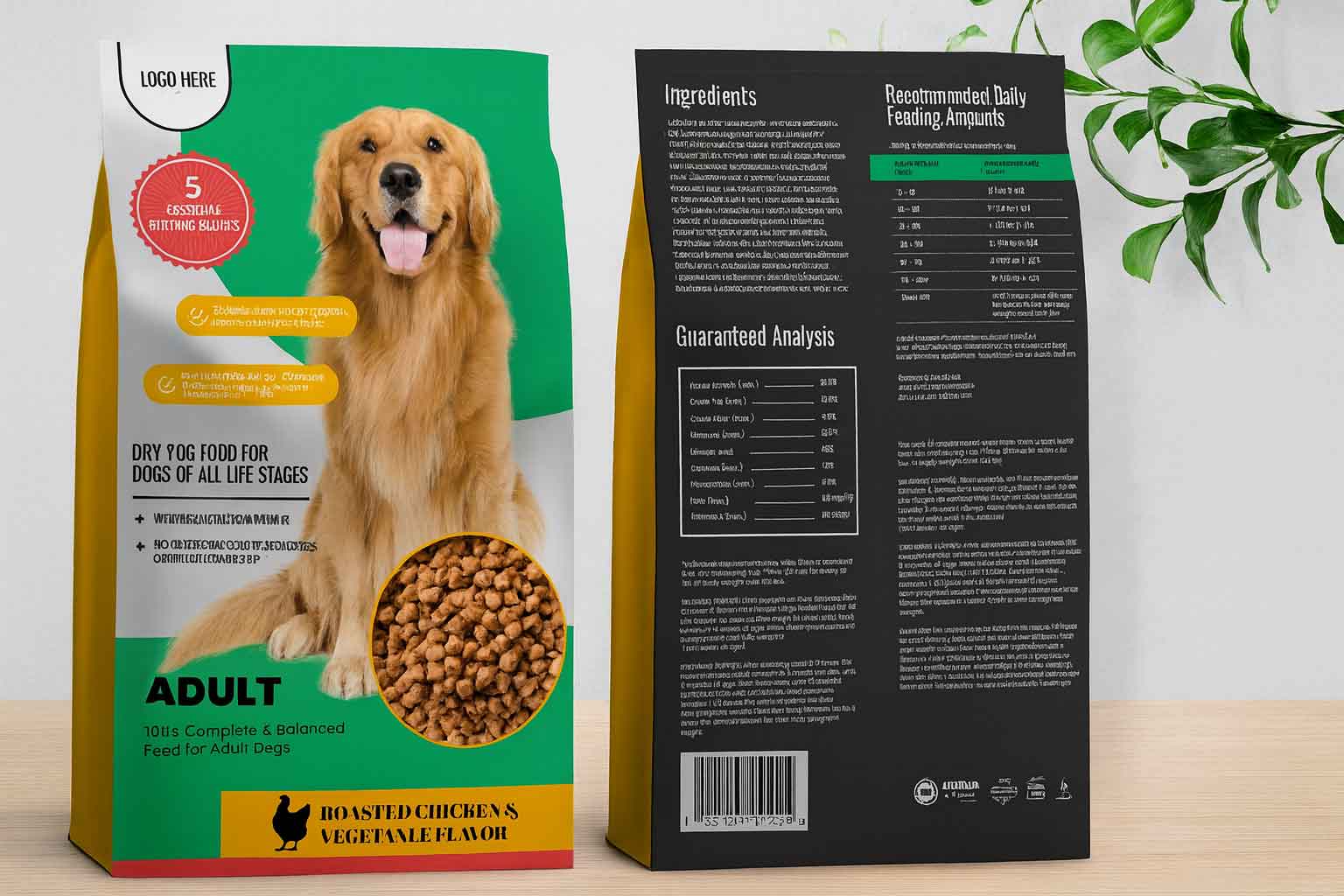
The WSAVA also recommends looking beyond individual ingredients and considering factors such as the nutritional expertise behind the food and the manufacturer’s quality-control practices.
The goal is simple:
Pay more for useful value, not just a more expensive label.
How Can You Tell If a Premium Dog Food Company Is Transparent?
If a company charges more for its dog food, you should be able to understand what you are paying for.
You do not need to know every detail about a factory, recipe, or supplier. But important information about nutrition, manufacturing, and quality should be reasonably easy to find.
Use these questions when you are comparing a premium dog food:
WHAT TO CHECK | A GOOD SIGN | WHAT TO LOOK CLOSER AT |
|---|---|---|
Who formulates the food? | The company explains who is responsible for nutrition and product formulation | There is little or no information about nutritional expertise |
Where is the food made? | Manufacturing locations or production arrangements are clearly explained | It is difficult to understand where or how the food is produced |
How is quality checked? | The company explains testing, safety checks, or quality-control procedures | “Premium quality” is claimed without explaining how quality is checked |
Is nutritional information clear? | Calories, feeding guidance, and nutritional details are easy to find | Important information is missing, vague, or difficult to understand |
Can you contact the company? | Clear contact details are available if you have questions about the food | It is difficult to get useful answers about the product |
Can the product be traced? | Batch or production information can be identified when needed | Traceability information is unclear or difficult to obtain |
Transparency Does Not Mean Sharing Everything
A pet food company does not need to publish every commercial detail about its recipes, suppliers, or manufacturing process.
What matters is whether the company can answer reasonable questions about nutrition, manufacturing, safety, and product quality.
If you want to look more closely at how manufacturers can be assessed, see our pet food manufacturer report.
FEDIAF’s guidance for pet food manufacturers also covers areas such as supplier controls, raw-material checks, production monitoring, finished-product testing, and traceability.
This does not mean that every premium food must publish the same information in the same way. The goal is to look for enough transparency to understand what supports the product’s claims and price.
If a food is positioned as premium but the company cannot clearly explain what supports that positioning, the price alone should not convince you.
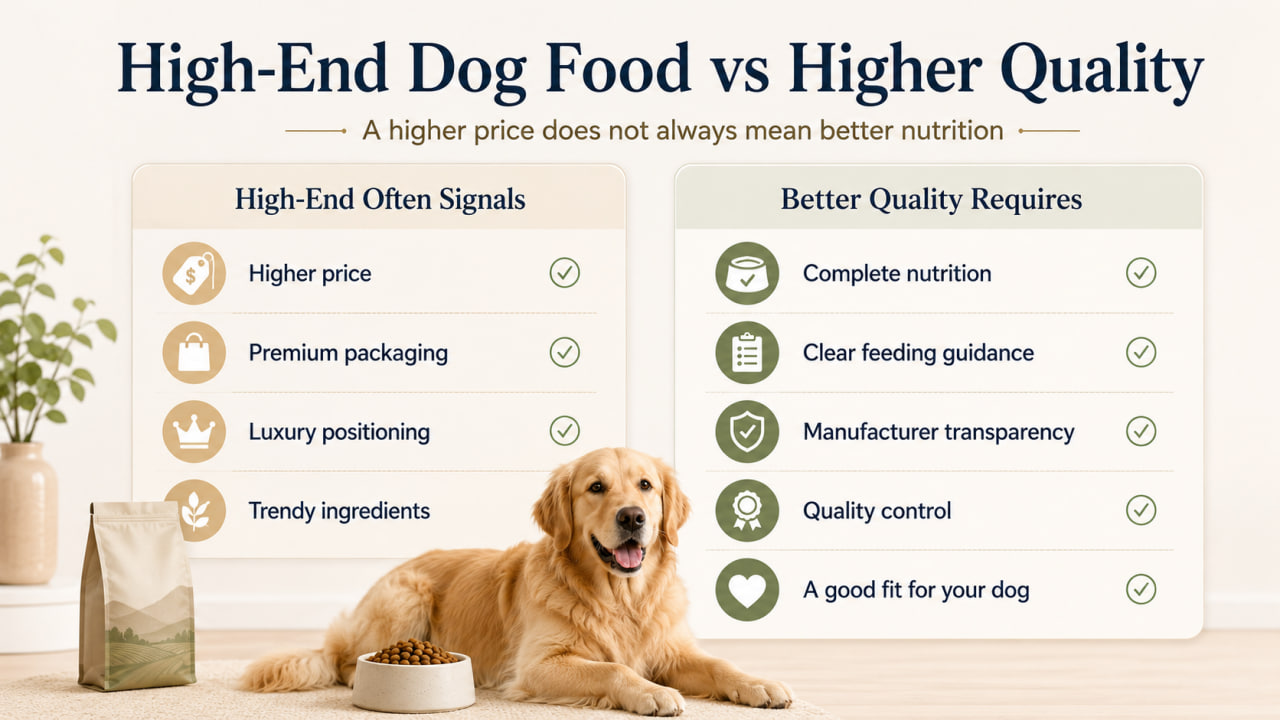
Does High-End Dog Food Actually Mean Higher Quality?
Not necessarily.
“High-end” usually tells you something about how a food is priced or positioned. It does not, by itself, tell you whether the food provides better nutrition for your dog.
That distinction matters because two expensive foods can look equally premium while being very different in formulation, nutritional information, feeding guidance, and manufacturer transparency.
Quality Is More Than an Ingredient List
It is easy to compare dog foods by looking for expensive-sounding ingredients.
For example, a product may highlight fresh meat, unusual proteins, vegetables, herbs, or ingredients associated with premium positioning.
Those details can be useful, but they do not tell you whether the complete diet is better for your dog.
A more useful question is:
How well does the whole food meet my dog’s nutritional needs?
That means looking at the complete formulation rather than judging quality from one ingredient near the top of the label.
High Quality Should Be Something You Can Evaluate
When comparing a high-end food with a less expensive option, focus on differences you can actually verify. Check whether the food is complete for the right life stage, whether calorie and feeding information is clear, and whether the manufacturer explains its nutritional expertise and quality-control process.
Then consider the individual dog. A food can look excellent on paper and still be a poor fit for your dog’s body condition, activity level, feeding needs, or tolerance.
If the more expensive food performs better on these checks, the higher price may be easier to justify.
If the main differences are packaging, premium wording, or an impressive-looking ingredient list, you still need more information before deciding that it is the higher-quality choice.
Think “Better for My Dog,” Not Simply “Higher-End”
The goal is not to find the most expensive food you can afford.
It is to find a nutritionally appropriate food that works well for your individual dog and gives you enough reliable information to make a confident decision.
A higher price can be part of the quality story, but it should never be the whole story.
How Much Does Premium Dog Food Really Cost Per Day?
The price on the bag does not tell you the full cost of feeding your dog.
One food may cost more per bag but recommend a smaller daily portion. Another may have a lower purchase price but require more food each day.
That does not make either food automatically better. But it does mean that bag price alone is a poor way to compare value.
Calculate the Daily Cost
You only need three pieces of information:
1. The price of the bag
2. The weight of the bag in grams
3. The suggested daily feeding amount for your dog
Then use this simple calculation:
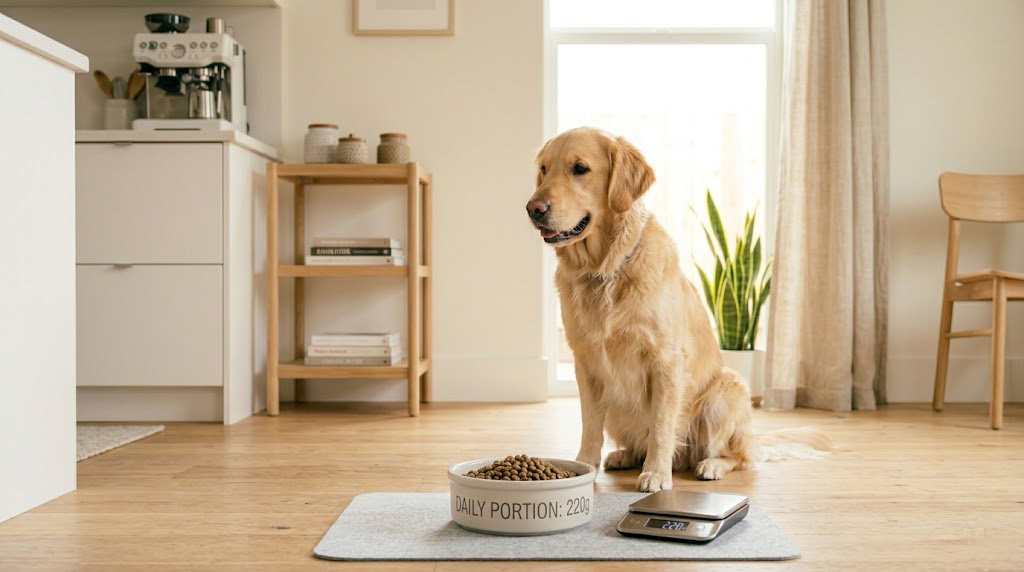
Daily cost = (bag price ÷ bag weight in grams) × grams fed per day
Use the same method for each food you are comparing.
This gives you a much more useful number than simply comparing two prices on a shelf.
Use the Feeding Guide as a Starting Point
The amount shown on the package is a starting point, not a perfect amount for every dog.
Your dog’s actual needs can vary with factors such as age, body condition, activity level, size, and the energy density of the food.
If you are unsure how to estimate an appropriate starting portion, see our guide on how much to feed your dog.
Cost Per Day Is Useful, But It Is Not the Final Decision
The cheapest food per day is not automatically the best value.
First ask whether both foods are nutritionally appropriate for your dog. Then compare daily cost alongside the other things you have already checked: nutritional suitability, manufacturer transparency, quality control, and how well the food fits your dog.
The goal is not to find the cheapest or the most expensive option.
It is to understand what you are getting for the money you spend each day.
When Is Paying More for Dog Food Actually Worth It?
Paying more for dog food can make sense, but only when the extra cost gives you something useful for your dog.
The goal is not to find the most expensive option. It is to understand whether the higher price brings better value for your dog’s actual needs.
Here are some situations where paying more may be easier to justify.
1. The Food Is Appropriate for Your Dog’s Life Stage
A puppy, adult dog, and senior dog do not always have the same nutritional needs.
A higher-priced food may be worth considering if it is clearly formulated for the right life stage and provides complete nutrition for that stage.
Do not pay more just because the front of the bag says “premium.” Check what the food is actually designed to provide.
2. The Manufacturer Gives You Better Information
Clear nutritional information, feeding guidance, calorie details, quality-control information, and access to knowledgeable customer support can make a product easier to evaluate.
That transparency has real value because it helps you understand what you are feeding rather than relying only on marketing claims.
3. The Quality-Control Process Is Better Explained
You cannot judge food safety or manufacturing quality from packaging alone.
If a manufacturer can clearly explain how products are made, tested, and traced, the higher price may be easier to understand.
This does not mean an expensive product is automatically safer. It means the company gives you more information to evaluate what you are paying for.
4. The Food Works Well for Your Individual Dog
A food that looks excellent on paper still needs to suit the dog eating it.
Pay attention to practical signs such as:
whether your dog eats the food consistently
whether their body weight and body condition remain appropriate
whether the portion size is practical
whether their stool remains consistent
whether the food fits their activity level and daily routine
If your dog has persistent digestive problems, unexplained weight changes, or other health concerns, those should be discussed with a veterinarian rather than solved simply by buying a more expensive food.
5. The Real Daily Cost Is Reasonable
A premium bag may look expensive at first, but the difference in daily feeding cost may be smaller than expected.
This is why comparing cost per day is more useful than comparing bag prices alone.
If two suitable foods are close in daily cost, factors such as transparency, feeding guidance, quality control, and how well the food suits your dog may become more important in the final decision.
When Paying More May Not Add Much Value
A higher price is harder to justify when the main differences are:
more expensive-looking packaging
vague “premium” or “luxury” language
fashionable ingredients without a clear nutritional reason
claims that are difficult to verify
a higher price without better information about the food
In those cases, you may simply be paying more for positioning rather than something that clearly improves the value of the diet.
The Simple Decision
Before choosing the more expensive food, ask yourself:
What specific benefit am I getting for the extra money?
If you can clearly answer that question and the food is appropriate for your dog, paying more may make sense.
If you cannot explain the difference beyond the label, packaging, or price, keep comparing.
The FAMMO 5-Minute Premium Dog Food Check
You do not need to be a pet nutrition expert to make a better comparison.
If you are choosing between two dog foods, take five minutes and work through these five checks before deciding whether the more expensive option is worth it.
1. Check Whether the Food Is Complete for Your Dog
Start here before comparing ingredients, packaging, or price.
Check whether the food is labelled as complete and whether it is appropriate for your dog’s life stage.
A puppy, adult dog, and senior dog may have different nutritional needs, so a food should first be suitable for the dog that will actually eat it.
If you cannot confirm that, stop there. A premium label cannot make up for a poor nutritional match.
2. Check the Feeding Amount and Calories
Now look at how much of each food your dog would actually eat.
Do not compare two bags only by size or price.
Check:
the suggested daily feeding amount
calorie information, where available
how long the bag is likely to last
whether the suggested portion seems practical for your dog
This gives you a much better picture of the real cost than the price on the shelf.
3. Check What the Manufacturer Tells You
Spend one or two minutes looking beyond the front of the package.
Can you easily find information about:
who formulates the food
where it is made
quality-control practices
feeding guidance
nutritional information
how to contact the company
You do not need every technical detail.
You are simply checking whether the company gives you enough useful information to understand the product you are paying for.
4. Ask What You Are Actually Paying Extra For
Now compare the two foods again.
Can you identify a clear reason why one costs more?
For example:
stronger quality-control information
clearer nutritional guidance
greater manufacturer transparency
a formulation that better fits your dog’s needs
a reasonable difference in daily feeding cost
Or is most of the difference based on:
premium-looking packaging
luxury wording
unusual ingredients
branding
vague claims that are difficult to verify
If you cannot identify what the extra money buys, do not assume the higher price means higher quality.
5. Decide Whether It Fits Your Dog
The final check is the most important.
Ask:
Is this food actually a good fit for my dog?
Consider your dog’s:
life stage
body condition
activity level
size
normal eating habits
individual tolerance
any known dietary restrictions
A food can look impressive on paper and still be the wrong choice for an individual dog.
If your dog has a diagnosed medical condition, persistent digestive problems, unexplained weight changes, or other health concerns, food decisions may need veterinary guidance.
Your Final Decision
After these five checks, you should be able to answer one simple question:
Can I explain why this food is worth the extra money for my dog?
If the answer is yes, the higher price may be justified.
If the answer is mainly “because it looks more premium,” keep comparing.
The goal is not to buy the cheapest food or the most expensive food.
The goal is to choose a food you can understand, evaluate, afford, and confidently feed to your dog.
Frequently Asked Questions
Is premium dog food always better than regular dog food?
No. A higher price or a premium label does not automatically mean better nutrition.
Compare whether the food is complete for your dog’s life stage, how transparent the manufacturer is, what quality-control information is available, and whether the food actually suits your dog.
Is expensive dog food worth the money?
It can be, if the extra cost gives you something useful and verifiable.
For example, better manufacturer transparency, clearer feeding guidance, strong quality-control information, or a formulation that better fits your dog may help justify a higher price.
If the main difference is packaging, branding, or vague premium claims, the extra cost may be harder to justify.
What is the difference between premium and regular dog food?
The biggest difference is not always nutrition.
Premium foods may differ in price, ingredients, manufacturing approach, quality-control systems, packaging, marketing, or the amount of information the company provides.
Instead of comparing the words on the front of the bag, compare the complete formulation, feeding guidance, manufacturer information, daily cost, and suitability for your dog.
Does premium dog food use better ingredients?
Not necessarily.
An expensive or unusual ingredient does not automatically make the complete diet better. What matters is how the full formula meets your dog’s nutritional needs.
Do not judge food quality from one ingredient or from the first ingredient on the list alone.
How can I compare two dog foods fairly?
Start by checking that both foods are complete and appropriate for your dog’s life stage.
Then compare:
feeding amount and calories
daily feeding cost
nutritional information
manufacturer transparency
quality-control information
how well each food fits your dog
Do not compare only the bag price or ingredient list.
The better choice is the food that provides an appropriate diet for your dog at a cost and level of transparency you are comfortable with.
Final Takeaway: Pay for Value You Can Verify
Premium dog food is not automatically better, and regular dog food is not automatically a worse choice.
The useful question is not whether a food looks premium. It is whether you can understand what you are paying for and whether it actually suits your dog.
Before paying more, check:
whether the food is complete for the right life stage
the feeding amount and real daily cost
how clearly the manufacturer explains its nutrition and quality controls
whether important product claims can be understood and verified
how well the food fits your dog’s body condition, activity level, and individual needs
If a higher-priced food gives you meaningful value in these areas, the extra cost may make sense.
If the difference is mainly packaging, branding, or premium wording, keep comparing.
The best value is not always the cheapest food or the most expensive food. It is a food that is nutritionally appropriate, practical to feed, affordable for you, and suitable for your dog.
Make Food Decisions More Personal with FAMMO
Choosing dog food becomes easier when you look at your dog, not just the label on the bag.
FAMMO helps you bring important details such as your dog’s age, breed, weight, activity level, and known dietary information together to explore more personalized nutrition guidance.
That context can help you think beyond words like “premium” or “high-end” and focus on what may be more suitable for your individual dog.
You do not need to find the most expensive food. You need enough reliable information to make a better-informed feeding decision.