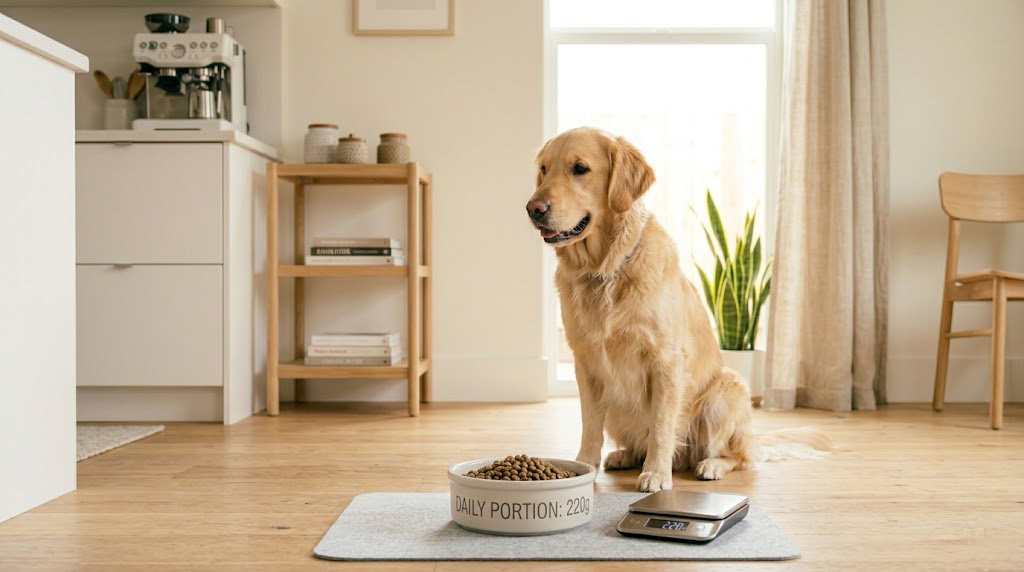
Knowing how much to feed your dog can be confusing because the right portion is not the same for every dog.
Your dog’s daily food amount depends on their weight, age, activity level, body condition, neuter status, and the calories in the food. If you are still choosing what to feed, start with our guide to the best dog food brands in Europe before calculating the portion.
The safest way to find a starting amount is to estimate your dog’s daily calorie needs, check the calorie information on the food label, measure the portion accurately, and then adjust it based on weight and body condition.
In this guide, you will learn how to turn your dog’s weight and calorie needs into a practical daily feeding amount, and how to tell whether that amount is actually working.
Quick Answer: How Much Should I Feed My Dog?
The right amount of food depends on your dog’s daily calorie needs and the number of calories in the food you are feeding.
A practical way to find a starting portion is:
Estimate your dog’s daily calorie needs using their ideal weight, age, activity level, body condition, and neuter status.
Check the food label for calories per gram, cup, can, or 100 g.
Convert those calories into a daily food amount.
Split the daily amount into measured meals.
Count treats and chews as part of the daily calorie total.
Adjust gradually if your dog gains or loses weight.
The basic calculation is:
Daily food amount = daily calorie target ÷ calories in the food
For example, if the label gives calories per gram, divide your dog’s daily calorie target by the calories per gram to estimate how many grams to feed per day.
The number you get is only a starting point. Your dog may need more or less depending on activity, metabolism, body condition, and health.
The best sign that the portion is working is a stable healthy weight, a visible waist, ribs that are easy to feel, normal energy, and consistent stool.
Dog Feeding Chart by Weight: A Practical Starting Point
A dog feeding chart can give you a useful starting point, but the right amount depends on more than weight alone.
For a healthy adult dog at an ideal body condition, veterinarians can estimate resting energy needs using:
RER = 70 × body weight (kg)^0.75
Daily maintenance needs are then estimated by adjusting RER for factors such as neuter status, activity, age, and body condition.
The table below shows an example starting calorie estimate for a healthy neutered adult dog using the commonly referenced maintenance factor of 1.6 × RER.
Dog Weight | Estimated RER | Example Daily Calories |
|---|---|---|
2 kg | ~118 kcal | ~188 kcal/day |
5 kg | ~234 kcal | ~374 kcal/day |
10 kg | ~394 kcal | ~630 kcal/day |
20 kg | ~662 kcal | ~1,059 kcal/day |
30 kg | ~897 kcal | ~1,436 kcal/day |
40 kg | ~1,113 kcal | ~1,781 kcal/day |
These are starting estimates, not fixed feeding prescriptions. Puppies, very active dogs, intact dogs, senior dogs, overweight dogs, and dogs with medical conditions may need substantially different amounts.
Sources: Merck Veterinary Manual, Daily Maintenance Energy Requirements for Dogs and Cats and AAHA Nutrition and Weight Management Guidelines.
How to Turn Daily Calories Into Food Amount
Once you have a starting calorie target, check your dog food label for:
- kcal per 100 g
- kcal per gram
- kcal per cup
- kcal per can or pouch
Then use:
Daily food amount = daily calorie target ÷ calories in the food
For example, imagine your dog’s starting target is 630 kcal per day and the food provides 360 kcal per 100 g.
That food provides 3.6 kcal per gram.
So:
630 ÷ 3.6 = about 175 g of food per day
You could then divide that daily amount between your dog’s meals.
This example only shows how the calculation works. Always use the calorie information from the specific food you are feeding, because two foods can provide very different calories in the same number of grams or cups.
When the Number Needs to Change
Do not keep feeding the calculated amount automatically if your dog’s body tells you it is not working.
Review the portion if your dog:
- gains or loses weight
- loses their visible waist
- becomes difficult to feel around the ribs
- seems unusually hungry
- regularly leaves food behind
- has major changes in activity
- receives a lot of treats or chews
For dogs that are overweight, underweight, still growing, pregnant, working, very active, or living with a medical condition, ask your veterinarian for a more individualized calorie target.
Why Calories Matter More Than Bowl Size
Two portions that look the same can provide very different amounts of energy.
Dry food is usually more calorie-dense than wet food, and even two dry foods can contain very different calories in the same cup. That is why filling a bowl “about the same amount” each day is not a reliable way to control portions.
For more accurate feeding:
- check the calorie information on the specific food you use
- weigh food in grams when possible
- include treats, chews, and toppers in the daily total
- use the package feeding guide as a starting point, not a fixed prescription
- adjust the amount based on your dog’s weight trend and body condition
A kitchen scale can be especially useful for dry food because small measuring differences can add up over time.
For dogs in Europe, choose a food that is appropriate for the correct species and life stage and follow the feeding information provided on the label. The FEDIAF Nutritional Guidelines provide European guidance for nutritionally complete and complementary pet food.
The goal is not to find one perfect number and never change it. The goal is to start with a reasonable amount, measure it consistently, and adjust it according to your dog’s real condition.
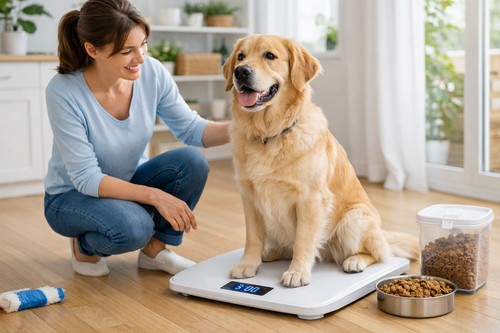
Key Factors That Affect How Much You Should Feed Your Dog
Your dog’s weight is only the starting point. The right daily portion can change depending on age, activity, breed size, food type, body condition, and health history.
That is why two dogs with the same weight may still need different food amounts.
1. Age and Life Stage
A puppy, an adult dog, and a senior dog should not be fed the same way.
Puppies usually need more calories per kilogram of body weight because they are growing.
Adult dogs need a stable maintenance amount that matches their activity level and ideal weight.
Senior dogs may need fewer calories if they are less active, but they still need high-quality protein and digestible nutrition.
Age also affects meal frequency. Puppies often need smaller, more frequent meals, while most healthy adult dogs do well with two measured meals per day.
Choosing the right food is just as important as choosing the right amount. If you are unsure which diet works best for your dog’s age, breed, weight, and activity level, read our Ultimate Guide to Choosing Healthy Dog Food by Breed, Weight & Age.
2. Activity Level
Activity level can change your dog’s daily calorie needs significantly.
A working dog, sport dog, or highly active Border Collie may need more food than a calm indoor dog of the same weight. On the other hand, a neutered indoor dog with low activity may gain weight quickly if fed the same amount as a more active dog.
Use this simple guide:
Activity Level | Feeding Adjustment |
|---|---|
Low activity / mostly indoor | start with the lower end of the food label guide |
Moderate daily walks | use the standard feeding guide as a starting point |
Very active / sport / working dog | may need more calories and closer monitoring |
Recovering, injured, or less mobile | may need fewer calories unless your vet says otherwise |
The goal is not to feed based on activity once and forget it. Monitor your dog’s weight, waist shape, stool, appetite, and energy every few weeks.
3. Breed Size and Body Type
Breed size affects metabolism, appetite, joint pressure, and how easily a dog gains weight.
Small breeds often need calorie-dense food in smaller portions, while large and giant breeds need controlled feeding to avoid excess weight and joint stress.
For example:
small breeds may need smaller kibble and precise portions
medium dogs often need portion adjustment based on activity
large breeds need controlled calories to protect joints
giant breeds may need slower eating routines and careful weight tracking
If your dog is a small breed, you can also read our guide to the best dog food for small breeds for more specific feeding considerations.
4. Food Type: Dry, Wet, Mixed, or Homemade
The type of food you use can completely change the portion size.
Dry food is usually more calorie-dense, so a small cup can contain a lot of calories. Wet food usually contains more moisture, so the same weight in grams may provide fewer calories. Mixed feeding can work well, but only if you calculate the combined calories from both foods.
Homemade-style meals vary the most because calories depend on the ingredients, cooking method, fat content, and supplements used.
A simple way to think about it:
Food Type | Portion Risk |
|---|---|
Dry food | easy to overfeed because it is calorie-dense |
Wet food | larger volume does not always mean more calories |
Mixed feeding | total calories can be miscalculated |
Homemade-style food | nutritional balance and calories can vary widely |
If you are comparing food formats, read our full guide to wet vs dry dog food before changing your dog’s portions.
5. Body Condition Score
Your dog’s body condition score is often more useful than weight alone.
A dog can be the “right” weight on paper but still have too much body fat. Another dog may look slim but be healthy for its breed and body type.
As a simple home check:
you should be able to feel the ribs without pressing hard
your dog should have a visible waist from above
the belly should tuck slightly upward from the side
sudden weight gain or weight loss should be checked
If your dog is overweight, do not crash diet. Reduce portions gradually, track treats, increase safe activity, and ask your vet for guidance if the weight does not improve.
6. Treats, Snacks, and Table Food
Many dogs gain weight not because their main meals are too large, but because treats are not counted.
Training treats, dental chews, leftovers, cheese, bread, and small snacks can add up quickly.
A practical rule:
keep treats limited
count treats as part of daily calories
avoid table scraps as a daily habit
reduce meal portions slightly on high-treat days
choose smaller training treats when possible
If your dog is always hungry, begging, or gaining weight despite measured meals, check treat intake before changing the main food.
How Often Should You Feed Your Dog?
Feeding schedule matters, but this article is mainly about portion size.
As a simple starting point:
Puppies: usually 3 to 4 meals per day
Adult dogs: usually 2 measured meals per day
Senior dogs: often 2 smaller meals per day
Consistent timing can help digestion, appetite regulation, and portion control. However, the best schedule depends on your dog’s age, health, activity level, and feeding behavior.
For a more detailed meal schedule by life stage, read our full guide: How Often Should I Feed My Dog?
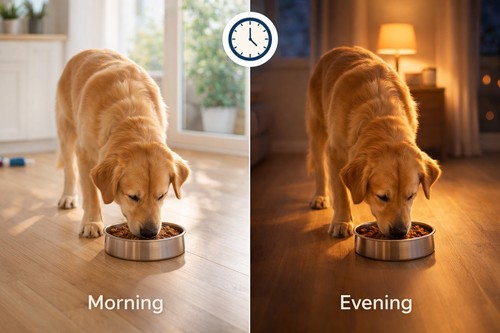
Signs You Are Feeding Your Dog Too Much or Too Little
Even if you follow a feeding chart, your dog’s real-life signals matter.
The right portion should support a stable weight, healthy energy, normal stool, a visible waist, and a body shape that feels healthy when you check the ribs and belly.
If your dog’s weight, appetite, stool, or energy changes, the food amount may need adjustment.
Signs You May Be Feeding Your Dog Too Much
Overfeeding does not always look obvious at first. Many dogs gain weight slowly over weeks or months.
Common signs include:
gradual weight gain
reduced waist shape when viewed from above
ribs are difficult to feel without pressing
low activity or reluctance to move
heavy breathing after mild exercise
difficulty jumping, walking, or climbing stairs
soft stool or digestive changes after meals
begging even after eating, especially if treats are frequent
One of the easiest home checks is the rib test. You should be able to feel your dog’s ribs with light pressure, but the ribs should not be sharply visible in a healthy adult dog.
This is similar to the body condition score approach used in veterinary weight assessment, where rib feel, waist shape, and visible body fat are used to assess whether a dog is underweight, ideal, or overweight.
If your dog is gaining weight, do not suddenly cut food dramatically. Start by checking treats, table food, portion size, and calorie content on the label.
Dog obesity can increase pressure on joints, mobility, digestion, and long-term health. For a deeper guide, read: Prevent Pet Obesity with AI.
Signs You May Be Feeding Your Dog Too Little
Underfeeding can also happen, especially when owners reduce portions too quickly, switch foods without checking calories, or follow a feeding chart that does not match their dog’s real needs.
Possible signs include:
visible ribs, spine, or hip bones
sudden or steady weight loss
low energy or weakness
constant hunger after meals
poor coat quality
muscle loss
slower recovery after activity
eating too fast because of hunger
behavioral changes around food
If your dog is losing weight without a clear reason, do not just increase food immediately. First check the food label, calories per serving, stool quality, appetite, and whether there are other symptoms.
Unexplained weight loss, vomiting, diarrhea, weakness, or loss of appetite should be discussed with a veterinarian.
Quick Check: Is Your Dog’s Portion Working?
Use this simple weekly check:
What to Monitor | Healthy Sign | Warning Sign |
|---|---|---|
Weight | stable or changing slowly as planned | sudden gain or loss |
Ribs | easy to feel with light pressure | hidden under fat or sharply visible |
Waist | visible from above | no waist or extreme thinness |
Energy | normal for age and breed | unusually low or restless |
Stool | consistent and well-formed | frequent soft stool or diarrhea |
Appetite | satisfied after meals | constant hunger or leaving food often |
A single sign does not always mean the portion is wrong. But if you notice several changes together, adjust gradually and track the result for 2–3 weeks.
The safest approach is to make small changes, monitor your dog’s body condition, and ask your vet for guidance if symptoms continue.
Common Feeding Mistakes Dog Owners Make
Many feeding problems do not happen because owners do not care. They happen because small daily habits slowly change a dog’s calorie intake.
Here are the most common mistakes to avoid.
1. Free Feeding All Day
Free feeding means leaving food available all day.
This may work for a few dogs, but for many dogs it makes portion control harder. It can also make it difficult to notice appetite changes, overeating, or digestive patterns.
A better approach is to feed measured meals at regular times and remove unfinished food after a reasonable period.
2. Measuring Food by Eye
Guessing by bowl size is one of the easiest ways to overfeed.
Different kibble shapes, wet food textures, and homemade-style meals can contain very different calories in the same-looking portion.
Use a measuring cup or, even better, a kitchen scale. Measuring in grams is usually more accurate than guessing by volume.
3. Forgetting to Count Treats
Treats, dental chews, training rewards, and small snacks all add calories.
If your dog receives many treats during the day, the main meals may need to be slightly smaller. Treats should be part of the daily feeding plan, not extra calories on top of it.
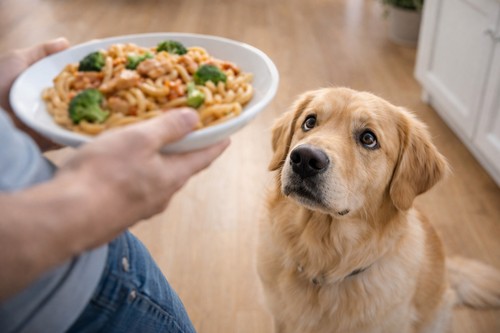
4. Giving Too Much Table Food
Many human foods are too fatty, salty, seasoned, or calorie-dense for dogs. Some foods can also be dangerous.
Avoid making table scraps a daily habit, especially if your dog is gaining weight, having soft stool, or begging constantly.
The FDA lists several potentially dangerous items for pets, including chocolate, grapes and raisins, garlic, caffeine, alcohol, fatty foods, and macadamia nuts. If your dog eats something unsafe, contact your veterinarian or an emergency pet poison service.
5. Not Adjusting Food as Your Dog Ages
A puppy, adult dog, and senior dog should not stay on the same portion forever.
Your dog’s calorie needs can change with age, growth, neuter status, activity level, weight changes, and health conditions.
Review the portion every few weeks for puppies and every few months for adult and senior dogs.
6. Ignoring Activity Level
A calm indoor dog and a highly active dog may need very different daily calories, even if they weigh the same.
If your dog becomes less active because of weather, injury, age, or lifestyle changes, the food amount may need to be reduced gradually.
If your dog becomes more active, you may need to increase calories carefully and monitor weight, stool, and energy.
7. Changing Food Amount Too Quickly
Sudden portion changes can upset digestion or make your dog feel unusually hungry.
If your dog needs more or less food, adjust gradually and monitor the result for 2–3 weeks.
The goal is not to make your dog lose or gain weight overnight. The goal is a steady, healthy trend.
8. Ignoring Stool, Appetite, and Weight Trends
Your dog’s body gives feedback every day.
Watch for:
sudden weight gain or weight loss
constant hunger
leaving food often
soft stool or diarrhea
vomiting after meals
low energy
changes in drinking or activity
If several signs appear together, the problem may not be only portion size. Food quality, food sensitivity, illness, stress, or feeding schedule may also be involved.
Dogs are very good at asking for food, but that does not always mean they need more food.
How to Find the Right Portion for Your Dog
The best feeding amount is not found by guessing. It is found by combining the food label, your dog’s body condition, and real-life tracking.
Use this simple step-by-step method.
Step 1: Start With the Food Label
Check the feeding guide on your dog’s food package.
Look for:
recommended amount by body weight
kcal per cup
kcal per can
kcal per 100g
life stage: puppy, adult, senior, or all life stages
The food label gives you a starting point, but it should not be treated as a perfect final answer. Your dog may need more or less depending on activity level, body condition, neuter status, age, and metabolism.
Step 2: Measure the Food Accurately
Do not rely only on bowl size.
If possible, measure your dog’s food in grams with a kitchen scale. This is more accurate than guessing by cups, especially for dry food, wet food, and mixed feeding.
If you use cups, use the same measuring cup every time and avoid “heaping” portions.
Step 3: Track Your Dog for 2–3 Weeks
After choosing a starting portion, monitor your dog’s real response.
Track:
weight changes
body condition score
appetite after meals
energy level
stool quality
vomiting or digestive changes
treat intake
activity level
Do not judge the portion from one day only. Look for patterns over 2–3 weeks.
Step 4: Adjust Gradually
If your dog is gaining weight, reduce the daily amount slightly and check treats first.
If your dog is losing weight, seems weak, or is always hungry, review calories and food type before simply adding more food.
Small changes are safer than sudden changes.
A practical adjustment is to change the daily amount by a small percentage, then monitor weight, stool, appetite, and energy again for another 2–3 weeks.
Step 5: Use Body Condition, Not Only the Scale
Weight alone does not tell the full story.
A healthy dog should usually have ribs you can feel with light pressure, a visible waist from above, and a slight abdominal tuck from the side.
According to the American Veterinary Medical Association (AVMA), keeping pets at a healthy weight can help lower the risk of health problems such as arthritis, diabetes, high blood pressure, breathing problems, back problems, and reduced quality of life.
Step 6: Ask Your Vet When the Signs Are Not Normal
Portion size is not the only reason a dog may gain weight, lose weight, or have digestive changes.
Speak with your veterinarian if your dog has:
unexplained weight loss
rapid weight gain
repeated vomiting
ongoing diarrhea
sudden appetite changes
weakness or low energy
excessive thirst
known medical conditions
The right portion should support your dog’s health, not create new symptoms.
Smarter Feeding with Data: Personalized Dog Nutrition
Every dog is different.
Two dogs can have the same weight but completely different feeding needs. One may be young, active, lean, and energetic. The other may be older, neutered, less active, or slowly gaining weight.
That is why the future of dog nutrition is not just about choosing a food brand. It is about understanding patterns.
A smarter feeding plan should consider:
current weight and ideal weight
age and life stage
breed size and body type
activity level
neuter status
food type: dry, wet, mixed, or homemade
stool quality and digestion
appetite changes
treats and table food
weight trend over time
This is where personalized nutrition can help.
Platforms like FAMMO are designed to help pet owners move from guessing to more data-driven feeding decisions. By tracking your dog’s profile, lifestyle, feeding habits, and health signals, FAMMO can help you understand whether your dog’s current portion still makes sense.
This does not replace your veterinarian. But it can help you notice patterns earlier, ask better questions, and make daily feeding decisions with more confidence.
FAQ: How Much Should I Feed My Dog?
How much should I feed my dog per day?
The right daily amount depends on your dog’s weight, ideal weight, age, activity level, body condition score, neuter status, food type, and the calories listed on the food label. Start with the feeding guide on the package, then adjust based on your dog’s weight trend, stool quality, appetite, and energy.
How much food should I feed my dog by weight?
Your dog’s weight is a useful starting point, but it should not be the only factor. A 10 kg active young dog and a 10 kg neutered indoor dog may need different daily calories. Use weight together with body condition, activity level, age, and food calorie content.
Should I feed my dog by calories, cups, or grams?
Calories are the most important measure because they show how much energy your dog is actually getting. Grams are usually more accurate than cups because kibble size, shape, and cup filling can vary. If possible, check kcal per cup, kcal per can, or kcal per 100g, then measure the food consistently.
Is the 2–3% body weight rule accurate for dogs?
The 2–3% body weight rule can be a rough starting point for some fresh or homemade-style diets, but it is not accurate for every dog or every food type. Dry food, wet food, mixed feeding, and homemade meals can all have very different calorie levels.
How much dry food should I feed my dog?
Dry food is usually calorie-dense, so even a small cup can contain many calories. Check the kcal per cup on the label, start with the feeding guide, and adjust based on your dog’s body condition, weight trend, activity level, and treat intake.
How much wet food should I feed my dog?
Wet food usually contains more moisture and often has fewer calories per gram than dry food. This means the portion may look larger, but it may not provide more calories. Always compare calories, not just grams, cans, or bowl volume.
How do I know if I am feeding my dog too much?
Signs may include gradual weight gain, reduced waist shape, ribs that are hard to feel, low activity, difficulty moving, soft stool, or frequent begging combined with too many treats. If your dog is gaining weight, check treats, table food, and label calories before making sudden portion changes.
How do I know if I am feeding my dog too little?
Possible signs include visible ribs, weight loss, low energy, constant hunger, poor coat quality, muscle loss, or behavioral changes around food. If weight loss is sudden, unexplained, or happens with vomiting, diarrhea, weakness, or appetite changes, speak with your veterinarian.
Should treats count as part of my dog’s daily food amount?
Yes. Treats, dental chews, training rewards, leftovers, and table food all add calories. If your dog gets treats every day, they should be counted as part of the daily feeding plan, not as extra calories on top of meals.
How often should I review my dog’s food amount?
For puppies, review portions every few weeks because they grow quickly. For adult and senior dogs, review portions every few months or whenever weight, activity, appetite, stool quality, food type, or health status changes.
Conclusion
Feeding your dog the right amount is not about finding one perfect number.
It is about starting with a safe estimate, checking the food label, measuring portions accurately, and adjusting based on your dog’s real-life signals.
Your dog’s ideal portion can change with weight, age, activity level, body condition, neuter status, food type, treats, and health changes.
A feeding chart can help you start, but your dog’s body tells you whether the amount is actually working.
If your dog has stable weight, healthy energy, normal stool, a visible waist, and a good appetite, the portion is probably close. If you notice weight gain, weight loss, constant hunger, low energy, vomiting, diarrhea, or sudden appetite changes, it is time to review the feeding plan.
The smartest approach is simple:
measure the food
track your dog’s body condition
count treats
review the food label
adjust gradually
ask your vet when symptoms do not look normal
With the right data and regular observation, feeding becomes less about guessing and more about understanding what your dog actually needs.
Start Feeding Your Dog With More Confidence
If you want to stop guessing your dog’s portions, FAMMO can help you understand your dog’s feeding needs based on profile data, lifestyle, weight, activity, and health signals.
Create your dog’s profile and start making more personalized feeding decisions.