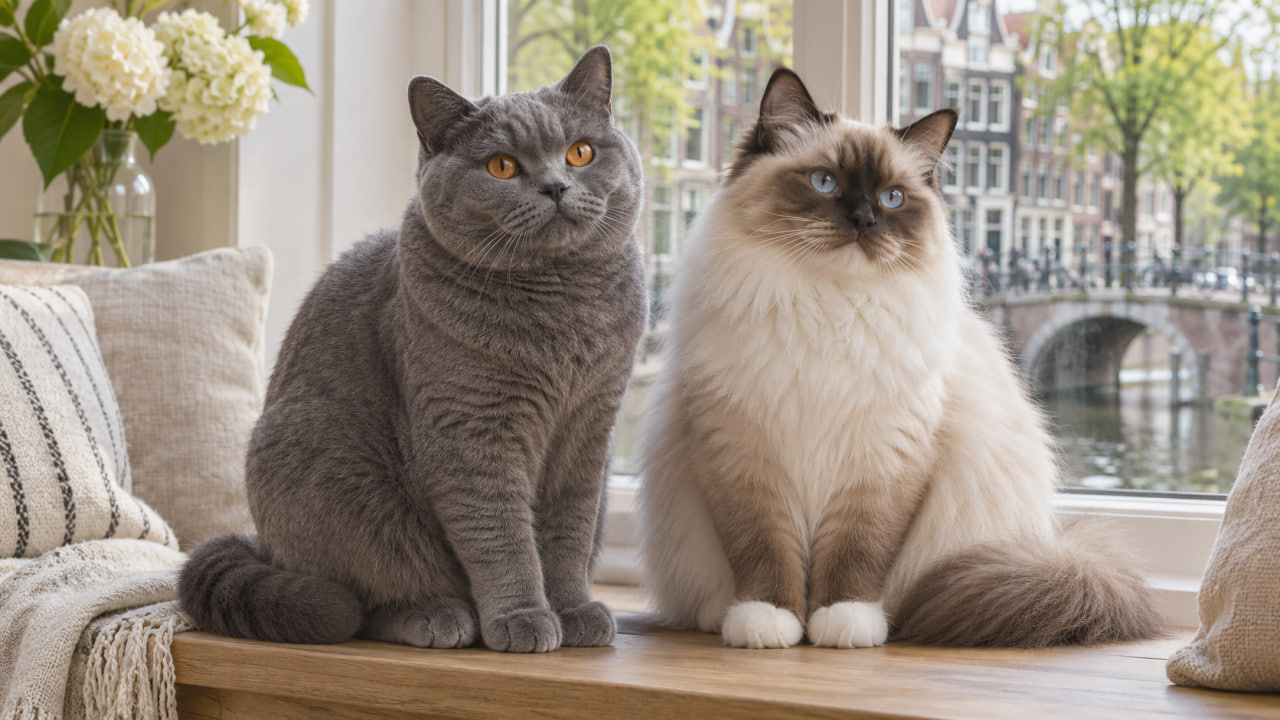
British Shorthairs have a sturdy build and a plush coat, while Ragdolls typically have a larger frame and longer fur. If you live with both, those differences can make shopping for cat food seem more complicated than it needs to be. Can you buy one food for both cats, and how do you decide how much goes into each bowl? Our guide to cat food by breed covers the broader picture. Here, we’ll focus on what to buy and how to serve it when you feed these two cats at home.
Quick Answer: Can Both Cats Eat the Same Food?
Yes. A healthy adult British Shorthair and a healthy adult Ragdoll can eat the same food if it’s labelled as complete for adult cats and both cats tolerate it well.
Serve it in separate bowls. Use the feeding guide on the pack as a starting point for each cat, then track how much each one eats and whether it maintains a healthy weight.
If one cat is still growing, choose a complete food suitable for kittens. If either cat is on a veterinary diet, check with your vet before switching that cat to the shared food.
When Can Both Cats Eat the Same Food?
Check the label before buying. Look for “complete food for adult cats” if both cats are healthy adults. A product labelled “complementary” is meant to be fed alongside other food. See FEDIAF’s guide to complete and complementary pet food.
Your situation | What to do |
|---|---|
Both adults do well on the same food | Buy one food and measure each cat’s portion separately. |
One cat is still growing | Choose complete kitten food for the kitten and adult food for the adult. |
One cat is on a veterinary diet | Follow your vet’s feeding plan and keep the meals separate. |
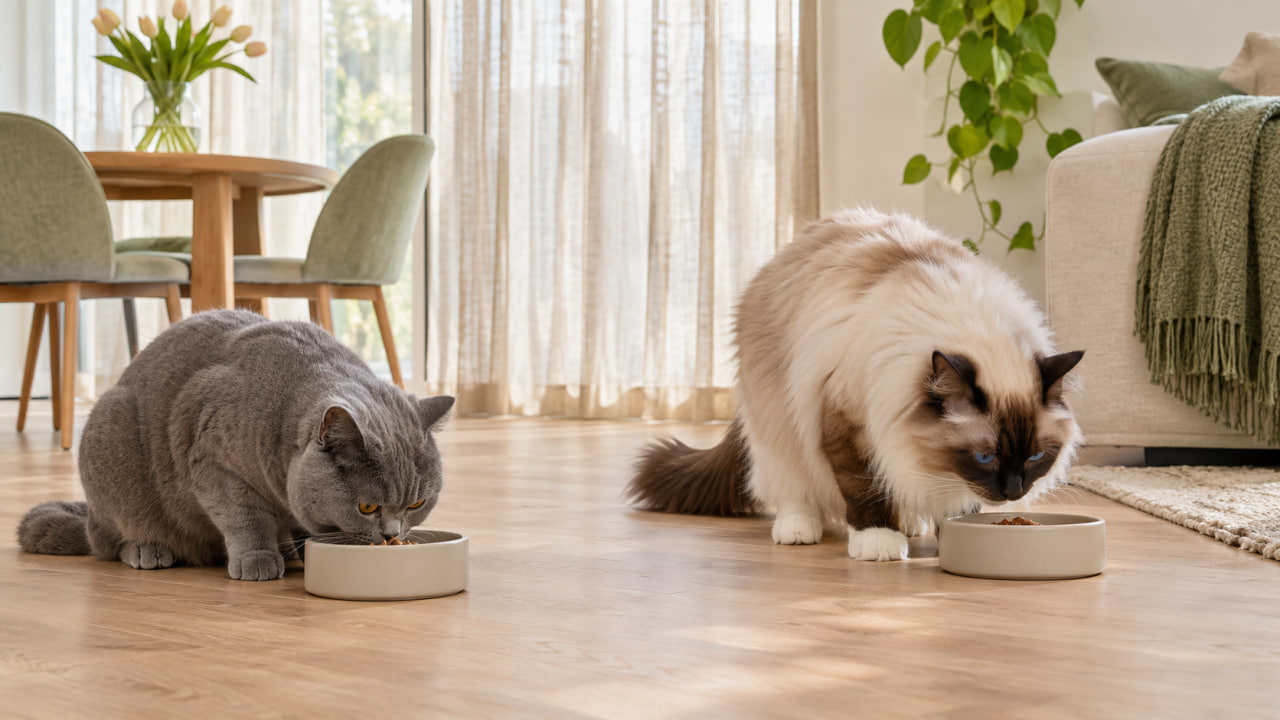
One cat finishes both bowls | Feed them in separate rooms so each cat can finish its own meal. |
How Much Should You Feed Each Cat?
Your British Shorthair and Ragdoll may eat from the same bag and still need different amounts. To work out what goes into each bowl, start with the feeding guide on the pack and measure each cat’s food separately.
Check the daily amount for each cat. Use the feeding guide as a starting point for a healthy adult at a healthy weight. If your vet has given either cat a specific feeding target, use that target.
Weigh the food before the first meal. Put each cat’s daily portion in its own container. If you serve two equal meals, use half the container at each meal. If you use kibble as a reward, take it from that cat’s container.
Track each cat’s weight over time. Compare each cat with its own previous weigh-ins. If one cat is steadily gaining or losing weight, review how much it actually eats, including treats and leftovers from the other bowl. Ask your vet about unexplained weight changes.
When you switch foods, check the new pack’s feeding guide. The same number of grams can contain a different number of calories.
How to Stop One Cat Eating the Other’s Food
If your British Shorthair finishes first and your Ragdoll likes to come back for another bite later, set up mealtimes so the slower eater can finish in peace.
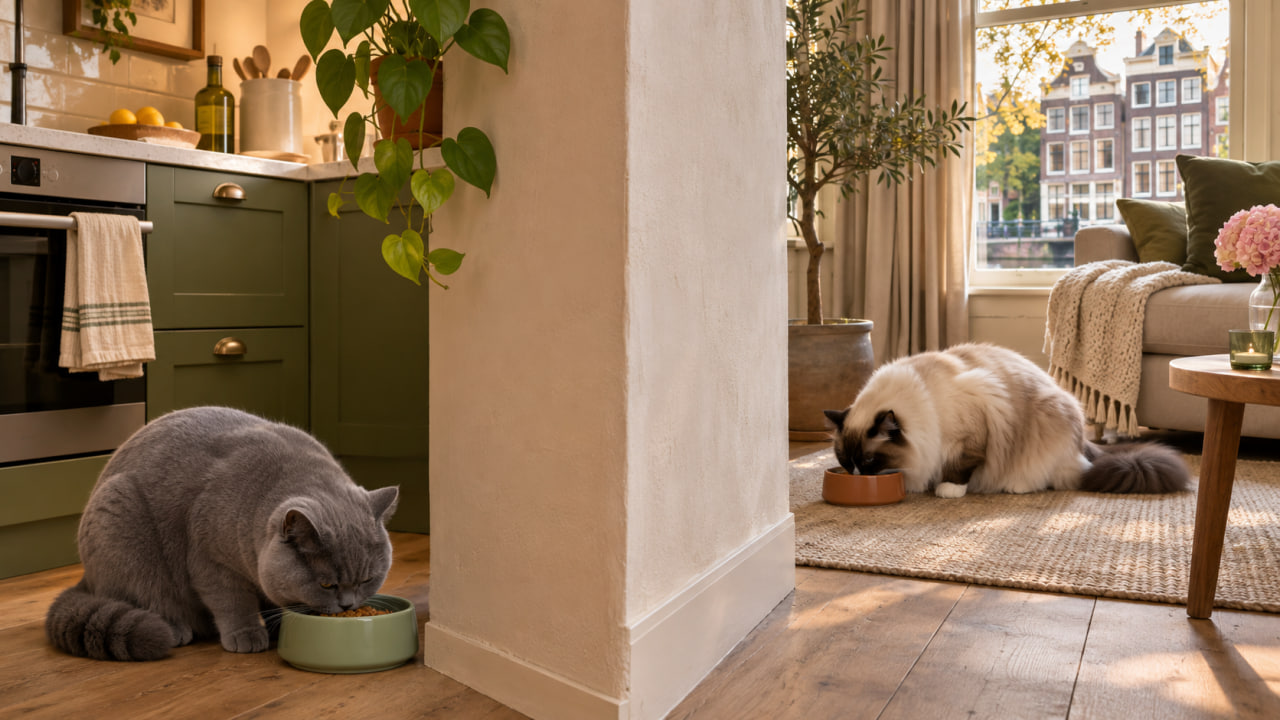
Use two feeding spots. Start with separate rooms if both cats are comfortable there. In a small flat, try placing the bowls around a corner or on opposite sides of a visual barrier. Stay nearby for the first few meals to see whether either cat still switches bowls.
Give the slower eater time. If one cat walks away and usually comes back later, keep its bowl somewhere the other cat can’t reach. Follow the storage instructions on the pack for leftover wet food.
Check what each cat actually ate. For the first few meals, note how much you served and what was left in each bowl. That gives you a baseline before you decide whether either portion needs changing.
For more on setting up feeding spots in a multi-cat home, see the AAFP and ISFM feline environmental guidelines.
How to Check How Much Each Cat Actually Ate
For the next few meals, weigh the food you put in each bowl and weigh what’s left once each cat has finished. Write both numbers in a note on your phone.
Cat | Example breakfast entry |
|---|---|
British Shorthair | 25 g served, 5 g left → 20 g eaten |
Ragdoll | 30 g served, 10 g left → 20 g eaten |
These numbers are just an example. If one cat gets into the other’s bowl, mark that meal as “shared bowl”. When you review how much each cat usually eats, use the meals you could track separately.
What If One Cat Refuses the Shared Food?
At the next meal, serve the cat’s usual food in its regular bowl. Offer a small taste of the new food on a separate dish nearby, where the other cat can’t get to it. Then check what the cat actually eats.
Eats the usual food and tries the new one. Replace a little more of the usual food over several days, as long as the cat keeps eating its meals.
Eats the usual food and leaves the new one. Keep serving the familiar food if it still meets that cat’s needs. If the other cat is doing well on the new food, you can keep two different foods in the house.
Eats much less than usual or refuses both foods. Pause the switch and contact your vet promptly. Tell them when the cat last ate a normal meal. If you’ve been tracking what went into each bowl and what was left, share those notes. Read what to do when your cat stops eating.
How to Give Treats When You Have Two Cats
Your British Shorthair and Ragdoll can have the same treat if it’s suitable for both. Work out how many each cat gets separately, especially if they have different daily calorie needs.
Check the calories per treat. For most healthy adult cats, treats and other extras should account for no more than 10% of each cat’s total daily calories. Count lickable treats and toppers in that total too. See the WSAVA guide to cat treats.
Set aside each cat’s treats for the day. Put them in two labelled containers. If someone else gives a treat later, they can use the same containers and see what’s left. If one cat tends to grab the other’s treats, reward them in their separate feeding spots.
Check first if either cat is on a veterinary diet. Ask your vet which rewards fit that cat’s feeding plan. If your vet says it’s suitable, you can use a few pieces of the cat’s usual dry food from its measured daily portion.
Example: If one cat’s daily total is 200 kcal, its treats can provide up to 20 kcal. Three treats at 4 kcal each account for 12 kcal of that daily total. Use your own cat’s calorie target and the figures on the packet.
Frequently Asked Questions
Can my Ragdoll eat food labelled for British Shorthairs?
Yes, if your Ragdoll is a healthy adult and the food is suitable for that cat. Turn the pack over and look for “complete food for adult cats.” If the label says “complementary,” use it alongside a complete diet. If your Ragdoll already does well on another complete adult food, there’s no need to switch just because the cats live together.
Can I feed one cat wet food and the other dry food?
Yes. Choose a complete food for each cat’s life stage. Use the feeding guide on each product’s own pack to estimate the daily amount. Equal weights of wet and dry food can provide different amounts of energy. See FAMMO’s wet vs dry cat food guide.
Can both cats eat the same food if only one is neutered?
They can if the food suits both cats. The neutered cat may need a different daily amount. Keep track of its weight after neutering and ask your vet whether its portion needs adjusting if you notice a steady change.
Start With the Next Meal
At the next meal, serve your British Shorthair and Ragdoll their measured portions in separate spots. Before either cat can reach the other’s bowl, check what’s left. Repeat this over a few meals. If one cat keeps walking away when the other approaches, move the bowls farther apart before changing the portions.