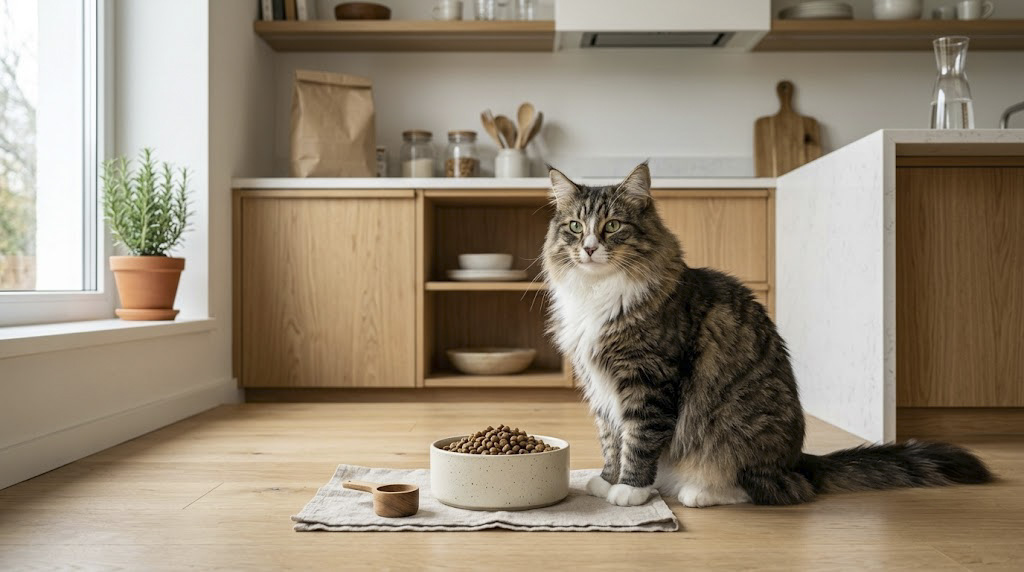
Choosing sustainable cat food in Europe is not only about finding a green package or a brand that promises to be carbon neutral. The food must first provide complete nutrition for your cat’s life stage, while its environmental claims should be specific, measurable, and verifiable.
For a broader comparison of nutrition, availability, and everyday value, start with our guide to the best cat food brands in Europe. This guide focuses specifically on sustainability: ingredient sourcing, independent certification, manufacturing practices, packaging, and company transparency.
A sustainable cat food brand does not need to lead in every category. One company may stand out for certified organic ingredients, while another may provide stronger impact reporting, recyclable packaging, or verified seafood sourcing. The goal is to identify the best-supported option for your cat and your priorities, not the brand with the loudest environmental marketing.
Quick Answer: Which Sustainable Cat Food Brands Stand Out in Europe?
Three European brands worth comparing are Yarrah, Edgard & Cooper, and Bozita, but they stand out for different reasons.
- Yarrah is relevant for cat owners comparing certified organic food from a Netherlands-based European brand.
- Edgard & Cooper is useful to compare for its company-level sustainability reporting, B Corp certification, and published packaging information.
- Bozita is notable for Swedish production and packaging formats used across parts of its wet-food range.
No brand should be called “the most sustainable” without comparing the same product category using consistent lifecycle data.
Before choosing a food, check that it:
- is labelled as complete food for your cat’s life stage
- identifies the certification or standard behind its environmental claims
- publishes specific information about sourcing, manufacturing, packaging, or emissions
- explains how its packaging should be disposed of in your country
- remains suitable for your cat’s age, health, digestion, and feeding routine
Sustainability is a useful decision factor, but it should never replace nutritional adequacy or veterinary advice when your cat has a medical condition.
Table of Contents
- Why Sustainability Matters in Cat Food
- How We Evaluated Sustainable Cat Food Brands
- Best Sustainable Cat Food Brands in Europe
- European Brand Profiles
- Cat Food Packaging and Recycling
- How to Spot Greenwashing
- Are Sustainable Brands More Expensive?
- How FAMMO Supports Feeding Decisions
- Frequently Asked Questions
- Sources and Methodology

Why Sustainability Matters in Cat Food
Sustainability in cat food cannot be judged by packaging alone.
FEDIAF’s 2025 Product Environmental Footprint Category Rules for Pet Food described a standardised framework for assessing environmental impact across the full product lifecycle, including:
- ingredient sourcing
- packaging production
- pet food manufacturing
- distribution
- the use phase
- packaging disposal at the end of its life
The linked 2025 version states that it was valid through 2025-12-31. It is used here to explain lifecycle stages, not to claim that any brand in this guide has completed a current verified PEF assessment.
This means that a recyclable package does not automatically make a cat food sustainable. Ingredient choices, production methods, transport, nutritional efficiency, and the local recycling system can all affect the final environmental footprint.
Nutrition must still come first. Before comparing environmental claims, review the FEDIAF guide to understanding pet food labels and confirm that the selected product is labelled as complete food for your cat’s life stage.
For broader industry developments, alternative proteins, and future sustainability trends, read our guide to sustainable pet food in Europe.
How We Evaluated Sustainable Cat Food Brands
This comparison is based on publicly available information reviewed on 2026-07-15.
It is not an independent laboratory ranking or a complete lifecycle assessment of every product sold by each company. Sustainability claims, recipes, certifications, packaging formats, and availability may vary by product line and country.
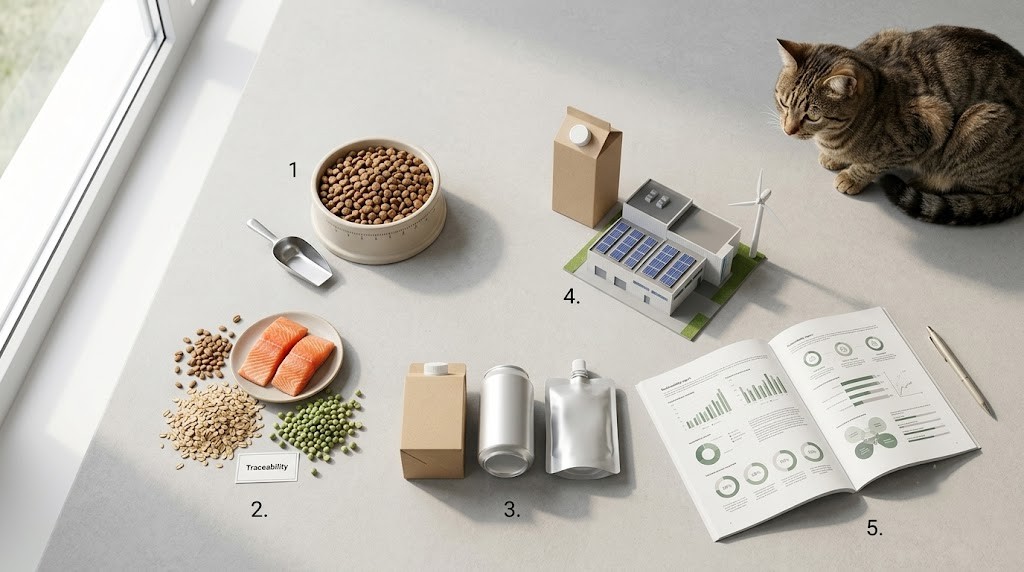
We evaluated each brand using five practical criteria:
1. Nutritional Completeness
We checked whether the company offers cat food and whether buyers can verify that the selected product is labelled as complete food for the appropriate life stage.
A company-level sustainability commitment does not prove that every recipe is nutritionally suitable for every cat.
2. Ingredient Sourcing and Certification
We looked for specific and verifiable information about:
- organic certification
- responsible seafood sourcing
- ingredient traceability
- farming or animal-welfare standards
- recognised third-party certification
A general statement such as “responsibly sourced” was not treated as equivalent to independent certification.
3. Packaging Evidence
We reviewed whether the company explains:
- which packaging formats it uses
- whether those formats are recyclable
- where recycling is available
- whether disposal instructions differ by country
Packaging described as recyclable may still depend on local collection and recycling infrastructure.
4. Manufacturing and Environmental Reporting
We looked for published information about:
- renewable energy
- manufacturing locations
- emissions targets
- waste reduction
- sustainability or impact reports
Company targets were treated as commitments, not proof that every target has already been achieved.
5. Transparency and European Availability
We considered whether the brand:
- publishes accessible sustainability information
- identifies the standards behind its claims
- provides cat-food products in European markets
- explains relevant limitations or areas still being improved
Brands received no star ratings or numerical sustainability scores because comparable product-level lifecycle data were not available for every company.
Best Sustainable Cat Food Brands in Europe: Evidence-Based Comparison
There is no single brand that can be verified as the most sustainable option for every cat, product type, and European country.
The table below compares three European brands with publicly available evidence in different sustainability areas.
| Brand | Evidence reviewed | Main reason to consider it | Important limitation to check |
|---|---|---|---|
| Yarrah | Organic cat-food range, certificate information, and published impact material | Relevant for cat owners prioritising certified organic pet food from a Netherlands-based brand | Confirm that the specific recipe is complete for your cat’s life stage and check current availability |
| Edgard & Cooper | Cat-food range, B Corp status, impact reporting, and published packaging information | Relevant for buyers who value company-level reporting and third-party assessment | B Corp evaluates the company, not the nutritional or environmental performance of every individual recipe |
| Bozita | Swedish dog and cat-food production, renewable-electricity information for its Vårgårda facility, and Tetra Recart packaging information | Relevant for buyers comparing Swedish production and recyclable wet-food packaging formats | Recycling availability varies by country, and not every product uses the same packaging format |
These brands stand out for different reasons:
- Yarrah provides clearer evidence around organic positioning and certification.
- Edgard & Cooper publishes broader company-level sustainability and impact information.
- Bozita provides specific information about Swedish production, renewable electricity, and packaging used for parts of its wet-food range.
Before buying, verify the exact product rather than relying only on the brand name. Check the nutritional declaration, life stage, recipe, certification, packaging instructions, and availability in your country.
European Brand Profiles: What the Public Evidence Shows
The following profiles explain why each brand appears in the comparison. They are not endorsements of every recipe sold by the company.
Always evaluate the exact product, because nutritional completeness, ingredients, certification, packaging, and availability can differ across product lines and countries.
Yarrah: Organic Certification and Published Impact Information
Yarrah has produced organic dog and cat food since 1992 and publishes information about its certifications, product standards, and environmental impact.
Its official certificates page explains the standards associated with its organic products, animal-welfare commitments, food safety, and company-level social and environmental performance.
Yarrah also publishes an impact report covering its progress, environmental priorities, and areas for further improvement.
Why Yarrah Is Worth Comparing
- It offers both wet and dry organic cat-food products.
- It provides dedicated information about its certifications.
- It publishes company-level impact information.
- Its organic positioning is supported by identifiable certification rather than only front-of-pack language.
What to Verify Before Buying
Check the exact recipe for:
- a complete-food declaration
- the intended life stage
- current organic certification
- ingredient and additive information
- feeding guidance
- availability in your country
Organic certification provides useful evidence about production standards, but it does not automatically make every recipe the best nutritional choice for every cat.
Edgard & Cooper: B Corp Status and Company-Level Reporting
Edgard & Cooper sells cat food in European markets and publishes information about its environmental strategy, packaging, sourcing goals, and company impact.
The company’s official B Corp page explains that it received B Corp certification after assessment across several areas of company performance.
Its planet and packaging information describes the company’s environmental goals and packaging approach, including the use of paper-based bags across relevant parts of its range.
Why Edgard & Cooper Is Worth Comparing
- It has independently verified B Corp status.
- It publishes regular company-level impact information.
- It provides public information about packaging and environmental goals.
- It offers a dedicated cat-food range in European markets.
What to Verify Before Buying
Check whether the specific product:
- is complete for your cat’s life stage
- uses the packaging format described on the company’s sustainability pages
- provides appropriate feeding instructions
- is available consistently in your country
- meets your cat’s individual nutritional and digestive needs
B Corp certification evaluates the company’s wider social and environmental performance. It does not certify that every individual recipe has the lowest environmental footprint.
Bozita: Swedish Production and Renewable Electricity
Bozita states that its dog and cat food is produced in Vårgårda, Sweden.
Its official sustainability information states that production in Vårgårda uses electricity from renewable sources and that production waste is converted into biogas where possible.
Bozita also reports using Tetra Recart packaging for parts of its dog- and cat-food range. The company describes this packaging as FSC-sourced and recyclable in many European countries.
Why Bozita Is Worth Comparing
- It publishes a clear manufacturing location.
- It provides information about renewable electricity used in production.
- It reports converting production waste into biogas.
- It uses recyclable carton-based packaging for parts of its wet-food range.
What to Verify Before Buying
Check:
- whether the selected product is complete for the relevant life stage
- whether it uses Tetra Recart or another packaging format
- whether that packaging is collected locally
- the product’s ingredient and feeding information
- availability in your market
A package described as recyclable may still enter general waste when the relevant material is not collected or processed by the local recycling system.
What These Three Brands Demonstrate
These brands represent different sustainability approaches:
- Yarrah provides stronger evidence around organic certification.
- Edgard & Cooper provides broader company-level reporting and B Corp assessment.
- Bozita provides specific manufacturing and packaging information.
This does not prove that one brand has the lowest total environmental footprint.
A reliable comparison would require equivalent product-level lifecycle data covering ingredients, manufacturing, packaging, transport, feeding efficiency, and disposal. That level of directly comparable information is not currently available across all three brands.
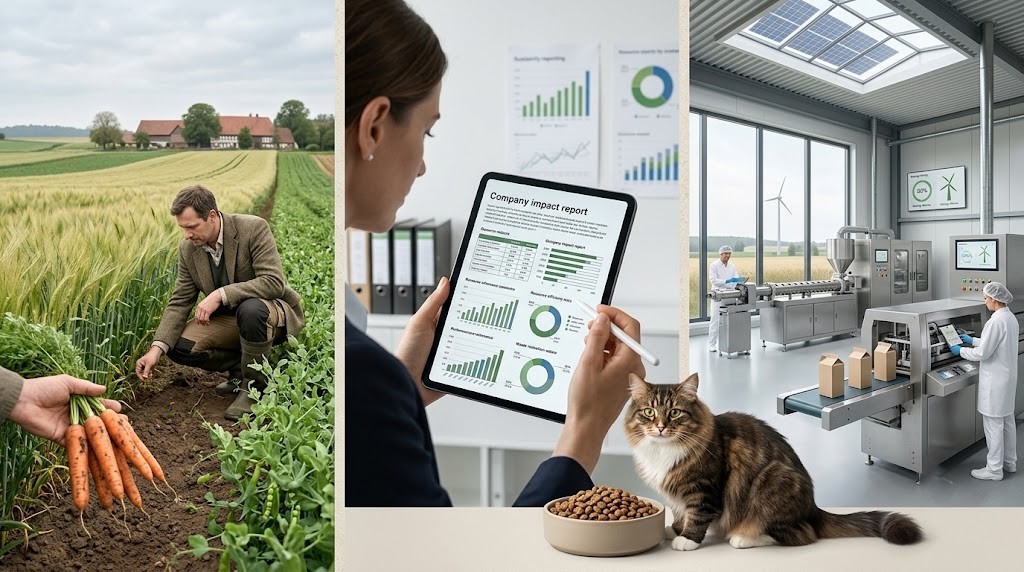
Cat Food Packaging: What “Recyclable” Really Means
Packaging protects cat food from moisture, oxygen, contamination, and spoilage. This makes packaging necessary for food safety, but it can also make recycling more complicated.
The FEDIAF position on circular pet food packaging explains that the pet food industry is working to reduce packaging, improve recyclability, and increase the use of recycled materials while continuing to protect product safety and quality.
A recycling symbol or a “recyclable” claim does not guarantee that the package will actually be recycled after use. The outcome may depend on:
- the materials used in the package
- whether different layers can be separated
- local household collection rules
- access to specialist recycling programmes
- whether the packaging is clean and empty
- the recycling infrastructure available in your country
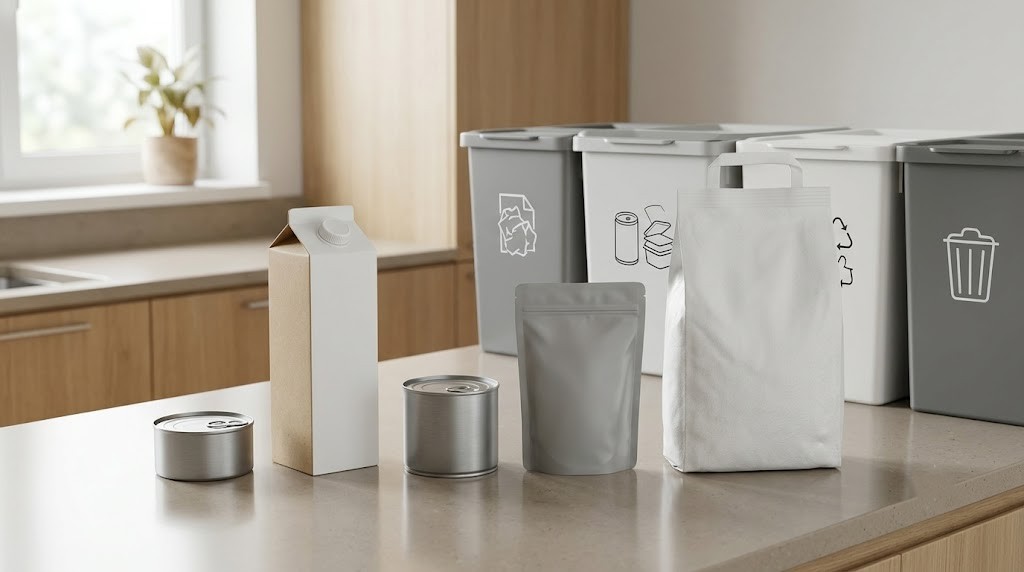
Common Cat Food Packaging Formats
Metal Cans
Metal cans are collected through household recycling systems in many European locations.
Before recycling, check whether your local authority asks you to:
- rinse the can
- remove the label
- separate the lid
- place it in a specific metal or mixed-recycling container
Cartons
Some wet cat food is packaged in carton-based formats.
These packages may contain several material layers to preserve food safely. Whether they can be recycled depends on whether the local system accepts beverage-style or food cartons.
Flexible Pouches
Flexible pouches use very little material and are lightweight to transport, but many traditional pouches contain bonded layers of plastic and foil.
These layers may not be accepted through ordinary household recycling. Some countries and retailers provide specialist collection points, but availability varies.
Dry Food Bags
Dry cat food bags may use paper, plastic, or multi-layer materials.
A bag that looks like paper may still contain an internal barrier layer. Check the disposal instructions on the package rather than judging the material by appearance alone.
Questions to Ask Before Trusting a Packaging Claim
Before treating packaging as a sustainability advantage, ask:
- What material is the package made from?
- Is the claim specific to this product or only to the company?
- Can the package be recycled through household collection?
- Does it require a specialist collection point?
- Are disposal instructions provided for your country?
- Does the company explain which packaging formats are still being improved?
European packaging policy is moving toward greater recyclability, waste reduction, recycled content, and reusable formats. However, a future target is not proof that a specific package is currently recycled where you live.
How to Spot Greenwashing in Cat Food Marketing
Greenwashing happens when environmental language creates a stronger impression than the available evidence supports.
The European Commission’s Green Claims proposal aims to make voluntary environmental claims more reliable, comparable, and verifiable, including requirements for substantiation and independent checking.
A useful claim should explain:
- what environmental benefit is being claimed
- which product, package, facility, or company it applies to
- how the claim was measured
- which reporting period it covers
- whether an independent organisation verified it
- what limitations still remain
For a broader review of how pet food companies answer questions about formulation and transparency, read our pet food manufacturer transparency report.
Green Flags
Look for:
- identifiable organic or sourcing certification
- a publicly available impact or sustainability report
- packaging instructions that identify the material
- measurable targets with a baseline and reporting date
- clear manufacturing and sourcing information
- honest disclosure of areas that are still being improved
- separate information for different products or packaging formats
Red Flags
Be cautious when a company relies mainly on:
- vague words such as “green,” “planet-friendly,” or “eco-conscious”
- nature imagery without supporting information
- an environmental logo that does not identify a certification body
- company-wide claims applied to every individual recipe
- carbon-neutral language without a defined scope
- recyclable-packaging claims without disposal instructions
- future targets presented as if they have already been achieved
The absence of a certificate does not automatically prove that a product is unsustainable. However, stronger claims require stronger evidence.
Are Sustainable Cat Food Brands More Expensive?
Some sustainable or organic products have a higher package price, but package price alone does not show the real daily feeding cost.
Compare:
- price per kilogram
- calories per kilogram
- recommended daily portion
- package size
- delivery costs
- treats or toppers added to the diet
- whether the food is complete or complementary
- product availability in your country
A more expensive food is not automatically nutritionally better or environmentally superior.
Similarly, a lower-priced complete food may be a more practical choice when it can be purchased consistently and fed in measured portions.
For a detailed comparison method, read our guide to cost versus quality in cat food.
The most useful comparison is the daily cost of a nutritionally suitable product, not the marketing category printed on the front of the package.
How FAMMO Can Support Better Feeding Decisions
Sustainability is only one part of choosing cat food. The selected product must also fit your cat’s age, weight, life stage, body condition, activity level, and feeding routine.
FAMMO helps pet parents organise these factors into more personalised nutrition guidance.
It does not independently certify sustainability claims or prove that one brand has the lowest environmental footprint. Use the evidence checklist in this guide to assess sourcing, certification, packaging, and transparency separately.
A practical decision process is:
- Confirm that the product is complete for your cat’s life stage.
- Check whether the portion and calorie level fit your cat.
- Review the ingredient and manufacturer information.
- Verify any organic, sourcing, or packaging claims.
- Monitor weight, appetite, digestion, and feeding response after the transition.
Build Your Cat’s Nutrition Profile
Create your cat’s profile to receive more personalised feeding guidance based on the information you provide.
Create your cat’s FAMMO profile
FAMMO provides educational guidance and does not replace veterinary diagnosis or treatment. Contact a veterinarian when your cat has persistent vomiting, diarrhoea, weight loss, appetite changes, urinary symptoms, or another health concern.
Key Takeaways
- Sustainable cat food must still be nutritionally complete and appropriate for the individual cat.
- No single brand can be verified as the most sustainable across every product and European country.
- Yarrah, Edgard & Cooper, and Bozita provide different types of publicly available sustainability evidence.
- Organic certification, B Corp status, renewable-energy information, and recyclable packaging measure different things.
- Company-level claims do not automatically apply to every individual recipe.
- Packaging recyclability depends partly on local collection and recycling infrastructure.
- Strong environmental claims should be specific, measurable, dated, and supported by evidence.
- Compare daily feeding cost rather than package price alone.
Frequently Asked Questions About Sustainable Cat Food
What makes a cat food brand sustainable?
A sustainable cat food brand provides clear evidence about areas such as ingredient sourcing, certification, manufacturing, packaging, emissions, and company reporting.
The food must also be nutritionally complete for the intended life stage. Environmental marketing cannot compensate for an unsuitable or incomplete diet.
Which sustainable cat food brands are available in Europe?
European cat owners may encounter brands such as Yarrah, Edgard & Cooper, and Bozita.
They are included in this guide because they publish different forms of sustainability information. Availability, recipes, certification, and packaging can vary by country, so check the exact product before buying.
Is organic cat food more sustainable?
Organic certification provides information about farming and production standards, but it does not prove that a product has the lowest total environmental footprint.
Transport, ingredients, packaging, manufacturing, feeding efficiency, and waste also influence environmental impact.
Is sustainable cat food nutritionally complete?
Some sustainable cat foods are complete, while others may be complementary products.
Check the label for a clear complete-food declaration and the appropriate life stage. Do not assume that organic, natural, or eco-friendly automatically means nutritionally complete.
Is recyclable cat food packaging always recycled?
No. A package may technically be recyclable but still not be accepted by the collection system where you live.
Check the packaging material, disposal instructions, local authority guidance, and whether specialist collection is required.
Does grain-free cat food mean sustainable?
No. Grain-free describes the recipe, not its environmental impact.
A grain-free product may still use resource-intensive ingredients, distant supply chains, or packaging that is difficult to recycle. Evaluate the full product rather than relying on the grain-free label.
Are sustainable cat food brands more expensive?
Some organic or sustainability-focused products have a higher package price.
Compare the recommended daily portion, calories, price per kilogram, delivery cost, and whether the product is complete. A higher price does not automatically mean better nutrition or stronger environmental performance.
How can I identify greenwashing on cat food packaging?
Be cautious of broad terms such as “green,” “planet-friendly,” or “eco-conscious” when no certification, measurement, reporting period, or disposal instruction is provided.
Stronger claims should explain exactly what they apply to and what evidence supports them.
Sources and Methodology
This guide was prepared using publicly available information reviewed on 2026-07-15.
It is an editorial comparison, not an independent laboratory test, veterinary endorsement, or complete product-level lifecycle assessment.
The principal sources used include:
- FEDIAF Product Environmental Footprint Category Rules for Pet Food
- FEDIAF: Towards Circularity of Pet Food Packaging
- Yarrah Certificates
- Yarrah Impact Report
- Edgard & Cooper B Corp Information
- Edgard & Cooper Planet and Packaging Information
- Bozita Sustainability Information
- European Commission Information on Environmental Claims
- FEDIAF: Understanding Pet Food Labels
Company information can change over time. Verify the exact recipe, certification, packaging instructions, and availability before making a purchase.