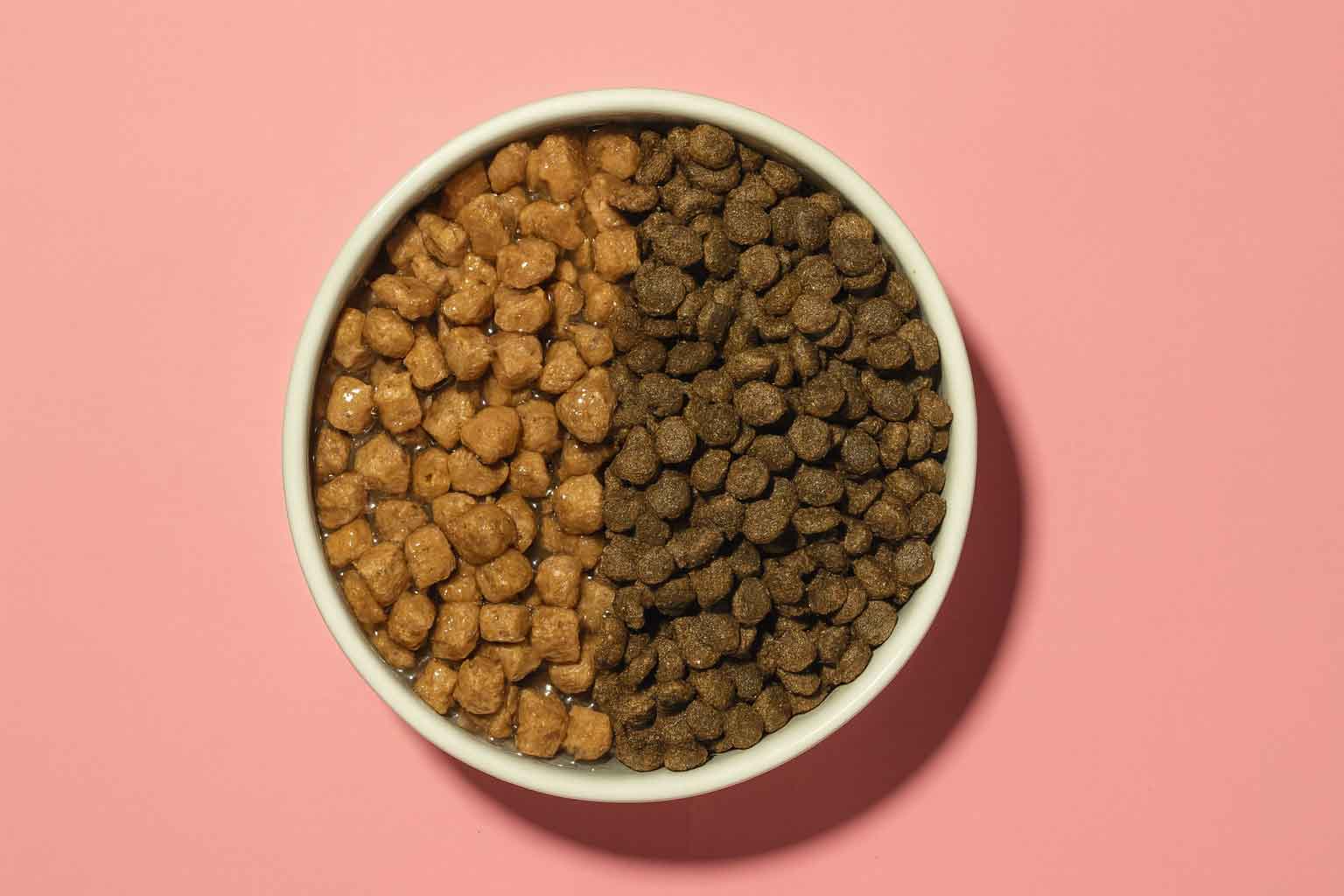
How can you compare protein or fat in two pet foods when one contains much more water than the other? The percentages on the packages may not tell the whole story.
A dry matter comparison accounts for that water, helping you compare nutrient concentrations on the same basis. Before calculating, find the protein, fat and moisture figures. Our guide to reading a pet food label explains where to look.
Below, you’ll find a simple formula, a worked example and a comparison table. You’ll also learn why a higher nutrient percentage does not automatically mean a better food for your dog or cat.
Quick Answer: How Do You Compare Pet Food Nutrients?
When two foods contain different amounts of water, convert their protein or fat percentages to a dry matter basis before comparing them.
Start with the as-fed percentages, which include the food’s water, and use these formulas:
Dry matter (%) = 100 − moisture (%)
Nutrient on a dry matter basis (%) = [as-fed nutrient (%) ÷ dry matter (%)] × 100
Repeat the calculation for each food using its own moisture value. If a nutrient value is already reported on a dry matter basis, do not convert it again.
The result compares nutrient concentration without water. It does not show which food is better for your pet or how much of that nutrient your pet eats each day.
What Does Dry Matter Basis Mean?
As-fed describes the food as it comes from the package, including water. A food with 10% protein as-fed contains 10 grams of protein per 100 grams of food.
Dry matter is everything in the food except water, including protein, fat, carbohydrates and minerals. A nutrient percentage on a dry matter basis describes its share of that water-free material.
This distinction matters because water contributes to the food’s weight. A wetter food can show a lower protein percentage on the package even when protein makes up a larger share of its dry matter.
Think of it as asking two different questions:
As-fed: How much protein is in 100 grams of the packaged food?
Dry matter basis: What percentage of the material excluding water is protein?
If two foods have the same moisture percentage, their as-fed nutrient percentages can be compared directly on that basis. When moisture differs substantially, a dry matter calculation helps put the figures on a common basis.
The FDA’s guide to comparing pet foods explains this distinction and the conversion method.
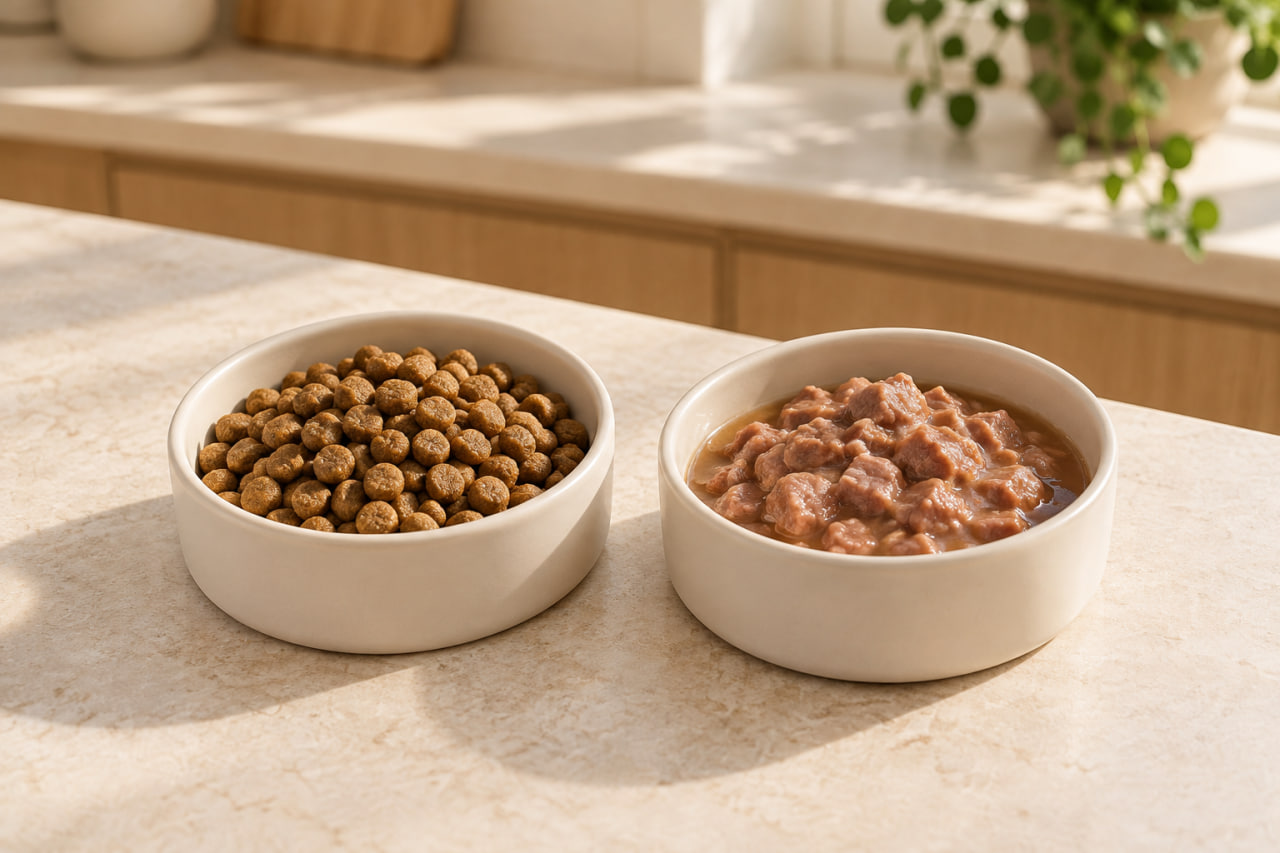
What Information Do You Need?
Before calculating, collect the following details for each food. Use information for the exact recipe you are comparing, as different products from the same brand can have different nutrient values.
Information | What to record |
|---|---|
Product | Exact recipe name and intended species |
Nutrient percentage | Protein or fat, depending on what you want to compare |
Moisture percentage | The water content reported for that product |
Reporting basis | Whether the nutrient figures are as-fed or already on a dry matter basis |
On European packaging, these figures usually appear under Analytical Constituents. US labels commonly use Guaranteed Analysis. FEDIAF’s guide to understanding pet food labels explains the European terminology.
Record the nutrient percentage from the analysis section, rather than a meat percentage from the ingredient list. For example, “40% chicken” describes an ingredient’s inclusion in the recipe; it does not mean the finished food contains 40% protein.
What If Moisture or Other Details Are Missing?
Check the manufacturer’s product page or contact its customer service team. Ask for:
The moisture percentage for the exact recipe.
A typical or average nutrient analysis.
Confirmation that the figures are reported on an as-fed basis.
Do not use a general moisture estimate as though it were a measured value for that food. If the reporting basis is unclear, confirm it before calculating.
How to Calculate Dry Matter Nutrients
Once you have the as-fed nutrient and moisture percentages, the calculation takes two steps. Here is a hypothetical food with 75% moisture and 10% protein.
Step 1: Find the Dry Matter Percentage
Subtract the moisture percentage from 100:
100 − 75 = 25% dry matter
For every 100 grams of this food, 75 grams are water and 25 grams are dry matter.
Step 2: Calculate the Nutrient’s Share of Dry Matter
Divide the as-fed protein percentage by the dry matter percentage, then multiply by 100:
(10 ÷ 25) × 100 = 40% protein on a dry matter basis
This means the example contains 10 grams of protein within 25 grams of dry matter. Protein therefore makes up 40% of that dry matter.
The packaged food still contains 10% protein as-fed. The calculation changes the basis of comparison, not the food itself.
To calculate fat, substitute the as-fed fat percentage for protein and use the same dry matter percentage. Repeat both steps for the other food using its own figures.
Keep the full calculation on your calculator and round only the final result, usually to one decimal place.
Worked Example: Comparing Two Pet Foods
Let’s compare a dry food with the wet food from the calculation above.
These are hypothetical examples for learning the method, not actual product measurements or feeding recommendations.
Measurement | Dry Food A | Wet Food B |
|---|---|---|
Moisture | 10% | 75% |
Dry matter | 90% | 25% |
Protein, as-fed | 25% | 10% |
Protein, dry matter basis | 27.8% | 40% |
Fat, as-fed | 15% | 5% |
Fat, dry matter basis | 16.7% | 20% |
For Dry Food A, the calculations are:
Protein:
(25 ÷ 90) × 100 = 27.8%Fat:
(15 ÷ 90) × 100 = 16.7%
For Wet Food B, protein is 40% on a dry matter basis, as calculated above. Its fat value is:
Fat:
(5 ÷ 25) × 100 = 20%
How to Read the Results
Wet Food B has a higher concentration of protein and fat within its dry matter.
However, 100 grams of the packaged Dry Food A contains 25 grams of protein, while 100 grams of Wet Food B contains 10 grams. The results differ because one comparison includes water and the other excludes it.
Neither tells you how much protein your pet receives each day without knowing the daily portion. They also do not establish which food is nutritionally more suitable.
Use this table to understand the comparison method, not to conclude that wet food always contains more protein or fat than dry food.
What Dry Matter Comparisons Cannot Tell You
Removing water from the calculation makes nutrient percentages easier to compare. It does not show how well your pet can digest those nutrients or whether the food provides a complete, balanced diet.
There is another limit to consider: the numbers on the label may be guarantees rather than exact amounts.
Guaranteed Values Are Not Exact Measurements
On US pet food labels, the Guaranteed Analysis generally lists protein and fat as minimums, and moisture and crude fiber as maximums, as explained in AAFCO’s nutritional labeling guidance.
For example, “crude protein: 25% minimum” means the food may contain more than 25% protein. “Moisture: 10% maximum” means its actual moisture may be lower.
Using these figures in the dry matter formula gives you a label-based estimate, not an exact measurement of the food. Combining a minimum protein value with a maximum moisture value also does not produce a guaranteed minimum dry matter protein percentage.
What to Do When Results Are Close
If two foods have similar calculated values, avoid choosing between them based on a small percentage difference alone.
Ask each manufacturer for a typical or average nutrient analysis for the exact recipe, including moisture. Confirm whether the figures are as-fed or already expressed on a dry matter basis before comparing them.
Average values can provide a more useful comparison, although individual batches may still vary. Use the result to understand nutrient concentration alongside the food’s nutritional adequacy and your pet’s needs.
Compare Calories and Daily Portions Too
Your pet eats a portion of food each day, so the next question is: how much energy and nutrition does that portion provide?
Find the calorie content on the package or the manufacturer’s website. It may appear as kcal/kg, kcal per cup, or kcal per can or pouch. “Kcal” is the unit commonly used for food calories.
Put Calories on the Same Scale
For a straightforward comparison, convert both foods to kcal per 100 grams of food as served.
Calorie information available | How to convert it |
|---|---|
kcal per kilogram | Divide by 10 |
kcal per can or pouch | Divide by the pack’s weight in grams, then multiply by 100 |
kcal per cup | Divide by the food’s weight in grams per cup, then multiply by 100 |
Use the weight provided for that exact product. A cup of one kibble may weigh differently from a cup of another. AAFCO’s calorie guidance explains how food weight relates to calories per serving.
A Simple Portion Example
Suppose one food provides 400 kcal per 100 g, while another provides 100 kcal per 100 g.
To supply the same 200 kcal, you would need:
50 g of the first food.
200 g of the second food.
These are hypothetical figures to illustrate the calculation, not a daily feeding recommendation. When changing foods, keeping the same serving weight could substantially change your pet’s calorie intake.
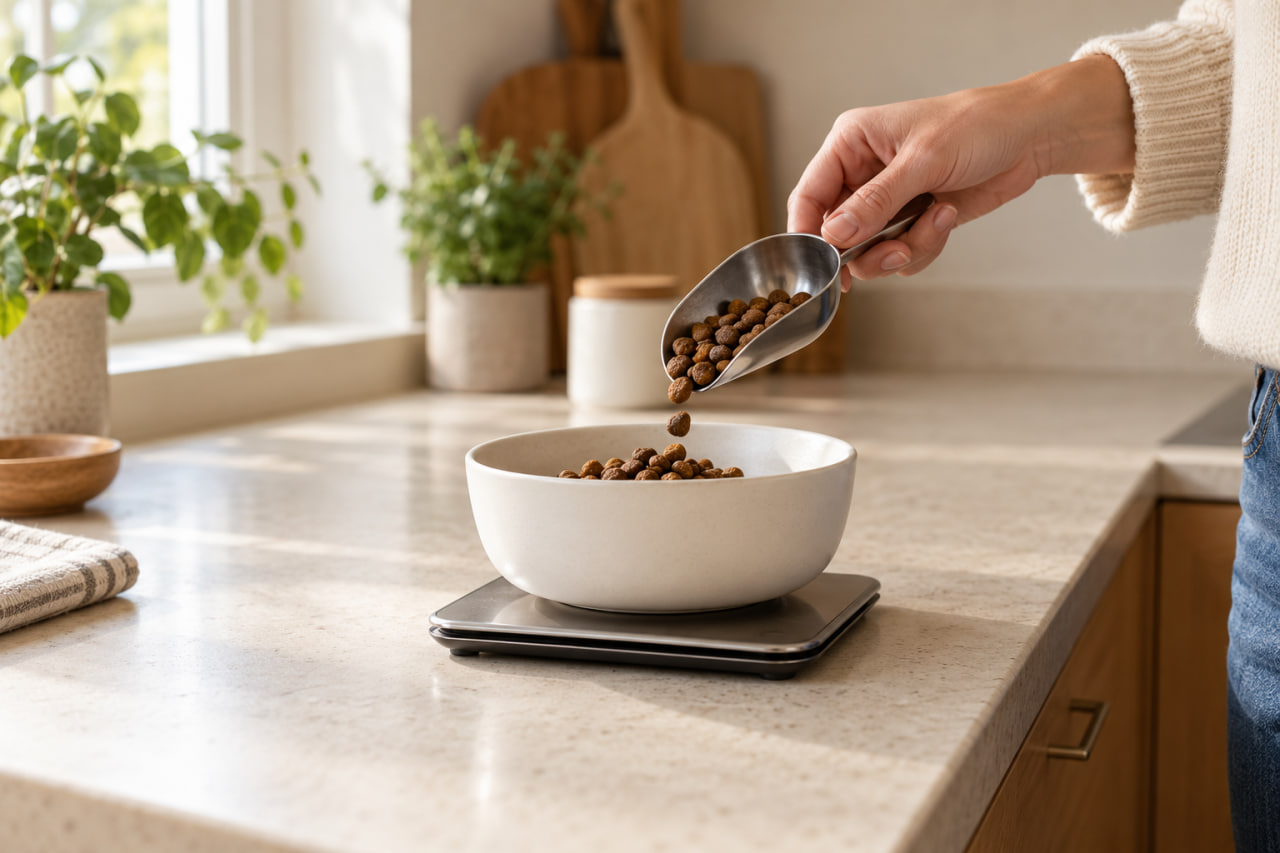
Connect the Portion to Nutrient Intake
Once you know the portion weight, use the as-fed nutrient percentage to estimate the amount eaten:
Nutrient consumed (g) = portion weight (g) × as-fed nutrient (%) ÷ 100
For example, a 50 g portion of food containing 25% protein as-fed provides approximately 12.5 g of protein, using the stated nutrient value.
Manufacturers may also provide nutrients in grams per 1,000 kcal. This helps compare how much of a nutrient two foods supply for the same amount of energy.
If you combine wet and dry food, count the calories from both, along with treats and toppers, within the daily feeding plan.
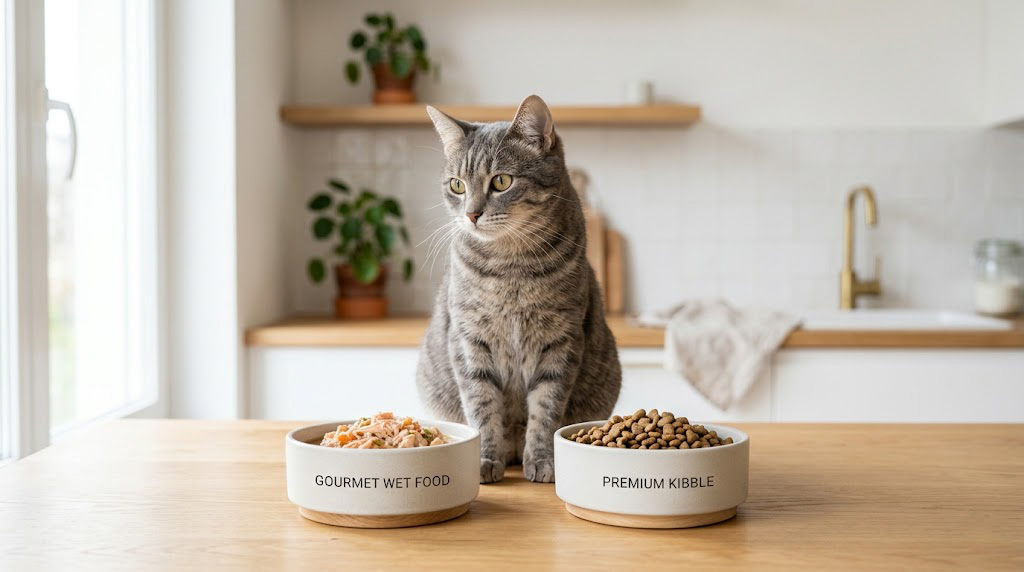
Choosing a feeding format for your cat? Our wet vs dry cat food guide explains what to consider about water intake, food preferences and combining both formats.
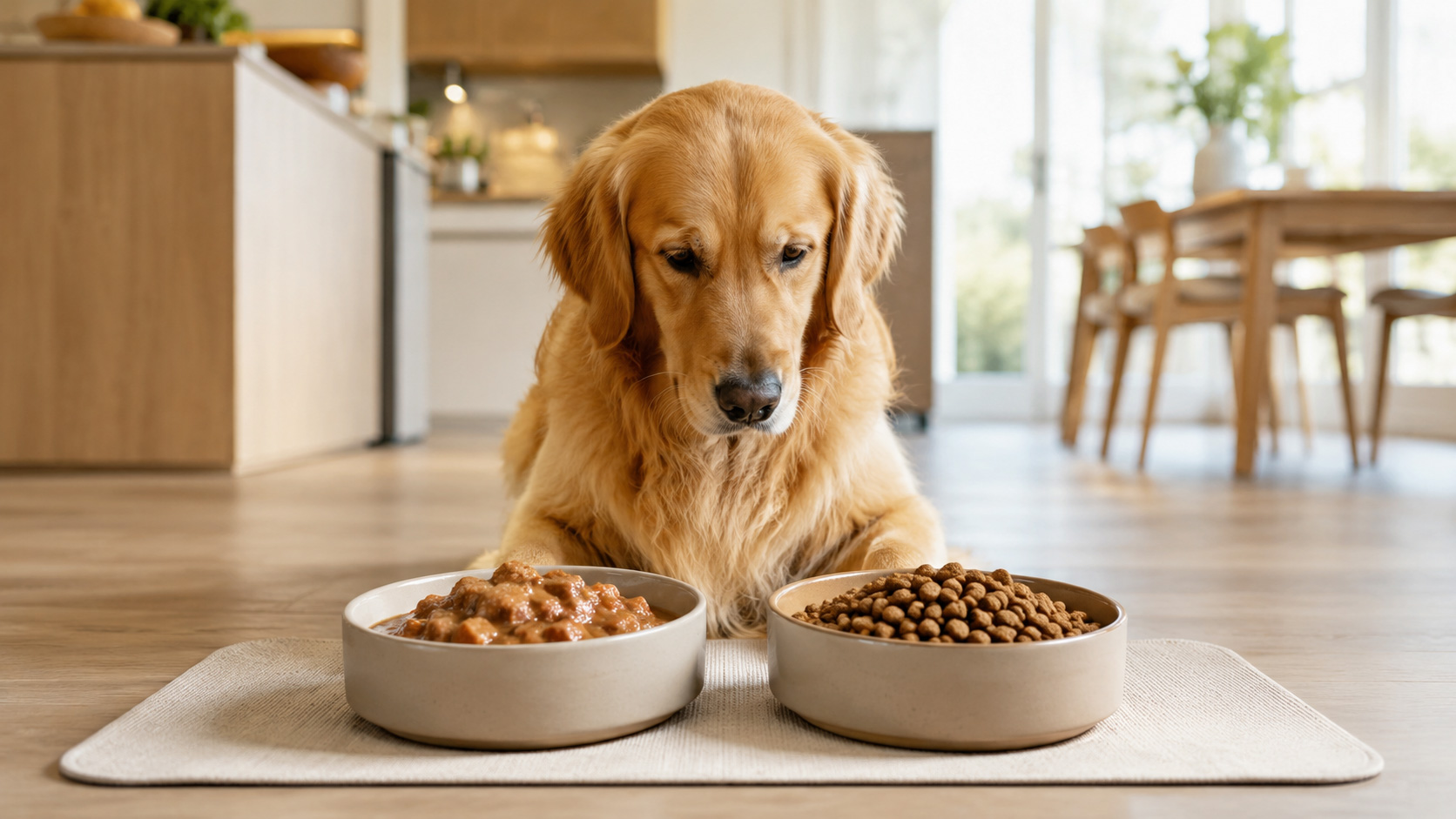
For dogs, explore our wet vs dry dog food guide to compare textures, storage needs and practical feeding options.
Check Whether the Food Is Suitable for Your Pet
Before choosing between the products you have compared, check what each one is designed to do. A main meal, a topper and a treat serve different purposes.
Complete Food or Complementary Food?
For everyday feeding, look for a complete food intended for your pet’s species and life stage. It should supply all required nutrients when fed as directed.
A complementary food is intended to be used alongside other foods. It should not replace a complete diet unless it forms part of a professionally formulated feeding plan.
For example, a meat-based topper may contain plenty of protein without supplying the full range of vitamins and minerals your pet needs.
Match the Species and Life Stage
Check the intended use on the package:
Species: choose food formulated for dogs or cats, as appropriate.
Growth: puppies and kittens need a diet suitable for growth. For a large-breed puppy, confirm that the recipe is suitable for its expected adult size.
Adulthood: check whether the food is intended for adult maintenance or all life stages.
If your pet has a diagnosed condition or eats a prescribed diet, ask your veterinarian before switching. Protein and fat figures alone cannot establish whether a replacement meets the treatment plan.
Ask How the Food Is Formulated and Tested
To assess the manufacturer, look for answers to three practical questions:
Who formulates the recipes, and what relevant nutrition qualifications and experience do they have?
How are ingredients and finished foods checked for safety and nutrient consistency?
What testing supports the food’s nutritional adequacy?
These questions follow the WSAVA guide to selecting pet foods. They provide more useful evidence than packaging terms such as “premium” or “holistic.”
Frequently Asked Questions
Can I use dry matter calculations for nutrients other than protein?
Yes. The same method works for fat, crude fiber and minerals such as calcium or phosphorus when their as-fed percentages and the food’s moisture content are available. Compare the same nutrient and measurement type: crude fiber and total dietary fiber, for example, are not interchangeable.
Can I calculate carbohydrates if they are not listed?
You can estimate a carbohydrate fraction called nitrogen-free extract, or NFE, using average as-fed values for protein, fat, crude fiber, moisture and ash. This is an estimate by subtraction, not a direct measurement of total carbohydrates. If ash is missing or you only have minimum and maximum guarantees, ask the manufacturer for more complete information rather than guessing.
Can I average the dry matter percentages of two foods I mix?
Not directly. Each food contributes a different amount of dry matter depending on its moisture content and the portion you serve. To calculate the mixture’s nutrient percentage, add the nutrient grams from both portions, divide by their combined dry matter grams, and multiply by 100. A simple average of the two percentages can give a misleading result.
Does adding water to kibble change its dry matter protein percentage?
No.adding plain water leaves the dry matter protein percentage unchanged, provided none of the food is removed. It lowers the protein percentage by total wet weight because the meal now weighs more. The original portion still contains the same amount of protein and calories if your pet eats all of it.
Make Your Next Food Comparison Easier
Choose two recipes you are considering and keep their nutrient figures, moisture levels and calorie information together. You can then compare them using the same method and identify any missing details to ask the manufacturers about.
For guidance tailored to your dog or cat, create your pet’s FAMMO profile. FAMMO provides personalised nutrition guidance based on details such as age, breed, weight and sterilisation status, helping you put your pet’s needs at the centre of everyday feeding decisions.

Use this guidance alongside your veterinarian’s advice, particularly when managing a medical condition or prescribed diet.