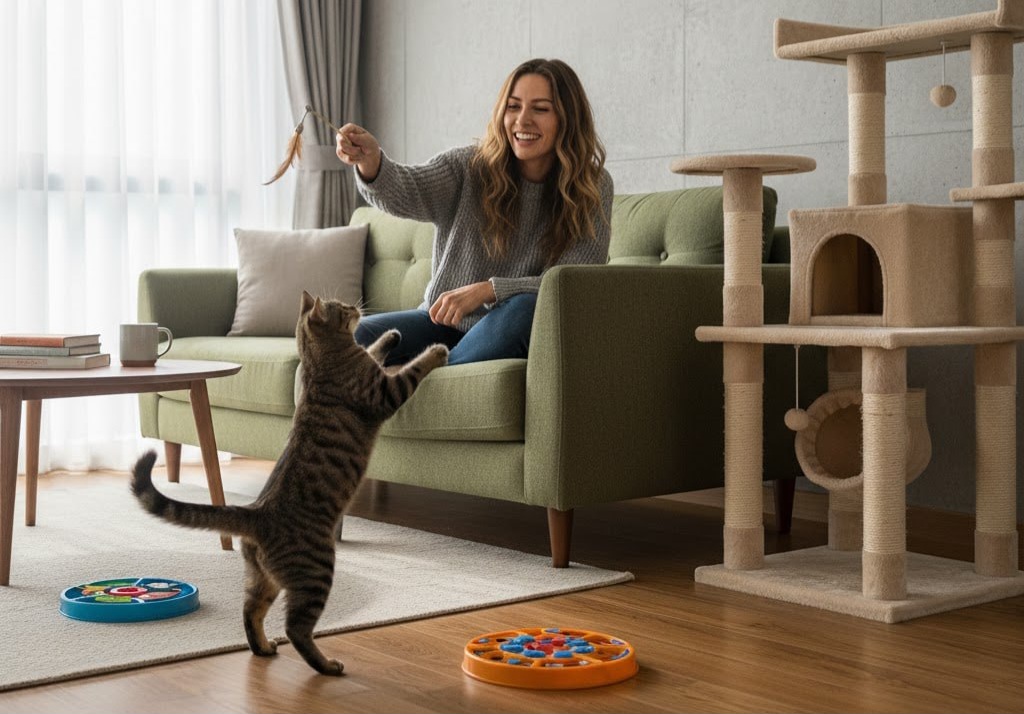
Your indoor cat ignores the toys you bought, then chases a cardboard scrap across the room. Where do you start? With a game that matches what catches their attention.
Indoor cat exercise can be simple: short, interactive games that invite your cat to stalk, chase, and catch, with time to pause. Appropriate feeding matters too; our guide to the best diet for indoor cats covers the nutrition side.
Below, you’ll find practical play ideas, adjustments for different ages and abilities, and steps to try when your cat seems uninterested.
How Do You Exercise an Indoor Cat?
Use short, supervised games that let your cat stalk, chase, and catch a suitable toy. Start on a clear floor with good grip, include pauses, and adjust the movement to your cat’s comfort and interest. Add easy food puzzles for variety, and let your cat leave the activity when they choose.
How Much Play Does an Indoor Cat Need Each Day?
Offer several short opportunities to play throughout the day, adjusting each session to your cat’s interest and comfort. There is no single daily target that suits every cat.
If you are introducing a new game, start with one or two minutes. Cats Protection notes that games this short are fine. Give your cat time to watch, approach, and catch the toy rather than expecting continuous running.
Use these steps to build a routine:
Choose an alert moment. Invite your cat to play when they are awake and showing interest in their surroundings.
Start small. Try a brief game, pause, and see whether they choose to continue.
Offer another opportunity later. Spread play across the day instead of trying to fit everything into one long session.
Adjust gradually. If your cat remains interested and moves comfortably, try a little more play next time.
For example, you could offer a short wand game in the morning and a ball game in the evening, with another opportunity when your cat seeks interaction. This is a starting routine to test, not a required exercise schedule.
When Should You End a Play Session?
Let the session end when your cat walks away or loses interest. Avoid repeatedly bringing the toy back to their face to make them continue.
A cat who watches before pouncing may simply need more time. Slow the toy down and pause before deciding that the game is unsuccessful.
If your cat has a medical condition or is recovering from illness, injury, or surgery, ask your veterinarian what activity is appropriate.
Which Games Are Best for Your Indoor Cat?
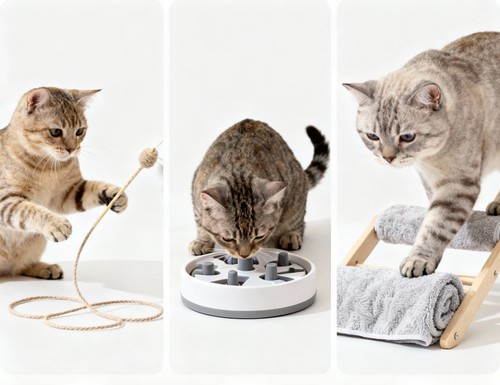
Start with the movements your cat already finds interesting. Notice whether they follow rolling objects, wait behind furniture, or investigate food puzzles. Use those observations to choose your first game.
The options below are starting ideas to test, rather than fixed categories for every cat.
What you notice | A game to try | How to start |
|---|---|---|
Your cat waits behind a box before pouncing | Wand-toy hide-and-seek | Move the toy past the box, then pause |
Your cat follows objects across the floor | A rolling-ball chase | Roll a cat-safe ball a short distance |
Your cat explores boxes and tunnels | A tunnel ambush game | Move a supervised toy near the opening |
Your cat enjoys searching for food | An easy food puzzle | Make a small portion of their usual food easy to find |
Your cat bats at nearby toys but rarely chases | Gentle floor-level play | Move the toy slowly within comfortable reach |
Change One Thing at a Time
If a game gets little response, adjust one detail before switching everything:
Movement: Try a slower glide instead of rapid waving.
Distance: Bring the game closer rather than expecting a long chase.
Setting: Try a quieter space without another pet competing.
For example, a cat that ignores a wand in the air may investigate the same toy when it moves along the floor and disappears behind a box.
Food puzzles add searching and problem-solving, but may involve little physical movement. Use them alongside interactive play when appropriate, and take food rewards from your cat’s daily allowance.
Once you find an activity your cat willingly joins, build on it using the play ideas below.
5 Simple Indoor Cat Exercise Ideas to Try
Choose one activity from the table above and try the easiest version first. Clear enough floor space for comfortable movement, use a surface with good grip, and let your cat approach voluntarily.
1. Ground-Level Wand Play
You need: A sturdy cat wand with a securely attached toy.
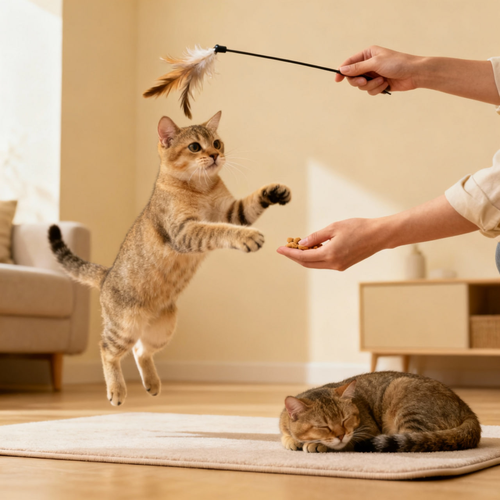
Move the toy a short distance along the floor, away from your cat. Pause to give them time to watch and stalk, then move it again. Let them catch it regularly instead of pulling it away at every attempt.
Make it easier: Keep movements slow and close to your cat.
Keep it safe: Avoid encouraging awkward leaps or sharp turns. Put stringed toys away after play.
The Irish Blue Cross’s guidance on playing with cats recommends low, realistic wand movements and allowing a catch at the end of a session.
2. Short Ball Chases
You need: A lightweight, cat-safe ball that cannot be swallowed and has no loose parts.
Roll the ball a short distance across a clear floor. Wait for your cat to follow or bat it before rolling it again. Try a different direction if the first roll gets little attention.
Make it easier: Roll the ball slowly on a rug so it stays nearby.
Keep it safe: Roll it away from stairs and obstacles. Your cat does not need to bring it back for the game to work.
3. Box or Tunnel Hide-and-Seek
You need: An open cardboard box or a stable cat tunnel, plus a supervised toy.
Let your cat investigate the space first. Move the toy past the opening, pause, and allow them to emerge when ready. Repeat only if they remain interested.
Make it easier: Keep the toy visible near the entrance rather than taking it far away.
Keep it safe: Remove staples, loose tape, and damaged edges from boxes. Leave the exit clear and let your cat use the space to rest when they choose.
4. An Easy Food Puzzle
You need: A washable cat puzzle feeder and a small portion of your cat’s usual food.
Begin with the easiest setting. Leave the food visible and accessible, then allow your cat to investigate. Once they can retrieve it comfortably, make a small increase in difficulty.
Make it easier: Open more compartments or demonstrate where the food is.
Keep it safe: Use food from the daily allowance. If your cat cannot retrieve it, offer the food normally rather than leaving them without their meal.
PDSA’s cat exercise guide includes puzzle feeders as a way to combine feeding with activity and mental engagement.
5. A Small Food Search
You need: A few pieces of your cat’s normal dry food and clean, accessible feeding spots.
Place the pieces in obvious locations near one another, for example, on a feeding mat and in a shallow dish beside a box. Let your cat find them, then gradually increase the distance between spots if they enjoy searching.
Make it easier: Start with the food in plain sight.
Keep it safe: Count the pieces within the daily food allowance and collect anything left behind. In a multi-cat home, offer the activity separately to avoid competition.
Food searches and puzzles may involve less movement than chasing games, but they add variety. Choose the mix your cat willingly participates in rather than trying to complete every activity each day.
What If Your Indoor Cat Won’t Play?
First, distinguish between ignoring one game and becoming less active than usual. A cat that rejects a ball but happily follows a wand may need a different activity. A normally playful cat that suddenly stops participating needs closer attention.
If Your Cat Otherwise Seems Well
Use the game-selection table above to try a different approach. Offer it in a quiet space when your cat is awake, and keep the first attempt brief.
Avoid presenting several toys in quick succession. Instead, observe what happens:
They watch but do not approach: Pause and give them time before moving the toy again.
They approach, then retreat: Reduce the movement and leave them room to withdraw.
Another cat takes over: Offer a separate play opportunity.
They ignore the activity completely: End the attempt and try a different game later.
These are adjustments to test, not explanations of your cat’s behavior. Do not pick them up, block their exit, or withhold food to make them participate.
Keep a simple note of any successful response, for example, “followed a soft toy across the rug in the evening.” Use that as the starting point for the next session.
If Their Interest in Play Has Changed
Contact your veterinarian if your cat suddenly becomes less active or shows changes such as eating less, hiding more, or avoiding normal movement. Stress and medical problems can produce overlapping signs, so do not assume the cause is boredom.
PDSA’s guidance on stress in cats recommends veterinary advice first when behavior changes suddenly.
If your cat is unusually weak or severely lethargic, seek urgent veterinary advice rather than continuing to test games.
How to Adapt Play for Kittens, Adult Cats, and Senior Cats
Choose activities according to your cat’s comfort and ability, rather than age alone. The same game can be adapted by changing its speed, distance, and difficulty.
Kittens: Encourage Exploration and Gentle Play
Offer supervised games with suitable toys, and let your kitten alternate play with rest. Direct chasing and biting toward toys rather than your hands or feet.
Start with simple movements and accessible hiding places. A kitten does not need difficult jumps or a challenging food puzzle to explore and learn.
If you use food rewards, choose food appropriate for their stage of development. Our kitten feeding guide by age explains how food texture, meals, and feeding needs change as kittens grow.
Adult Cats: Build on What Works
Use the activities your cat already enjoys, then introduce small variations.
For example, roll a ball slightly farther or move a wand around a box once your cat comfortably follows it across an open floor. Change one element at a time so you can see whether the new challenge remains enjoyable.
Keep easier games available too. Every session does not need to be harder than the last.
Senior Cats: Make Participation Easier
Older cats may still enjoy play, but gentler movements and shorter games can make it more accessible.
Keep toys nearby and close to floor level.
Place rugs where slippery floors make movement difficult.
Use boxes with easy entrances and exits.
Provide secure steps or ramps to favorite resting places when needed.
Cats Protection’s older-cat care guide recommends gentle play and practical changes that help older cats navigate their home.
Watching or batting a nearby toy can provide stimulation, even when your cat does not chase it.
Cats With Pain or Restricted Mobility
If your cat has arthritis, an injury, or activity restrictions, ask your veterinarian which movements are appropriate. Do not use forced stretches, repeated jumps, or obstacle drills as home treatment.
Steps and ramps help with access; they do not need to become exercise equipment. Let your cat use them voluntarily, and follow any activity restrictions your veterinarian provides.
How to Keep Indoor Cat Exercise Safe
Safe play gives your cat room to move, opportunities to catch a suitable toy, and the freedom to stop. Before each session, check the equipment and the space around you.
Before You Start: A Quick Safety Checklist
Inspect the toy: Remove damaged toys or those with loose parts your cat could swallow.
Supervise strings and cords: Put wand toys, ribbons, and rope toys away after use. Do not leave them out for unsupervised play.
Clear the route: Keep games away from stairs, fragile objects, and places where your cat could become trapped.
Check stability: Cat trees, tunnels, steps, and ramps should stay securely in place.
Keep hands out of the game: Use toys rather than fingers or feet as targets for biting and pouncing.
When to Stop and What to Do Next
What you notice | What to do |
|---|---|
Your cat walks away or loses interest | End the session and let them rest |
Your cat retreats, flattens their ears, or appears distressed | Stop the activity and give them space |
Your cat limps, moves painfully, or avoids putting weight on a leg | Stop play and contact your veterinarian |
Your cat pants, breathes with an open mouth, struggles to breathe, or collapses | Contact a veterinarian or emergency veterinary service immediately |
Do not use panting or exhaustion as a sign of a successful workout. If breathing becomes abnormal, stop the game, keep your cat calm, and seek veterinary advice immediately. Do not wait for a set “recovery period” to see whether it improves.
PDSA’s guidance on breathing problems in cats advises immediate veterinary contact for panting, open-mouth breathing, or difficulty breathing.
After an ordinary session, put hazardous toys away and allow quiet rest. If an activity repeatedly causes discomfort or distress, stop using it until you have appropriate advice.
Can Indoor Cat Exercise Help With Weight Management?
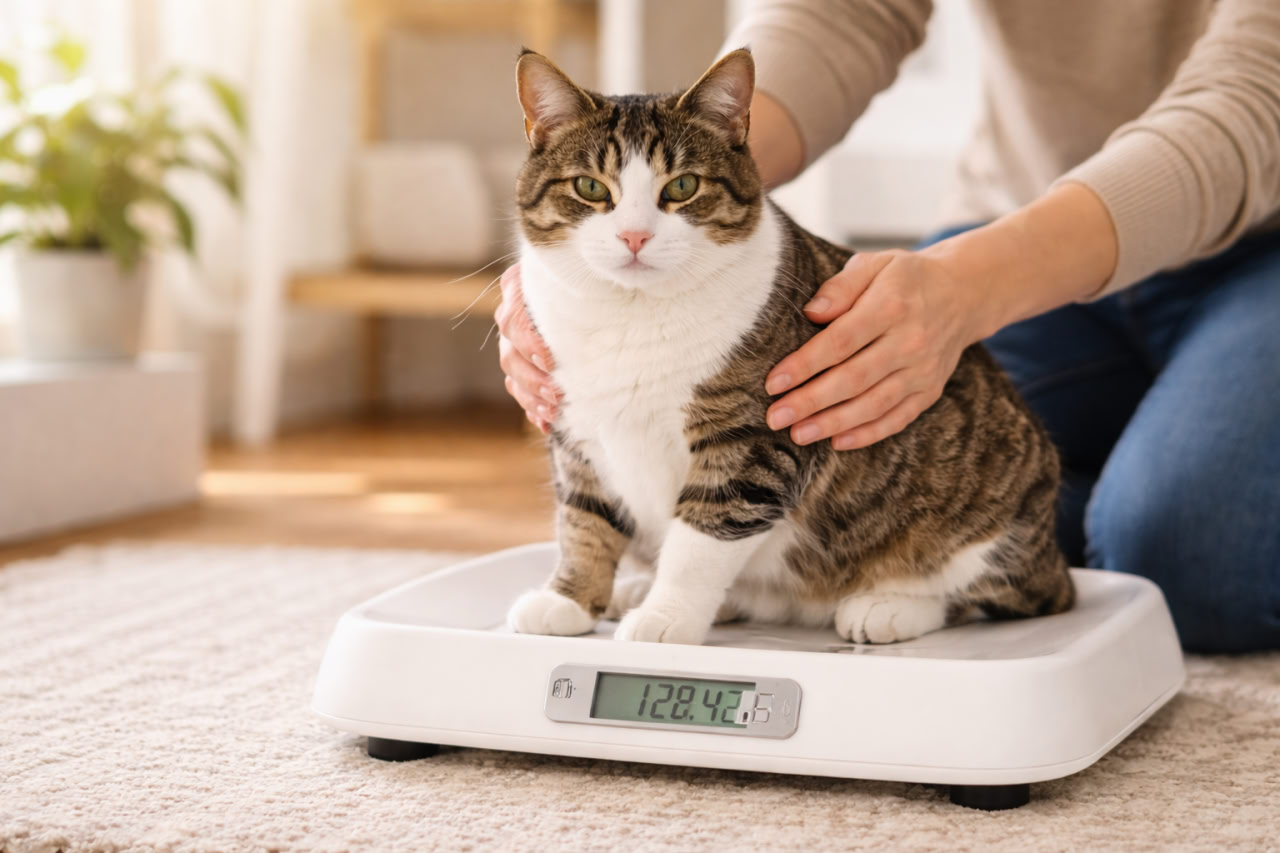
Regular play can support weight management, but it needs to work alongside appropriate feeding. Longer games do not automatically make up for extra food or treats.
If you are unsure whether your cat is carrying excess weight, our guide to signs your cat is overweight explains body-condition checks to discuss with your veterinarian. Low interest in play alone does not confirm that a cat is overweight.
Keep Food Rewards Within the Daily Allowance
Before starting food-based games, set aside a small portion of your cat’s usual daily food. Use that portion for puzzles, searches, or rewards instead of adding extra food each time.
For example: If you put some of the day’s dry food into a puzzle feeder, that food is already part of the daily allowance. Do not serve it again in the bowl.
PDSA’s cat-feeding guidance recommends using a portion of regular food for puzzles or training.
If Your Cat Needs to Lose Weight
Ask your veterinary team to assess body condition and agree on a feeding and activity plan. Avoid sharply cutting portions or using exhausting play sessions to speed up results.
Start with comfortable movement and monitor progress as advised. Record weight consistently, along with any changes in appetite or willingness to move.
More play is useful progress, but it does not prove that weight loss is needed, or that the feeding plan is correct.
Indoor Cat Exercise FAQ
Does my indoor cat need expensive exercise equipment?
No. A sturdy wand toy, a cat-safe ball, and a cardboard box can provide varied play opportunities. Choose items without loose parts, inspect them regularly, and supervise toys with strings or cords. How you present the game, and whether your cat enjoys it, matters more than buying lots of equipment.
Are laser pointers a good choice for cat exercise?
A physical toy your cat can catch is a better first choice. Laser lights provide nothing to grab, which may leave some cats frustrated. Battersea’s cat-play guidance advises against laser pointers for this reason. Try a wand toy or a rolling ball that lets your cat stalk, chase, and make a real catch.
Can a food puzzle replace interactive play?
A food puzzle adds searching and problem-solving, but it may involve much less movement than chasing a toy. Use it alongside interactive play when suitable for your cat. Start with an easy puzzle, count its food within the daily allowance, and make sure your cat can retrieve the food comfortably.
How should I play with cats in a multi-cat household?
Offer each cat individual play opportunities, especially if one takes over the toys or another hangs back. Use separate spaces or different times so each cat can participate at their own pace. Do not assume that watching another cat play meets their activity needs, and keep food rewards separate to reduce competition.
Can playing before bed help my cat settle at night?
It may help some cats, but it does not guarantee a quiet night. Try a short evening game as part of a routine that also offers play and enrichment during the day. Let your cat catch the toy and finish voluntarily. Do not keep them awake or push them to exhaustion. If nighttime restlessness is new or comes with other behavior changes, contact your veterinarian.
Start With One Game Your Cat Enjoys
A useful indoor cat exercise routine starts with a game your cat willingly joins. Choose one activity, keep it easy at first, and adjust it according to their interest and comfort. Build consistency before adding difficulty.
Pair those play opportunities with appropriate feeding. Food used in puzzles or as rewards should fit within the daily allowance, and changes in weight or mobility deserve veterinary advice.