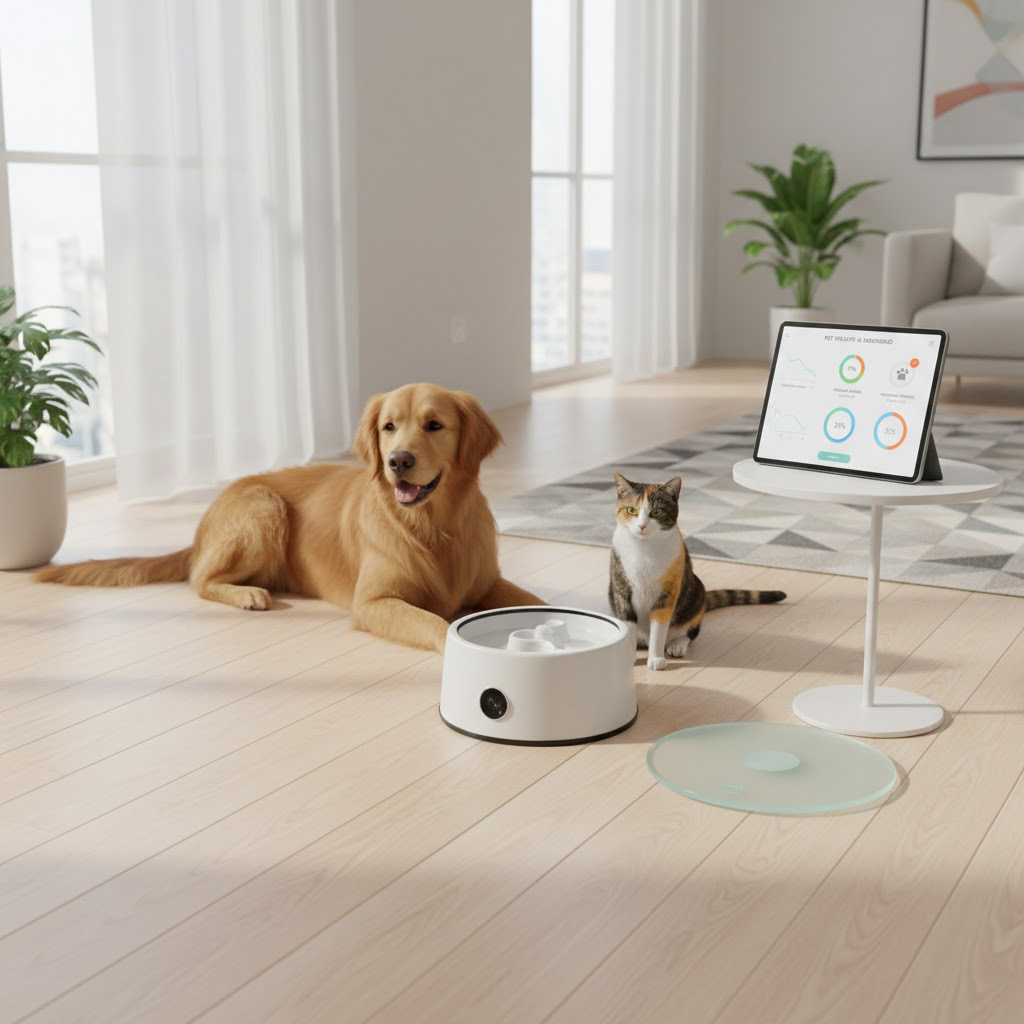
Prevent Pet Obesity with AI
A practical guide to using AI—wearables, smart feeders, and predictive scores—to keep dogs and cats at a healthy weight. Educational only; not medical advice.
Table of Contents
- Why Pet Obesity Happens—and How AI Helps
- Your Data Stack: Wearables, Smart Bowls, Scales, and EHR
- AI Calorie Budgets: From Math to Meals
- Activity Targets That Actually Stick
- Early Warning: Weight Velocity, BCS, and Risk Scores
- Multi-Pet & Indoor Cats: Special Tactics
- 30-Day AI-Powered Plan (Template)
- For Vets & Clinics: Closing the Loop
- Risks, Privacy & Responsible AI
- Mini Case Studies
- Key Takeaways
- FAQ
- References & Further Reading
Why Pet Obesity Happens—and How AI Helps
Extra calories sneak in. Walks get skipped. Treats add up. By the time we notice, body fat has crept past healthy and energy levels drop.
AI changes this by:
- Measuring continuously (steps, play bursts, sleep, weight).
- Comparing to a personal baseline (your pet’s norm—not a generic chart).
- Translating data into actions you can do today: grams per meal, play goals, and reminders right when you need them.
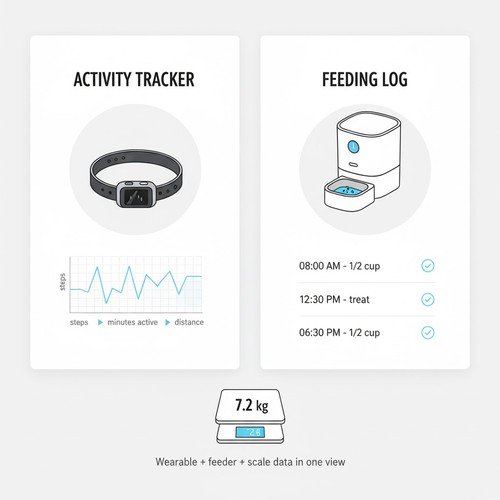
Your Data Stack: Wearables, Smart Bowls, Scales, and EHR
Wearables track activity intensity, steps, and sometimes heart rate/HRV. Smart bowls and feeders log portions and time of day. A Bluetooth pet scale gives weekly weight points. Clinic EHR adds life-stage, neuter status, and health history.
Why it works:
- Unified timeline: All signals land in one feed, so you see how food, exercise, and sleep interact.
- Context matters: A low-activity day after vaccines is not the same as a two-week slide.
- Sharing made simple: One tap exports a vet-ready report for weight consults.
To start, you only need one device (wearable or feeder) plus weekly weighing. Add the rest as you go.
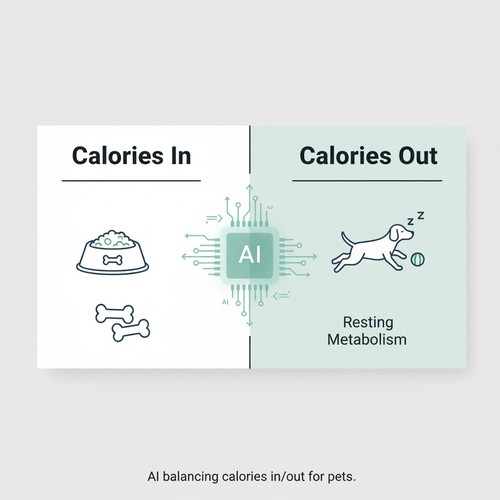
AI Calorie Budgets: From Math to Meals
Calorie calculators are common; AI makes them personal.
1) Baseline math: AI estimates TDEE from age, size, sex/neuter status, and breed mix.
2) Personalization loop: It learns from the scale. If weekly weight drifts, the model auto-adjusts the budget by small steps (e.g., ±3–5%).
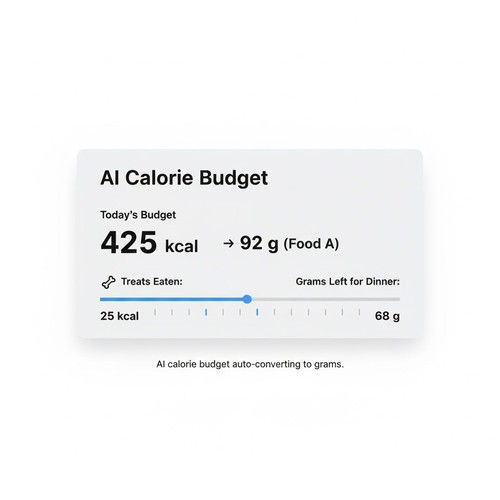
3) Grams, not guesses: The app converts kcal → grams of your exact food. No mental math.
4) Treat accounting: Snap a photo or scan a barcode. Treat calories subtract from the day’s budget automatically.
5) Meal timing: If late-night calories lead to morning hunger spikes, AI may suggest an earlier last meal or a small, high-fiber topper.
For cats: High-moisture meals help satiety. For dogs: Protein and fiber improve fullness; puzzle feeders slow intake.
Activity Targets That Actually Stick
Steps alone miss the picture. AI blends:
- Play intensity (sprints vs strolls),
- Breed/age context (a senior Persian ≠ a young Border Collie),
- Sleep quality (restless nights often predict low-energy days).
The result is a daily activity target you can hit:
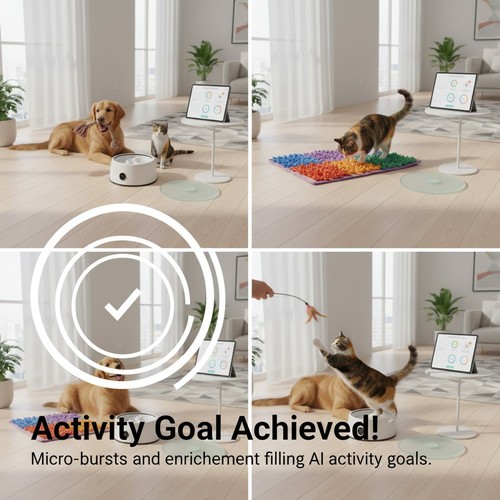
- Dogs: Short micro-bursts (2–3 × 5–7 minutes) of fetch, scent games, or quick cue training often beat one long walk.
- Cats: Two 5–8 minute hunt cycles with a wand toy or laser, then a small snack to “close the loop.”
Nudges arrive at the right time: a midday alert if the morning was sedentary, or a reminder to switch toys if play has stalled.
Early Warning: Weight Velocity, BCS, and Risk Scores
Don’t wait for a full kilogram to creep on.
- Weight velocity: AI flags rate of change, not just absolute weight.
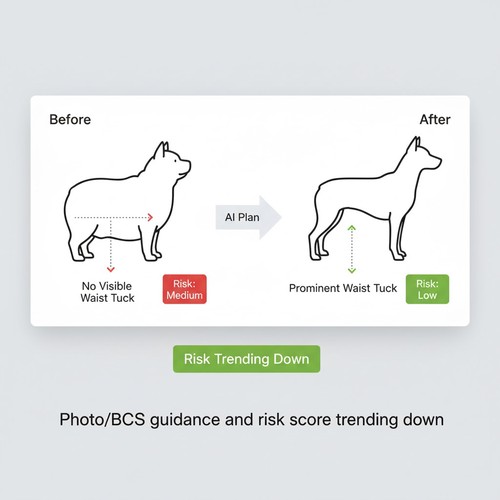
- Photo-based BCS helper: Computer vision compares side and top-down photos to BCS exemplars to suggest a range (e.g., 6/9). A vet confirms.
- Risk score: Combines age, neuter status, breed mix, step trend, snack frequency, and sleep fragmentation to estimate 30–90 day obesity risk.
When a risk threshold is crossed, you get clear next steps: reduce treats by 10%, add one enrichment burst, move the last meal earlier, reweigh in 7 days.
Multi-Pet & Indoor Cats: Special Tactics
- Access control: Smart feeders open only for the tagged pet, so the cat on a diet isn’t outcompeted.
- Grazers vs gobblers: AI detects fast eaters and suggests slow bowls; for grazers, it caps total daily grams.
- Indoor cats: Increase vertical play and scent games. AI rotates activities and flags under-stimulated days that often lead to food seeking.
- Training calories count: Use part of the meal ration as training rewards to stay within budget.
30-Day AI-Powered Plan (Template)
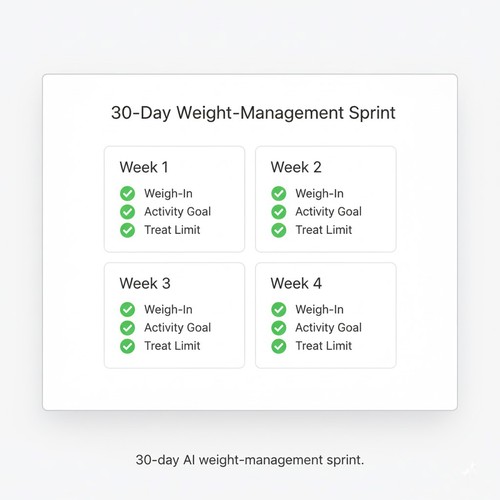
Week 1 — Baseline & Setup
- Log food brand; weigh grams per meal for 7 days.
- One 5–8 min play block for cats or two micro-bursts for dogs.
- Weigh pet once; upload top/side photos.
Week 2 — Nudge & Convert
- AI converts your budget to grams; add treat scanner.
- Switch to puzzle/slow feeder.
- Add one extra micro-burst on sedentary days.
Week 3 — Tighten the Loop
- Review weight trend; AI applies ±3–5% budget tweak.
- Introduce high-moisture meals (cats) or fiber topper (dogs).
- Lock treat calories to ≤10% of daily total.
Week 4 — Sustain & Share
- Hit 80% of activity goals on 5 days/week.
- Export the vet-ready report; align on next month’s targets.
For Vets & Clinics: Closing the Loop
- Structured histories: AI summarizes diet, treats, activity, and medication changes into a single page.
- Precision nudges: Instead of “exercise more,” clients leave with grams per meal and named play menus.
- Population health: Aggregate data can surface high-risk patients for proactive outreach.
Risks, Privacy & Responsible AI
- False positives/negatives: Keep weighing weekly; consult your vet before major changes.
- Edge cases: Endocrine disease, arthritis, dental pain, or CKD demand clinical oversight.
- Data protection: Choose vendors with encryption, export options, and human-readable explanations for alerts.
Mini Case Studies
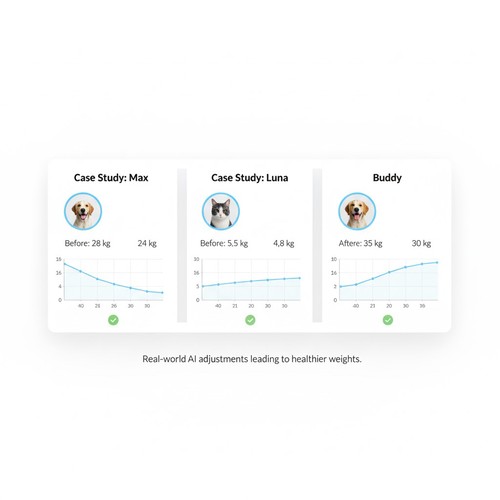
- Indoor cat, slow creep: AI spotted rising snack calories and late-night feeding. Moving the last meal earlier and adding two 6-minute hunt cycles cut intake by 12% and stabilized weight in 3 weeks.
- Food-motivated Lab: Treat scanner revealed 25% of daily calories from training bits. Switching to meal-ration rewards and a fiber topper produced a safe, steady loss.
- Senior small-breed dog: Wearable showed low step counts tied to joint pain. Vet added pain control; AI reduced calorie budget modestly. Weight dropped without hurting mobility.
Key Takeaways
- Measure what matters: weight trend, calorie grams, and short activity bursts.
- Personal beats generic: let AI adjust the plan based on your pet’s data.
- Make it easy: convert kcal to grams, cap treats, and use puzzle play.
- Team sport: share a monthly summary with your vet.
FAQ
Is AI safe to rely on for weight loss plans?
Use AI for decision support. A vet should confirm goals, especially for seniors or pets with medical conditions.
How fast should my pet lose weight?
Target 1–2% of body weight per week for dogs and 0.5–1% for most cats—your vet may tailor this.
Do I need a wearable and a smart feeder?
No. Start with one device and a weekly weigh-in. Add tools as needed.
What about free-feeding cats?
Use smart feeders to portion grams across the day. Many cats do better with scheduled pulses plus enrichment.
References & Further Reading
- Association for Pet Obesity Prevention (APOP): Annual pet obesity data and guidance.
- AVMA: Obesity overview and clinician resources for dogs and cats.
- WSAVA Global Nutrition Committee: Calorie calculation and body condition scoring resources.
- FEDIAF Nutritional Guidelines for Cats & Dogs.